
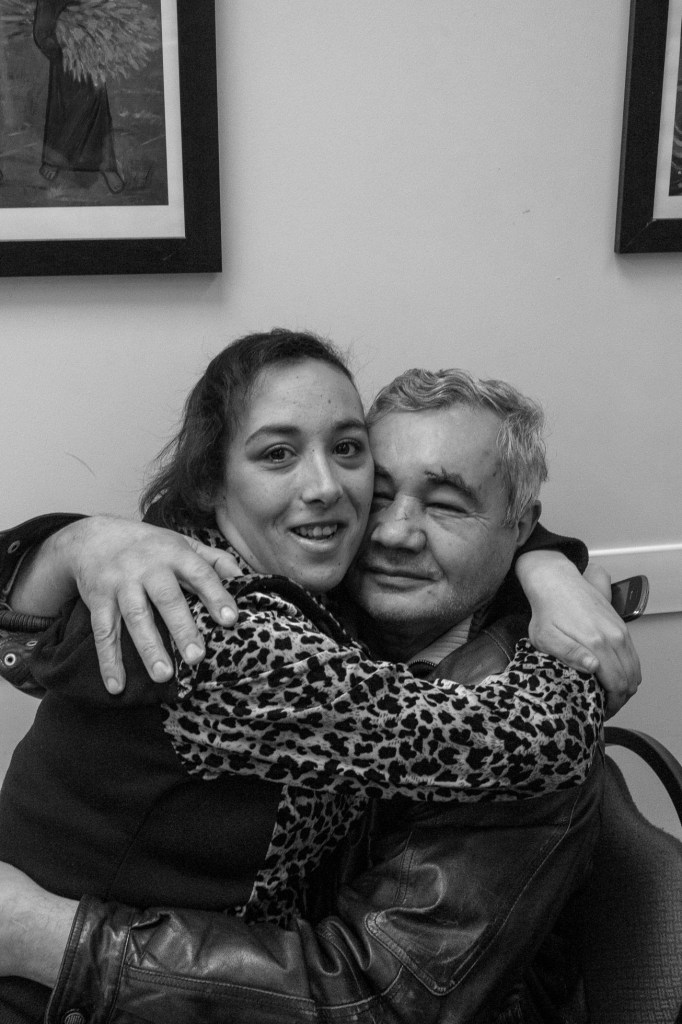
Photographer: Phil Jackson.
The term ‘ordinary people‘ has a dual edge to it. At one level, there is no such being – everyone has their own unique tale to tell, their own personality, and way of relating to the world. At another level though, an ‘ordinary person’ is also one who doesn’t get – or rarely – any public acclamation for their contribution to the world.
Artists though, have the skill, and with it the power, to change that, if they so choose. They can choose an individual and record in visual art forms their impressions of that person, and the images can stay around for a long time. But often the subject of portraits painted are of those who can afford to pay, or who are people well-known to the artist.
Yet there have been, and still are, artists in the district who have painted the portraits of others completely unrelated to them, free of charge, because the people concerned interested the artist in some way, socially or artistically.

Apple Mary, by artist, John Sowden.
The rise too of documentary photography over the last 100 years has led to an increase in visually recording the lives of ordinary people. And there are now a significant number of Bradford district photographers today who make it their task to photograph the people of the district as a social record of the times we live in.
This article celebrates the work of the district painters and photographers, past and present, who have presented us with their interpretations of the society and world we live in. We may not always like their way of seeing, but it does, at least, make us think about the social reflection they present.
The Past
John Sowden (1838-1926) was a Bradford born watercolour painter specialising in landscapes, portraits and still life. Although from a relatively humble background, he rose to prominence in Bradford, first as an architect, then as a successful portrait painter in the city.
But with wealth comes choice, and John also chose to paint, for his own pleasure, the street characters of Bradford. He paid them for their time and over a thirty year period painted over 350 street character paintings, creating an important social historical record of street traders, beggars, and others who made their living on the streets of the city.

John Mannis, street musician, by John Sowden. Image: Bradford Museums & Galleries.
For more information on this artist – Street characters of Bradford
Marie-Louise Pierrepont, later the Countess Manvers (1889 – 1984), might at first glance seem an unlikely subject for this article. She was born into the wealthy Butterfield family of Cliffe Castle, and married Captain Gervas Pierrepont, who later inherited Thoresby Hall in Nottinghamshire. Countess Manvers herself inherited Cliffe Castle in 1943 on the death of her father.
Countess Manvers was also a talented artist and she painted detailed interior scenes of her homes, as well as portraits of villagers of Thoresby, or the workers on the estate, where she was well-regarded.

John Carey was the Head Keeper at Thoresby Park from 1924 to 1952. Image: The Pierrepont Collection.
For more information about this artist – Marie-Louise Pierrepont
Stan Boardman (1915 – 1996) was a self-taught sign-writer, but in his late fifties, in a twelve month burst of creativity, he produced a series of paintings of Keighley street characters based on his 1920s childhood in the town.
When these paintings were exhibited in the town and elsewhere in the district, they struck a chord with local people, and over 20,000 people visited the travelling art show.Stan went on to become a television celebrity when the paintings were shown in London.
Although the paintings were generally light-hearted in style, his portraits often had a serious or ironic edge to them, as if reminding people that the ‘good old days’ were not always so good, particularly for those at the bottom of the social ladder.

Image: courtesy of Keighley & District Local History Society
For more information about this artist – Stan Boardman
Frank Johnson (1917 – 1998) was born in Leicester, but was a tutor at Bradford Art College from 1952 – 1980. During his time at Bradford College, he was to play an important role in supporting David Hockney whilst Hockney was a student there. This included helping Hockney to submit pictures for the Royal Academy’s 1957 Summer exhibition, and supporting his application for a place at The Royal College of Art.
Frank Johnson had a great affinity with the people of Bradford and his paintings in the 1970’s captured the sense of change in the city. The painting of a mother and her daughter, shown here, also echoed the appeal of the traditional portrait photograph for Asian families, complete with its with its ornate background.

Image: Estate of the late Frank Johnson” (James Edward George Johnson)
For more information about this artist – Frank Johnson
The Present
Nudrat Afza is a self-taught social-documentary photographer who lives and works in Bradford. For over 30 years she has documented the everyday lives of people from diverse communities.
Nudrat came to Britain in 1966, but her professional career as a photographer began in 1986 when she received a grant from Yorkshire Arts to photograph the Bangladeshi community in Bradford.
Her photographs have been widely shown across the district and elsewhere, and notable collections of her work include ‘The Salon’ – photographs of customers of a hairdressing salon in Toller Lane, Bradford; ‘City Girls’ – Nudrat’s photographs taken over a number of years of the female supporters of Bradford Football Club; and more recently, ‘Kehillah‘ – a record of the shrinking numbers of people of the Jewish faith at worship at their local synagogue (see example below).

From the ‘Kehillah’ collection. ‘Image: Nudrat Afza.
For more information about this artist – Nudrat Afza
Ian Beesley has been documenting the lives of ordinary people for nearly 50 years, starting in 1973, when he photographed his fellow workers at the local sewage works.
He studied for a year on an Art Foundation Course at Bradford College then continued his studies in photography at Bournemouth and Poole College of Art, where he graduated in 1977 with distinction in documentary and editorial photography. In 1978 he was awarded a Kodak Scholarship for Social Documentation and began recording the decline of industrial society and its impact on community.
Since then he has authored over twenty books and his photographs have been exhibited nationally and internationally. They are held in national collections both in the UK and overseas, including the National Media Museum, and the Industrial Museum, both in Bradford; the National Museum for Coal Mining at Wakefield; the Imperial War Museum and Victoria and Albert Museum in London; and the Central Museum of Labour, Tampere, Finland, and the Smithsonian Museum, Washington, USA.

BCFC fans in full throat. Image: see Ian Beesley’s website.
For more information about this artist – Ian Beesley
Bradford-born, Doug Binder, rose to prominence in the commercial art world when he became the co-founder of the ‘Underground Design Group’ in the 1960s. The Group gained a reputation for their colourful and often psychedelic designs, that included household furniture, sports cars, and buildings.
Based in London, his work was widely commissioned and sold both in the UK and internationally. But in 1985 he returned to Yorkshire and began to organise the exhibition programme at the nearly-opened South Square Gallery in Thornton, near Bradford.
He also began to work at the Dean Clough Galleries in Halifax as voluntary curator for three years before being appointed as its paid curator, a post he held for twenty-five years. His present role is as Painter-in-Residence at Dean Clough, where he has a studio and leads weekly life drawing and painting classes. All his paintings now depict life models, who are predominantly local people.

Image: see Doug Binder’s website.
For more information about this artist – Doug Binder
Street documentary photographer, John Bolloten, has lived in Bradford for over 30 years. Although he is well-known for his edgy street photographs of Bradford people, other projects include photographing artists from the UK punk period in the 1970s and 80s, as well as documenting life in the Bradford Shia Muslim community, barber shop culture, and the Bradford inner city cricket scene (see example below).

Image: see John Bolloten’s website.
John’s photographs have been printed in a range of media, including The Times, Guardian, and Asian Express, plus featured on book, CD and record covers. He has also written and illustrated two books of photographs of local people.
For more information about this artist – John Bolloten
Shy Burhan is a Shipley-based commercial photographer, but has gained a following for her social-documentary projects featuring local people. Shy documented staff and customer activity at cafes run by the Real Junk Food Project (RJFP) – with its aim of reducing food waste by preparing, cooking and serving unsold food in the 120 RJFP cafes in Britain and overseas at prices customers can afford to pay.
Her collection, ‘Butterfly’, illustrated her work with victims of domestic abuse; and in 2018, Shy began her ’40’ Project, with the aim of photographing people in their fortieth year in ways that reflected or signified important events in their lives (see example below).

Image from the ’40’ project; see Shy Burhan’s website.
For more information about this artist –Shy Burhan
John Cade, was raised in the Holmewood area of Bradford and many of his photographs now document life in and around the city. He studied at The Northern Film School, Leeds Beckett University, graduating in 2006 with a first class honours in Film and Moving Image Production.
Since graduation he has worked as a freelance film-maker, director and editor, but has taken a parallel career path into social and documentary photography. John’s subjects are ordinary men and women going about their business. He also strives to capture those special or spontaneous moments in people’s lives that have universal resonance.

Mr Raymond Foster. Image: see John Cade’s website
For more information about this artist – John Cade
Martin Hearne was born on the Isle of Man and studied art initially at the Douglas art college, then to degree level at St Martin’s College in London.
He has lived in the Bradford district now for over 25 years and from 1990 onward taught fine art at Bradford College, School of Art. He has also taught art as a visiting lecturer at the University of the Basque Country, Spain.
His Bradford street paintings and drawings, based on his observation on his journeys to and from work, have been the focus of a number of solo exhibitions in recent years, including at the Dye House Gallery, Bradford; The Bingley Gallery; and at the Dean Clough Gallery. He is the author of ‘A Short Walk Through Bradford’ featuring 50 mono-prints of people he has observed in the city.

Bradford street scene. Image: see Martin Hearne’s website
For more information about this artist – Martin Hearne
David Hockney is Bradford’s most famous visual artist – and one with a worldwide reputation. In 2011, a thousand artists voted Hockney the most influential artist of all time. As his fame has grown, so too has the demand on him to paint portraits of the rich and famous.
But he has always painted the portraits of the people that interest him, or he loved, and he still maintains that stance. His painting, shown here, ‘My Parents’ was voted by 38,000 in Britain to be the nation’s favourite.

Image: David Hockney.
For more information about this artist – David Hockney
Phil Jackson is a professional photographer working in documentary, portraiture and reportage. Phil completed a Graphic Design course at Bradford College in 1982 and was employed in several design and advertising agencies until redundancy in his mid-twenties prompted him to go freelance, including establishing a design agency with two former colleagues.
In 2014 he decided to return to solo freelance work as a photographer. Since then Phil has been involved in a range of community projects, documenting the life and work of many local people. He is particularly interested in recording culture, habits, and the daily interaction between people.

From the ‘Hale Project’ that Phil photographed. Image: see Phil Jackson’s website.
For more information about this artist –Phil Jackson
Carolyn Mendelsohn lives in Shipley and has a gallery and studio at Saltaire. Carolyn’s award-winning documentary photography has gained increasing attention in recent years. She was, for example, a 2016 winner of a Royal Photographic Society Gold Medal for her ‘Being In-between’ project and photographic collection, which involved documenting the transitional life changes of girls aged 10 – 12 years.
In 2017 her portrait of Alice from the project gained her a winning place in the British Journal of Photography’s ‘Portrait of Britain’ competition. This resulted in the portrait of Alice being featured in a wide range of public spaces (see image below).

For more information about this artist: – Carolyn Mendelsohn
Paul Reas was born into a working-class family on the Buttershaw estate in Bradford. His early life experiences had a profound impact on his work, and set him on course to photograph people from his own background and experiences.
He studied Documentary Photography at the University of Wales, Newport, and in 1985 was selected by Ffotogallery, Cardiff, to be one of a number of commissioned photographers to record social change in South Wales. The Valleys Project gave him the opportunity to record the changing South Wales landscape and, in particular, the decline of coal mining, and its replacement with ‘new technology’ industries.
Since then he has been involved in a wide range of documentary projects, but each concerned with recording the impact on ordinary people following significant change in a particular area or place of work.
Paul’s work has been exhibited in solo exhibitions in Britain and overseas, notably at the Photographers’ Gallery, London; Olympus Gallery, Amsterdam; Stills Gallery, Edinburgh; Fotobienal, Vigo; London College of Communication; Impressions Gallery, Bradford; and Ffotogallery in Penarth, Wales.

Last of the coal miners. Image: see artist’s website.
For more information about this artist – Paul Reas
Tim Smith is a Bradford-based professional photographer, writer and researcher, with a distinguished record of recording the social transitions of minority communities as they adjust to their new lives in Britain, including in Bradford.
Tim has exhibited his work widely across the UK and overseas, including in Pakistan. These include exhibitions for The Commonwealth Institute, British Council, British Film Institute, and a wide range of public galleries, including Cartwright Hall, National Media Museum, and Industrial Museum in Bradford.
He is also the author of a range of books featuring collections of his documentary photographs in Britain and elsewhere.

Young Yemeni girl at school assembly in the docklands area of Newport. Image: see Tim Smith’s website.
For more information about this artist – Tim Smith