

Valley Pasture, Marsh Meadows is an oil on canvas painting, measuring H 131 x W 184 cm, by Bertram Priestman, dated 1902, and is in the permanent collection of the Bradford Museums and Galleries Service.
It is scene of summer in all its lazy verdant splendour. It depicts a group of cows slowly making their way forward, as if toward the artist, across a meadow and stream that appears to feed into a river, shown behind trees to the left. It is the height of summer: the trees are in full leaf and the meadow is lush with grass and wild flowers; a human figure is glimpsed by the trees to the left.
The light source is from the top left of the painting and the sun is shown illuminating the meadow in the foreground and on to the back of the leading cow, which in turn casts its shadow into the stream at its feet.
The predominant colour is green, but this is depicted in all its hues: from the darkness of the leaves, to the sun-lit grasses of the meadow. Browns – again in a range of hues – also complement the green and are seen in the trunk and branches of the trees, and in the hide of the cows. These primary colours of nature are relieved with patches of white and yellow, including the sky in the background, on the leading cow, and in the stream; splashes of white also suggest the scattered blooms of the wild meadow flowers. The insertion of a splash of red on the hat of the onlooking figure draws the eye in a zig-zag from the foreground to the middle section of the painting, left, then out again right, to take in the remainder of the scene presented. This is a painting by a local artist at the peak of his talent.
The Artist
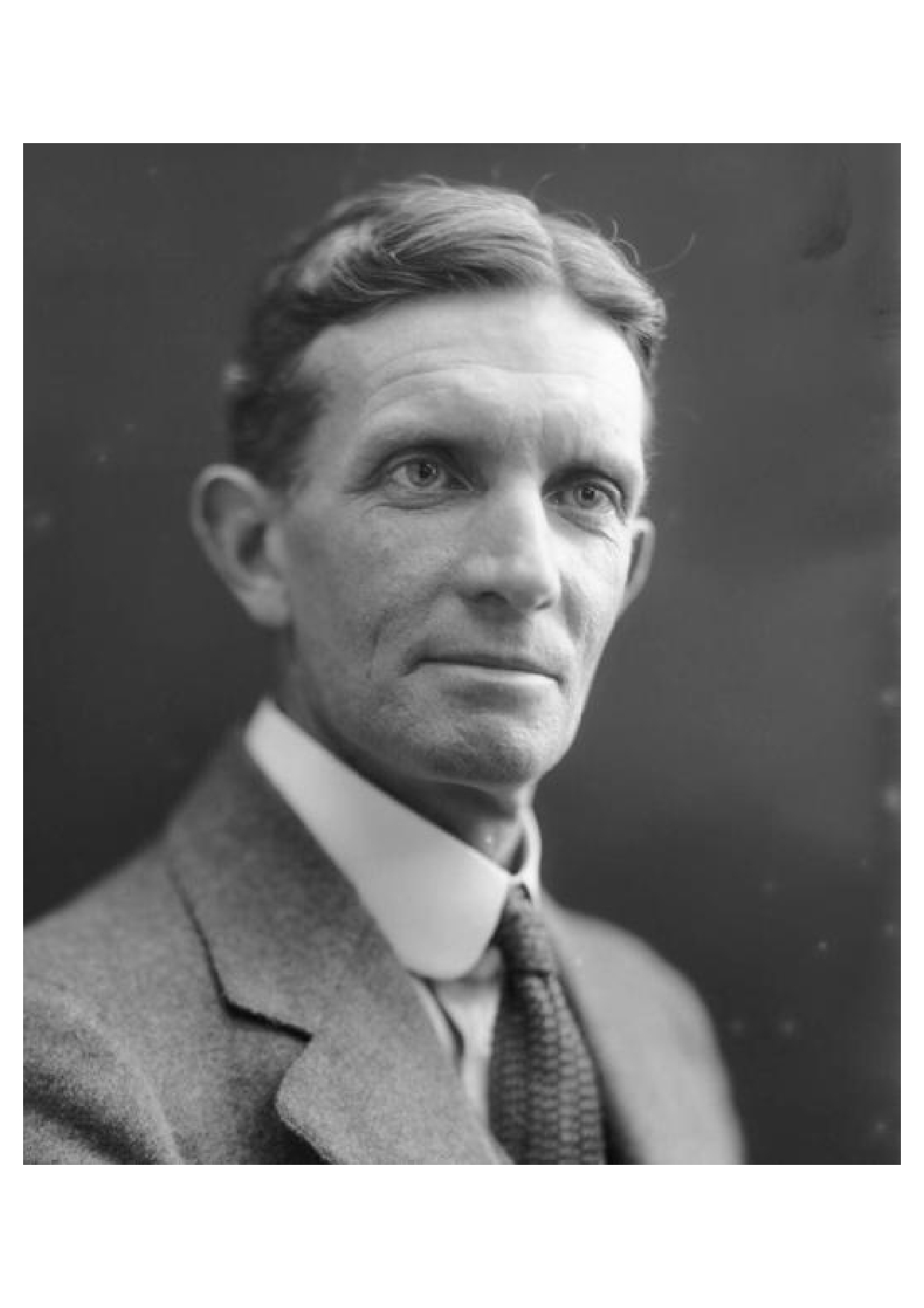
Bertram Priestman (1868-1951) was the son of Edward and Henrietta Priestman, and one of seven children. His father was a local businessman and enthusiastic art collector, who filled his house at Toller Lane, then later at Ben Rhydding, Ilkley, with fine paintings.
Bertram, on leaving the Friend’s School in York, travelled on a sketching tour to Italy, Egypt and Palestine and on his return, began to study engineering at Bradford Technical College. However, he quickly abandoned this idea, and after a year left Bradford to study art at the Slade School of Fine Art in London. His talent was quickly recognised and he worked as an assistant at the studios of William Llewllyn, later to be President of the Royal Academy.
Bertram is best known for his land and seascapes, and his work combines the influence of French impressionism with his own atmospheric interpretation of the English landscape, characterised by its bright luminous colours. His work was inspired by the power of the landscape, and its scale and grandeur is often represented in his work, often on large canvasses. His work was widely exhibited and he was elected to the Royal Institute of Oil Painters and the Royal Society of British Artists. His paintings can often be seen on display at Cartwright Hall, Bradford.
More information on Bertram Priestman and other artistic members of the Priestman family can be found on this website at Priestman family.