
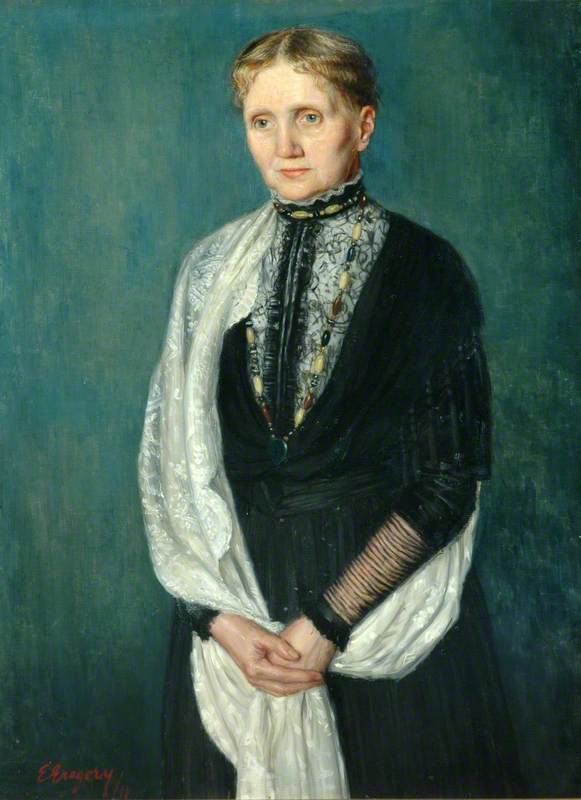
The portrait, ‘Old Lady’, by Edward Gregory was painted around 1911 and is in the permanent collection of Bradford Museums and Galleries and was on display at Cliffe Castle, Keighley, in 2026.
It is a portrait of an unknown woman who appears, from her clothing, to be from an affluent social background. Edward, by this time was living in London, so the sitter may have been an early London commission for him.
Although the title refers to an ‘Old Lady’, she appears to be on the edge of old age, rather than in the midst of it. She still retains, for example, her fair hair colouring and her face, whilst creased, still retains its elasticity, and her posture is still upright.
The artist captures the dignified subject as if deep in thought. Her expression is somewhat serious: her eyes are downcast, and the black dress, despite the jewellery and decorative wrist banding, might suggest she is in mourning, or the last stages of it.
The detail of the painting is quite remarkable. Gregory catches the squint or cast in the left eye of the sitter and the lacework at the neck of the dress and of the shawl around her neck is finely done. The discreet colouring of the necklace and dress lacework at her neck, plus the white of the shawl, relieves the black colouring of her dress. The plain dark green of the background is also lightened with yellow patching, and the overall effect of the background is to put the portrait into an almost 3D perspective and focus attention initially on the face of the sitter.
It is a portrait of a woman who has transitioned in life from the beauty of youth to the beauty of age.
The Artist

(Not to be confused with the artist Edward John Gregory, 1850-1909)
Edward Gregory (1881-1955) was born in Edinburgh, one of nine children to father, James, a Minister of the Congregational Church, and mother, Martha. By 1901 the family were living at Oak Villas, Bradford.
Both parents, James and Martha, had been born respectively in the Bradford and Craven areas, and James had served as a Minister in Edinburgh until an opportunity arose for him to serve locally. He continued to serve in Bradford until his retirement.
In 1911 Edward married Winifred Priestley, the daughter of Sir William E.B. Priestley, a local mill owner and Liberal politician, who had been the Member of Parliament for Pudsey and Mayor of Bradford, 1906-1919. The 1911 census also records the married couple’s address in the NW3 area of London and Edward’s profession recorded as ‘Artist – portrait and landscape’. It is currently unknown where, or if, Edward studied art, although as he was living in the Bradford area by his late teens, it may have been at the Bradford School of Art.
Edward and Winifred had three children and continued to live in North London, eventually settling in the Hampstead area. When he died he left over £42,000 in his will; a considerable sum of money at that time.
Edward painted portraits and landscapes and exhibited work from 1907 onward at venues including the Groupil Gallery, Manchester Academy of Fine Arts, New English Art Club, Royal Society of Portrait Painters, Royal Academy and the Walker Art Gallery, Liverpool.