
Image: Bradford Museums and Galleries.
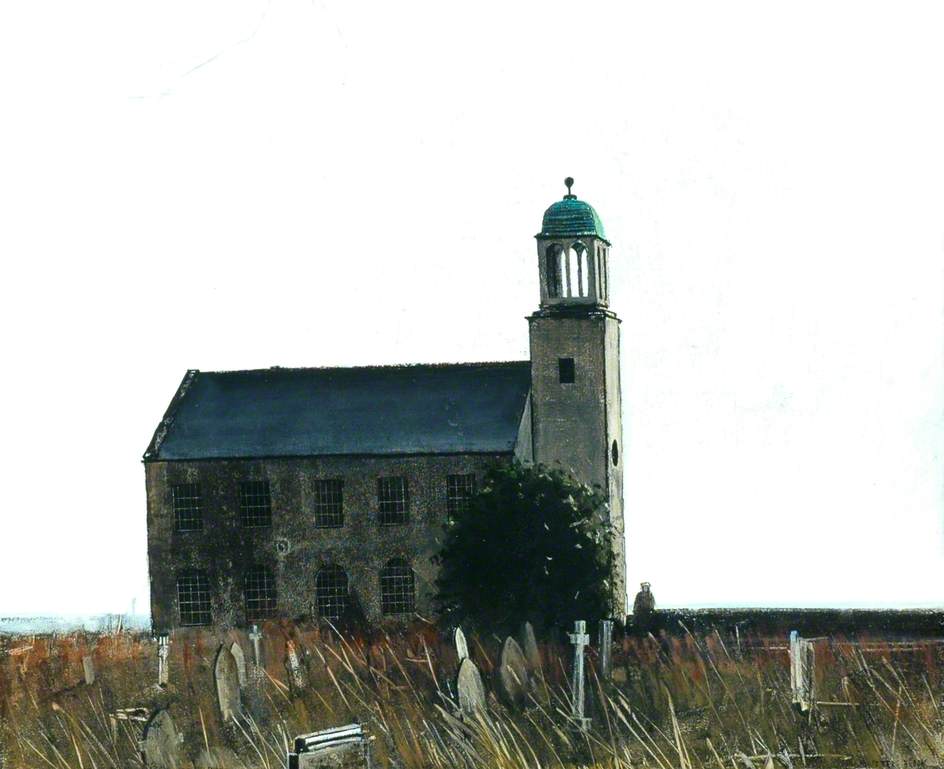
‘Self-Portrait with Lightcliffe Old Church, Halifax’ is an oil painting by the Yorkshire artist, Peter Brooke. It is in the permanent collection of Bradford Museums and Galleries Service and can often be seen at Cliffe Castle, Keighley.
Although the painting was acquired by Bradford in 1981, it is likely to have been painted much earlier – or remembered in its whole state by the artist – as the church was badly damaged by a storm in the early 1960s, and all but the tower was demolished in the early 1970s.
The title of the painting is an example of Peter Brooke’s sense of humour, as his ‘self-portrait’ is hardly that! Instead, as was his trademark way, he inserts himself into the scene, smudge-like, at the base of the tower.
Brooke’s painting of the church is a study of light and dark; of horizontal and parallel forms; and of loss and decay. The isolation of the church is starkly captured, with the blacks and greys of the roof and church walls framed against a white and cloudless sky.
The viewpoint of the artist is slightly downhill from the church and the horizon is glimpsed in the background. The light source is from the top right, which lightens the side wall of the tower and the gravestones in the foreground. A number of the graves have a left tilt to them, as does the sway of the grass, suggesting the direction of the prevailing wind.
The church and tower presents a study of both horizontal and parallel lines, as well as oval forms in the tower and a number of the side windows. The figure of the artist mimics the the top of the tower. The severity of the church is softened by the irregular presence of an old tree at the base of the tower; the dark mass of green of the tree is relieved by the patch of sunlight on its branches, top right.
The staining on the walls of the church, left, suggests age and decay, as do the old gravestones, leaning in their antiquity. The image of the artist has a rather ghostly aspect to it, adding to the rather forlorn and abandoned feel to the overall scene. The late Ian Dewhirst, Keighley historian and Librarian, had written about Brooke’s painting: ‘It makes what could be a mundane subject look dramatic. I like the ‘self-portrait’ mystery – or is the artist fore-seeing his own death.’
The Artist
Peter Brooke was born in Scholes, West Yorkshire. in 1927. He attended Barnsley Grammar School, then studied art, initially at Huddersfield School of Art, then at Goldsmiths College, in London.
After graduation he taught art at secondary schools in the Rastrick and Sowerby Bridge areas, but also began to develop his own unique style of landscape art. He painted northern industrial scenes initially, then from the 1960s onward he began to specialise in Pennine rural landscapes, particularly winter scenes. He often sought to capture the bleakness of the season, as well as the beauty of stone-built, and often abandoned, Yorkshire buildings.
His work was widely exhibited, admired and collected. In 1960 he had a solo show at Wakefield City Art Gallery and from 1968–72 was contracted to the Agnew Gallery, with seven solo shows, including overseas in the USA and Australia. He had a retrospective show in 2004 at the New Grafton Gallery. He lived in Brighouse, West Yorkshire, until his death in 2009.