
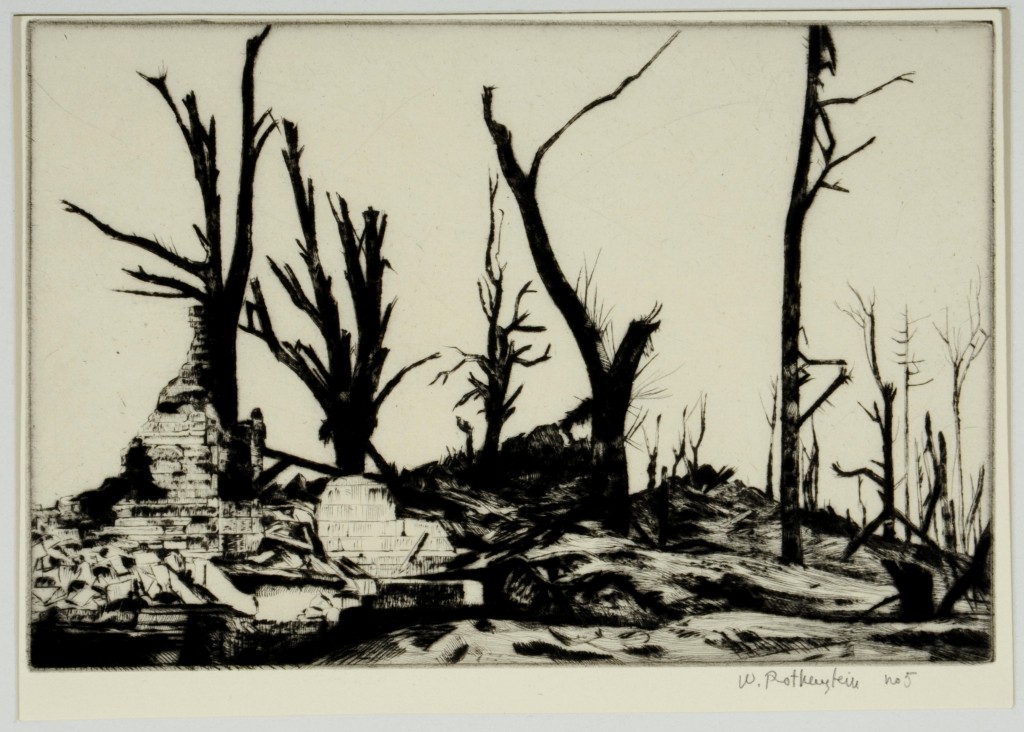
‘Landscapes of War’ is a dry-point print by the local artist, Sir William Rothenstein, and is in the Bradford Print Collection, which is a part of the Bradford Museum and Galleries Service. It is numbered five of twelve dry point prints made by Rothenstein during his time as an Official War Artist to the British on the Western Front in 1917, and after the war was appointed by the Canadian Army during 1919-1920 to record post-war scenes in France and Germany.
He stayed in France for three months in 1917/18 and during this time Rothenstein’s artwork focused on the impact that war had on the architecture and nature in the battlefields. At the end of March 1918 he returned to Britain and exhibited his paintings in London. In his catalogue to the exhibition, he wrote:
Over a battlefield, where the hopes and fears and passions of thousands of men were concentrated, a strange atmosphere of awe seems to hang. Throughout the desolation of war there is a pattern of austere beauty, and the human drama associated with war gives to this beauty a religious character … I felt as a pilgrim visiting sacred scenes.
He later produced a portfolio of the 12 dry-point prints, titled ‘Landscapes of War’, in a limited edition of 56 copies published by the Cotswold Gallery. The image shown above is one of these prints.
The shell-blasted trees are shown adjacent to the ruins of a building. The black-and-white of the images of the trees, relieved only by the white brickwork of the smashed building, convey the sense that both the man-made and natural features of the landscape have been completely destroyed by war; neither has escaped the destruction of shelling.
British Official War Artists were not allowed to depict the physical damage of war on serving soldiers. However, the severity of the damage shown in this image suggests the horrific impact that shelling would have had on any humans in the vicinity.
Sir William Rothenstein (1872-1945) was born in Bradford and had a distinguished career as a painter, writer and educationalist; he was the Principal of the Royal College of Art from 1920 to 1935 and was knighted for his services to art in 1931.
More information on his life and work can be found at Sir William Rothenstein