
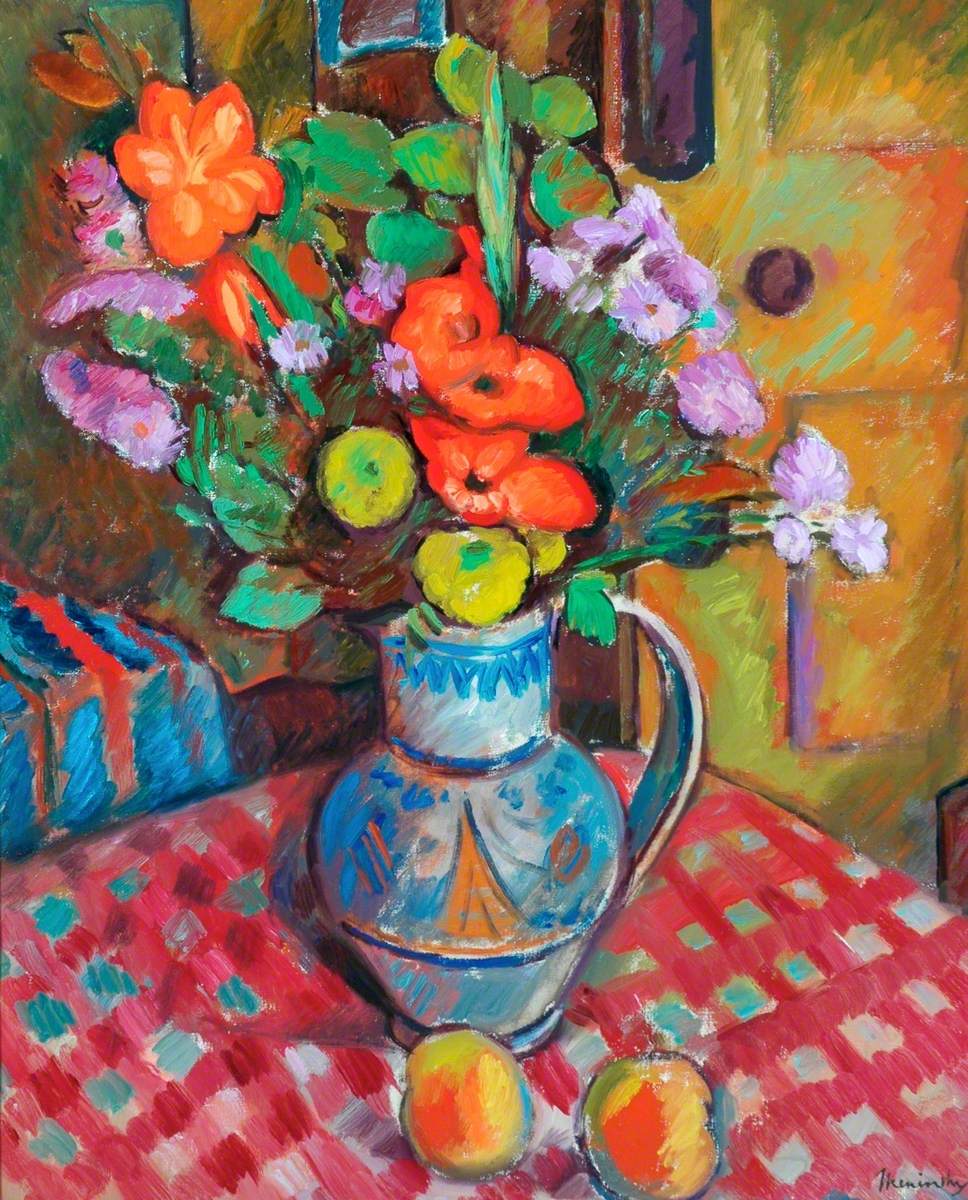
‘Flowers in a Pot’, circa 1910, is an early work by the artist Bernard Meninsky and is in the collection of Bradford Museums and Galleries; it is often on display in the gallery at Cliffe Castle, Keighley. The striking colours of this oil painting on canvas commands attention – but its composition and form also deserves close observation.
Shades of scarlet, red and orange dominate, but then other colours blend to present a striking whole. The red chequered table-cloth, with its random inserts of light blue and white – which relieve the dominance of its primary colour – presents, in effect, a ‘stage’ for the less-commanding, but equally pleasing pastel ranges in the vase.
Similarly, the bright yellow of the door in the background is tempered by splashes of green, white and orange, which reduces the visual impact of the bright yellow. The door then contributes to the colour-filled painting, but not in a way that distracts the eye from the flower arrangement.
The painting is given perspective by the inclusion of the two fruits in the foreground, which presents a three- dimensional aspect to the scene: foreground, central focus, and background. The space between the handle of the vase also leads the eye through to the background, adding to this three-tiered effect. The spike decoration on the front of the blue vase, pointing upwards, is echoed in the closed spike of the flower at the top of the floral arrangement.
The squares and rectangles in the composition: table, door panels and door plate, blend with the circular shapes of the vase, fruits, door knob, and some blooms, presenting a range of pleasing spatial as well as colour contrasts.
The Artist
Bernard Meninsky (1891-1950) painted still life, landscapes and figures in oils, watercolour and gouache in an impressionistic style. He was also an art teacher.
He was born in Karotopin, Ukraine, to Jewish parents, who brought him to England. The family home was in Liverpool, and showing artistic talent from an early age, he attended Liverpool School of Art, 1906-9, where he won the King’s Medal for his draughtsmanship.
He was awarded a scholarship to study at the Royal College of Art , London, from where he travelled to Paris to study at the Academie Julian. On his return to Britain he transferred his studies to the Slade School of Art, where he studied, 1912-13.
He then worked in Florence for a while under the direction of the artist, Gordon Craig and after returning to Britain taught art at the Central School in London until 1940. He also an art tutor at Westminster School of Art from 1920 onward, and at the City of Oxford Art School between 1940-45.
During World War One he served in the Royal Fusiliers and was stationed in Palestine under General Allenby. He was later was appointed as an Official War Artist. The Imperial War Museum in London holds his artwork from this period.
After the war his artwork was widely exhibited and his artwork today is held in many public galleries in Britain, including regionally in Bradford, Leeds, Kirklees, Sheffield, Hull, and the Hepworth at Wakefield, and Mercer Gallery at Harrogate.