

Image: Keighley News
Joseph West (1881 – 1958) painted watercolour land and seascape scenes, particularly of the Norfolk Broads, the Yorkshire Dales, and Yorkshire coast, that sold well in Britain and the USA. He was also well-regarded for his animal paintings, particularly equine and cattle subjects.

Coastal landscape with cows. Image: AskArt. In a private collection.
He was born, 27 April 1881, the son of a labourer, in Farnhill, near Skipton, but lived for most of his adult life at Tufton Street North (later Green Avenue), Silsden, with his wife, Sally, who he married in 1905.
Joseph trained and worked as a house painter, which then was one of the only few practical choices for boys from a working-class background with an aptitude for art. He later formed a business partnership with another local man, Jim Murgatroyd, working from premises at 15 Kirkgate, Silsden.
His obituary in 1958 noted that Joseph had first learned formally to draw at Glusburn School of Art, then later studied painting (most likely via a correspondence course) with the Yellow Door School of Art, in Beckenham, run by the artist Frank S. Spenlove.
In 1910, Joseph broke away from his business partnership with Jim Murgatroyd and opened a studio in Cavendish Street, Keighley, and later one in Silsden, at 11 Greengate, close to his terraced home in Tufton Street North.
From this point on, Joseph’s career as a professional artist began to advance. By 1911, Joseph was describing himself (1911 Census) as a ‘Painter/Artist’ and from 1910 onward, he had an annual solo exhibition of his artwork at Riby’s Art Gallery in Keighley. He also exhibited work between 1908 and 1912 at The Yorkshire Union of Artists exhibitions in the region and began to exhibit work further afield as he became better known.

Rural Cottage. Image: Colin Neville, watercolour, in a private collection.
He exhibited his work regularly at shows of the Royal Institute of Painters in Watercolours, as well as at the Walker Art Gallery’ Liverpool, Royal Cambrian Academy and at the Royal West of England Academy. In 1927 alone he had paintings accepted for exhibition at the Royal Cambrian Academy, Walker Art Gallery, Liverpool, Hull Art Gallery, Norfolk Artists Exhibition at Yarmouth, and at Cartwright Hall, Bradford.
In 1939 he was elected a Fellow of the Royal Society of Art, and a member of the British Water Colour Society. West was also a member of the Fylingdales Group of Artists, as his frequent trips to Whitby to paint was considered sufficient to make him eligible for membership (normally only reserved for artists resident in that area).

‘The Windmill’. Richard Taylor Fine Art
His obituary noted too, that Bolton Council had commissioned 80 paintings from him for their galleries and museums and he was also commissioned to paint a diorama 23 foot by 10 foot of Morecambe Bay for the Bolton Civic Centre. Other dioramas were commissioned by the Tolson Memorial Museum in Huddersfield, and for the original Keighley Museum, forming, it is believed, a backdrop for museum exhibits.

‘Bronte Land. On Haworth Moor’. Image: Colin Neville, watercolour in a private collection
Bradford Museums and Galleries has 19 of Joseph West’s watercolours in their collection, including views of his home area of Silsden (see example, below). Three were still on display at Cliffe Castle in 2017. Keighley Reference Library has a watercolour of Marley Manor, Keighley, demolished in the 1930s, and painted by joseph West in 1913, presented to the Library in 1989 by a local collector. As such, it presents, along with his other architectural paintings, an important record of local history .

‘George Dixon’s Small-holding Summer’. C.1920. In the permanent collection of the Bradford Museums & Galleries Service.
Joseph appears to also have had an interest in geology and history, particularly Prehistoric periods. The Bradford Museums and Galleries collection, for example, includes a watercolour, ‘Keighley in Prehistoric Times’ (1945), envisaging how the area would look at the early part of the Neolithic Age (7000-5000 BC). Eight other paintings in the Bradford collection are labelled as ‘Geology’ in subject.
Bolton Libraries and Museum Service too, still has 27 items relating to West in their collection, painted in the 1920s and 1930s (see examples below). Most are part of a series commissioned by the museum of watercolours of Pleistocene mammals, some imaginary paintings of Iron age settlements, and a few contemporary landscapes.

Moeritherium (1938). Based on figures in the book, ‘The British Museum (Natural History) A Guide to the Elephants (Recent and Fossils)’, 1922. Image: courtesy of Bolton Council. From the Collection of Bolton Library and Museum Service.
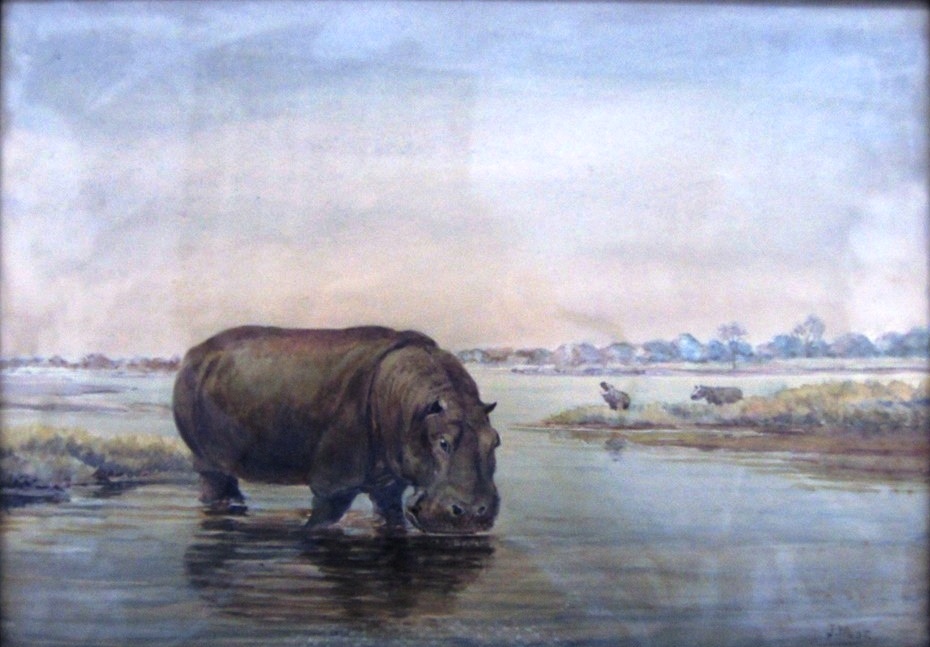
Hippopotamus (1938). Image: From the Collection of Bolton Library and Museum Service.
Joseph West’s artwork still regularly appears on auction sites and much of it now is in private collections.

Bolton Abbey. Image: in a private collection
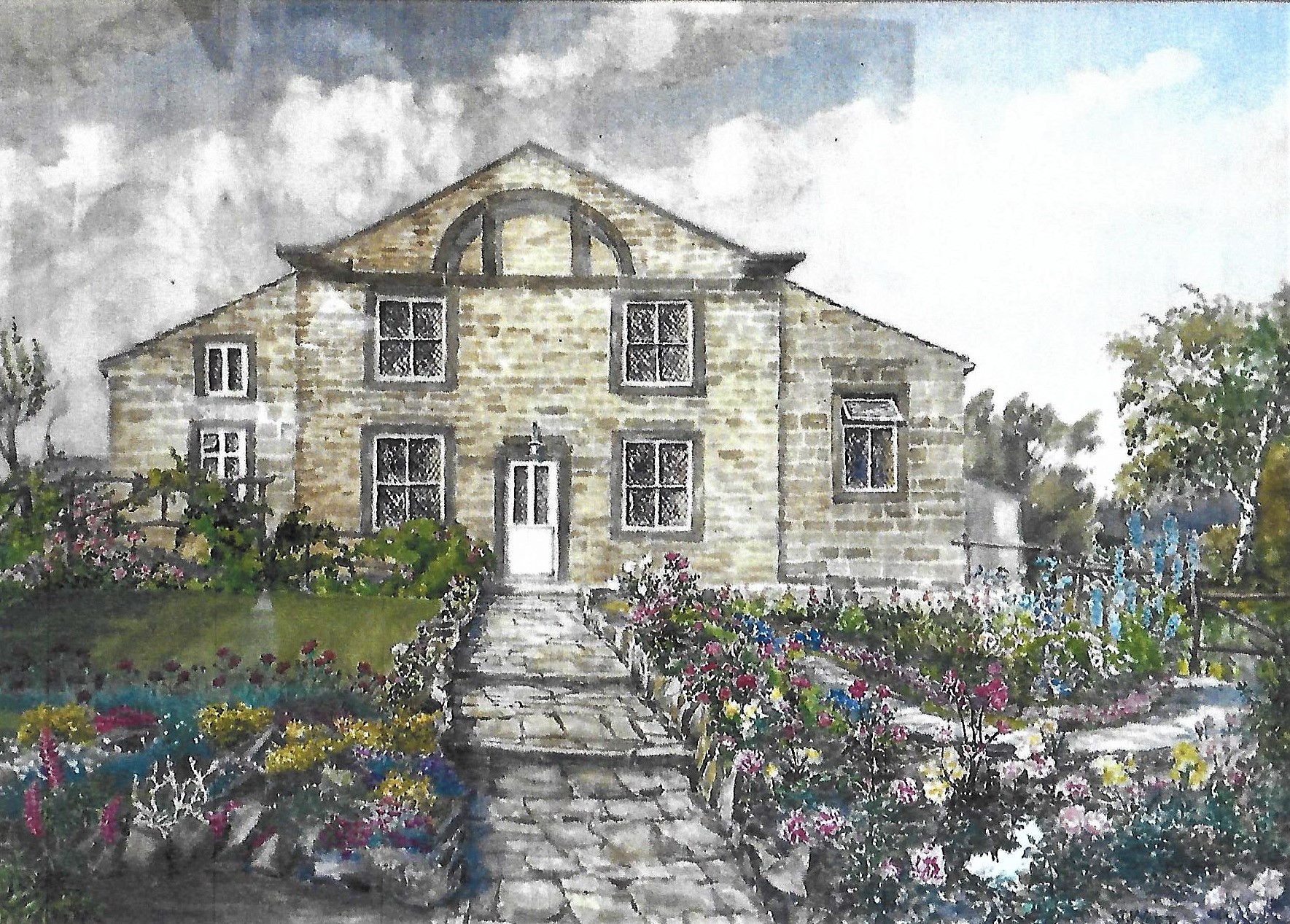
Green Farm, Silsden. Image: In a private collection, courtesy of Barbara Hetherington.
After his death in 1958, a fellow artist, Owen Bowen, R.A., wrote an obituary in the local newspaper, stating that West ‘lived solely for art’. He wrote:
In my opinion he was one of the finest water-colour painters in the country, and in the North of England was considered the greatest of them all.
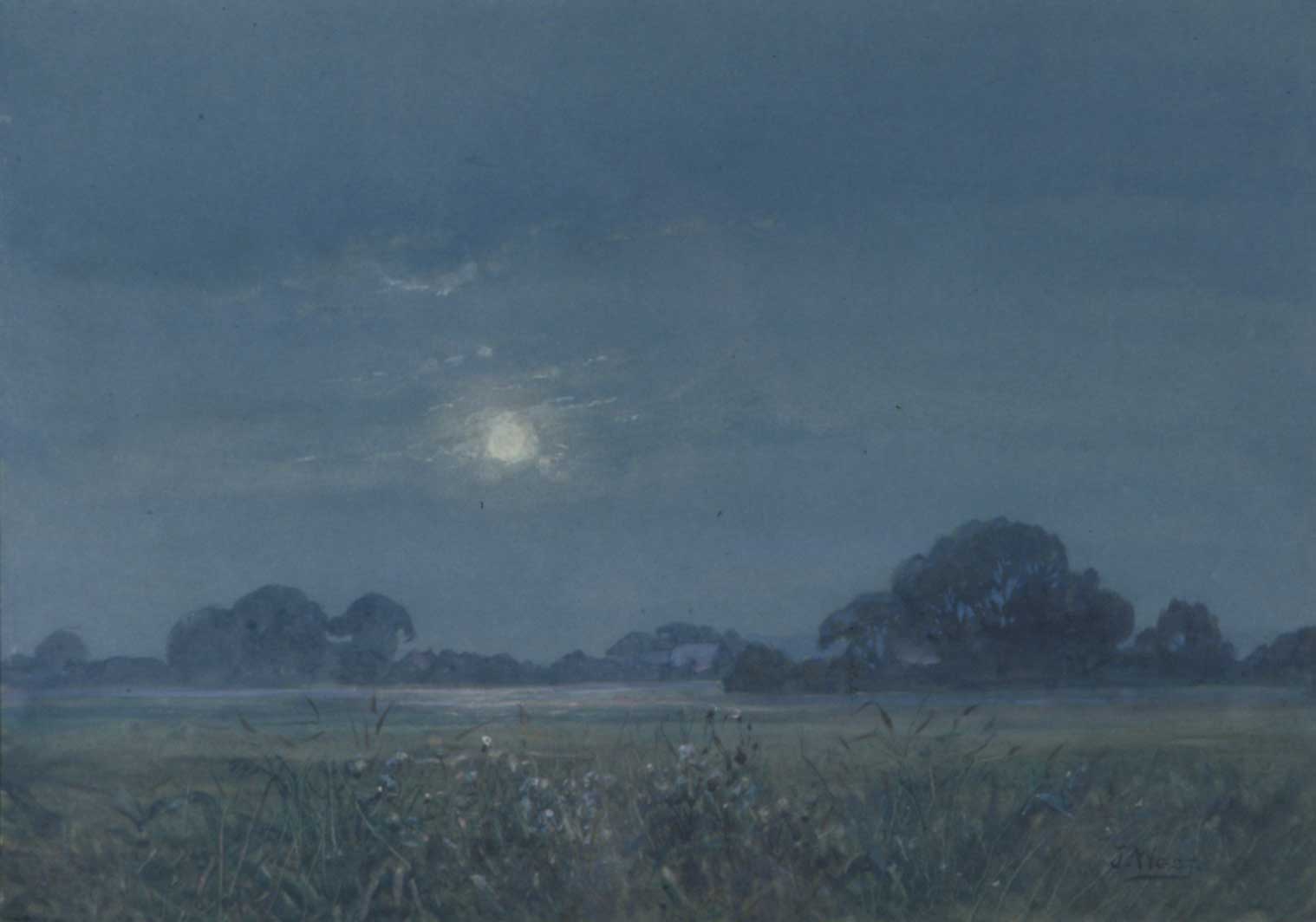
‘Moonlight, Norfolk Marshes’ (1923). Image: Bolton Council. From the Collection of Bolton Library and Museum Service.
Own Bowen also wrote of West:
Mr West was of a most retiring disposition. He never sought publicity and relied solely on the quality of his work for the sale of his pictures … To the average individual, he was regarded as very reserved. Only those, like myself, who entered into a close personal relationship with him could estimate the integrity and sterling worth of his character.
*
Joseph West is one of seven Silsden artists featured in the book, ‘Past Silsden Artists’, published 2019, by the Silsden History Group, available for sale at £5 via Ebay
*
(With thanks to Cathy & John Liddle of Silsden, Cllr. Malcolm Slater, Bradford Met. District Council, and to Daru Rooke, Curator at Cliffe Castle, Keighley, and Matthew Watson, Bolton Library and Museum Service for their invaluable assistance with this profile of Joseph West.)