

Herbert Whone, photographed in 2006. © Frances Sander
Herbert Whone (1925 – 2011) Musician, self-taught painter, photographer, author, and teacher, was born in Bingley into an aspiring and cultured working-class family. Herbert’s grandfather had been a chapel organist and from an early age his parents, also both interested in music, encouraged Herbert’s talent with the violin.
At the age of 13 he gained a scholarship to study at the Royal Manchester (now the Royal Northern) College of Music, and later Manchester University, to gain a combined degree, although the completion of his studies was delayed by three years war service in the RAF.
After the war, between periods of violin study in Paris, Herbert played with the Royal Opera House Orchestra (1 year) and the BBC Symphony Orchestra (3 years), before moving to Glasgow in 1955, where he stayed for nine years with the Scottish National Orchestra, including seven years as their Deputy Leader.
His interest in the visual arts started early in his life. By the age of eight he was photographing scenes around his Bingley home and in his teenage years began drawing and sketching. In adulthood he produced black and white cartoon illustrations for an unpublished book on orchestra life, based on his early experiences and observation of his musician colleagues with the Royal Opera House Orchestra.
Herbert’s interest in painting began in earnest during his nine year stay in Glasgow. He had started with portraits of his musician colleagues, but this quickly broadened to include city scenes.
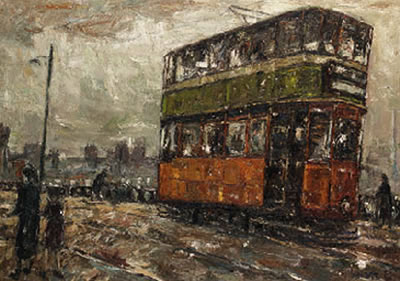
Glasgow was changing fast, as tenements, tramcars and horse-drawn carts began to disappear in the wake of post-war new building. Herbert began to prolifically sketch and paint the scenes around him – the people, buildings, roadways, trams. As a self-taught artist, he developed his own style, but influenced by friends he had made among the artist community of Glasgow.

‘Tramcar in Fog’. Image: BBC ‘Your Paintings’/National Galleries of Scotland
His work was evocative, expressionist and atmospheric, often dramatic in its composition; his usual medium was oil on canvas, capturing the essence of the subject before him in broad brush strokes.
From 1958 onward, Herbert began to exhibit his work, attracting favourable reviews from the art critics. His Glasgow work was later edited and published by Colin Baxter in the book, ‘Glasgow in Transition. Paintings 1958-64’ (the image shown below features in this book).
Yorkshire
Herbert returned to Yorkshire in 1965 to teach music at the Huddersfield Polytechnic Music School and was leader of the Guildhall Orchestra in York for twelve years. During this time he continued his pursuit of the visual arts through photography and by painting the land and townscapes of the West Riding of Yorkshire, illustrating and recording the fast-changing rural and urban scene in the same way as he had done in Glasgow. He wrote in the introduction to his his book, ‘The Essential West Riding’:
I found myself being pulled back to the scene of my childhood. And as I walked, sketched and tracked down my family tree, I became fascinated by its unique landscape, the quality of which I had found nowhere else, either in this country or abroad.
But he found the landscape was being irrevocably altered by new building.
There was a feeling of an end of an era. Everywhere progress was encroaching upon its beauty – graveyards were being uprooted, chapels razed to the ground, back-to-backs being eliminated for blocks of flats, and motorways being cut through the centre of villages
Between 1971 and 1996 he had nine books published (see list below), including three collections of his Yorkshire photography.

‘Farm at Outlane’. Image: BBC ‘Your Paintings’/ ’© Kirklees Museums and Galleries.
On his retirement, and by now living in Harrogate, Herbert became a guide for the National Trust at Fountains Abbey, a position he held for fifteen years. During this time he photographed, sketched and painted the changing seasons around the Abbey and in other parts of Yorkshire.

Terraced street in winter. from Herbert Whone’s book, ‘The Essential West Riding’
In 2006 the Mercer Gallery in Harrogate mounted an exhibition of his work: ‘Herbert Whone: a Life in Art’ .
Herbert married Margery Reed in 1952. They had five children, and by the time of his death in 2011, six grandchildren.`
Books Published
- Church Monastery Cathedral: An Illustrated Guide to Christian Symbolism (1971)
- The Simplicity of Playing the Violin (1973)
- The Hidden Face of Music (1974)
- Integrated Violinist (1976)
- Nursery Rhymes for Adult Children (1985)
- The Essential West Riding (1987)
- Fountains Abbey (1987)
- Touch Wood, A Journey Among Trees (1990)
- Glasgow in Transition: Paintings 1958-64. (1996)
- Snapshots from Childhood (2000)
Herbert Whone paintings can be found within Yorkshire at Kirklees Museums, Galleries and History Service and The Hepworth Wakefield. Outside of Yorkshire, Herbert Whone’s Glasgow paintings can be found at Scottish National Gallery of Modern Art in Edinburgh