
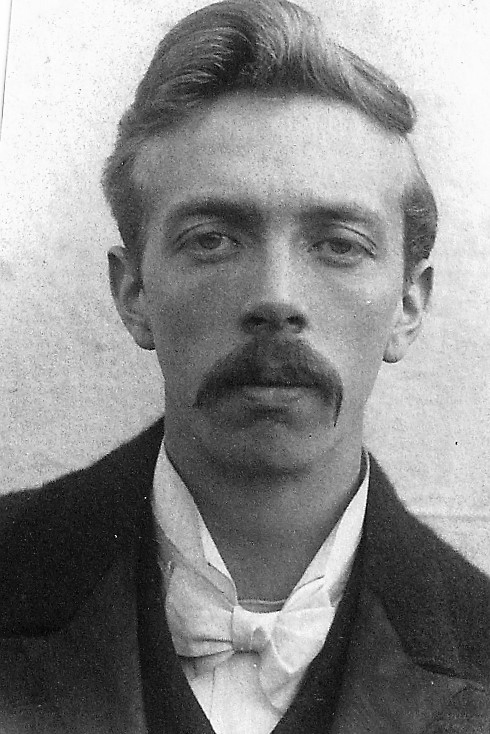
Edward G. Hobley. Image by courtesy of Carol Hobley.
Edward George Hobley (1866-1916) was born in Brightwell, near Wallingford, Berkshire. The eldest of three sons, his parents were father, Frederick, a school-master, and mother, Mary. In 1870 the family moved to Bradford and Edward spent his childhood and early adult life in the city, including his initial art education.
He was apprenticed aged 14 to a Bradford draper, but attended evening classes at Bradford School of Art, where he developed his drawing skills, and won the Brown Silver Medal for an artwork: ‘Flowers from Nature’.
Edward gained a scholarship to study at the National Art Training School (now The Royal College of Art) in South Kensington, London, later moving to the Royal Academy of Art, where he gained an Art Masters Certificate.
To extend his art education, he went to Paris in 1890 to attend at the Académie Julian, where he exhibited an oil painting, and in 1891 he returned to study at William-Adolphe Bouguereau’s life drawing workshops at the Académie Julian, and to attend lectures on artistic anatomy at L’Ecole des Beaux-Arts.
From 1890 onward he began to exhibit work with the Yorkshire Union of Artists and in 1894 was elected to the Council of the Union, serving on the Council at different times between 1894 -99.
Between 1891-2 Edward embarked on a series of painting trips to West Sussex, North Wales, and Lancashire, painting landscapes and other rural genre subjects. His largely en plein air artwork shows the influence of his study in France, which combines attention to detail with an English-Impressionist style and luminous colour palette. He was also able to effectively capture plays of light and shade, particularly in his rural genre subjects (see examples below).

‘A Shaft of Light’, 1899. Image: Walker Art Gallery, Liverpool
By 1893 Edward’s residency address was shown as Farsley, on the outskirts of Bradford, and he had become the Honorary Secretary to the Bradford Arcadean Art Club.
In 1898, aged 32, he moved to Penrith, where he was appointed Art Master at the Queen Elizabeth Grammar School, and taught art in the evenings at the Penrith Technical Schools.
In 1899 he married Annie Vipond and the couple settled at Brunswick Square, Penrith, and raised five children He quickly established himself as a leading artist in the town, giving talks and receiving portrait commissions from local dignitaries.
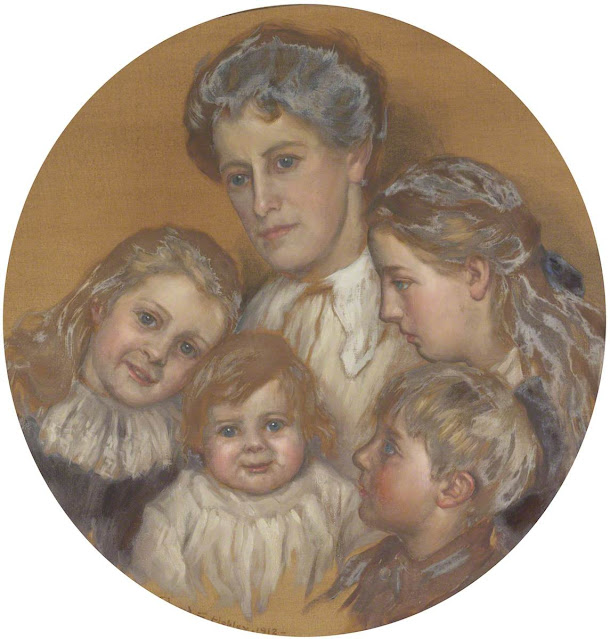
Portrait by Edward Hobley of his wife, Annie, with four of their five children. Image: Eden District Council
Edward Hobley gained a reputation for his landscape and genre paintings and in addition to shows of the Yorkshire Union of Artists, he exhibited work at with the Royal Birmingham Society of Artists, Manchester Academy of Fine Arts, Walker Art Gallery, Liverpool, Royal Academy, and on 18 occasions with the Royal Cambrian Academy, who unanimously elected him an Associate Member in 1903. He also exhibited at the Paris Salon in 1905.
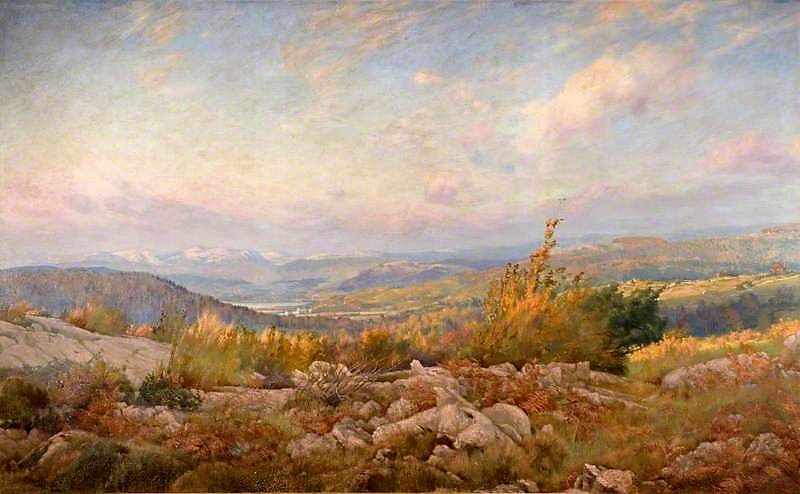
‘Cumberland Hills’. Image: Shipley Art Gallery, Gateshead.
In 1906 Edward was also elected to the Lake Artists Society, and in 1909 was commissioned by the Ullswater Navigation & Transit Company to produce 36 watercolour landscape paintings to use for printing postcards to boost tourism to The Lake District in general, and in particular to generate business for the tourist boats operating on the lakes (see below example’ ‘Striding Edge from Helvellyn’; other commissions for postcard artwork by other companies followed.
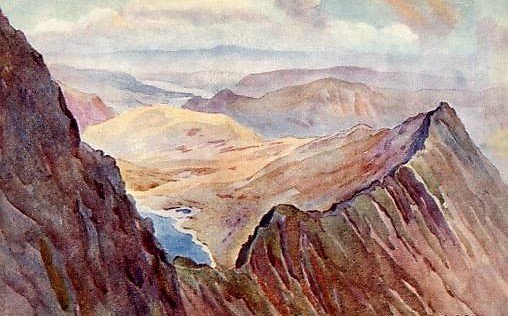
Image by courtesy of Carol Hobley.
In 1911 Edward suffered a physical and nervous breakdown after becoming lost on the Fells above his home. He never fully recovered from this, and in 1916 he was found dead in the Swarthbeck Gill area of Swarth Fell. An inquest jury later decided that he had committed suicide ‘while his mind was unbalanced’.

‘Cutting Stacks Rods’. Image: Bradford Museums and Galleries;
Edward Hobley’s artwork can be found today in many private collections and in public galleries at Bradford (see above example), Liverpool, Penrith and Gateshead.
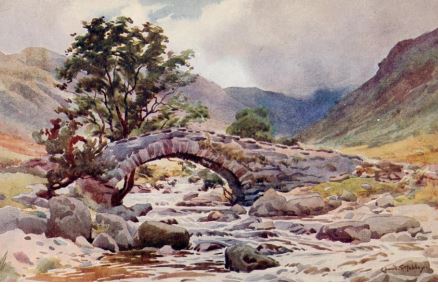
Wall End Bridge, Deepdale. Image by courtesy of Carol Hobley.
(With thanks to Carol Hobley for her painstaking research into her grand-father’s life and work, and for her permission to use a number of images shown here.)