

George Demaine (1892 – 1966) , architectural sculptor, model-maker and landscape painter was born and lived until his teens at Malsis Crescent, Keighley. His father, Frederick William Demaine, was a time-keeper in a local mill, and his mother, Isabella, worked as a draper. The family were members of the Wesleyan Methodist Chapel in Fell Lane, and George was brought up in accordance with Methodist principles and values.

Above. A still life by George Demaine, aged 16, dated 1908. He signed it deMaine. Image: by courtesy of John Demaine, grandson of the artist.
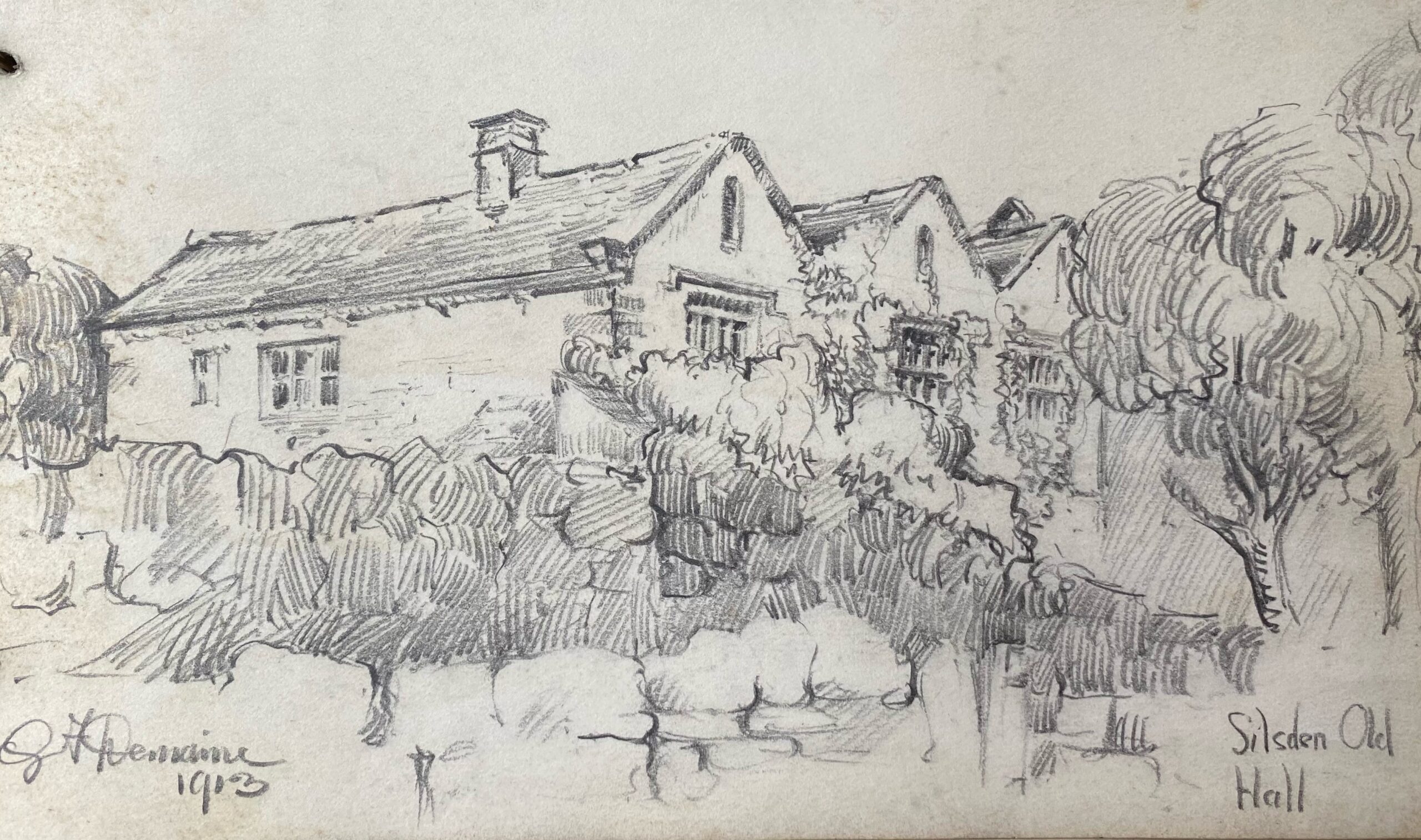
Sketch of Silsden Old Hall, Bradley Road, 1913, shortly before Demaine started his art training at the Royal College of Art. Image: courtesy of John Demaine, grandson of the artist.
Demaine studied initially at Keighley School of Art, then gained a West Riding County School Scholarship to the Royal College of Art, where he studied sculpture. George, still a committed Wesleyan Methodist, joined the Royal College Christian Union, and to indicate his opposition to the 1914-18 war, he also joined the No-Conscription Fellowship (NCF).
But, inevitably, in 1916 he was called-up to serve in the armed forces. George duly appeared before Chelsea Military Service Tribunal and claimed exemption on the grounds of his religious beliefs and objection to war. He was one of 16,000 men in Britain who claimed exemption from military service during the 1914-18 war on the grounds of conscientious objection. However, very few were granted full exemption and many accepted non-combatant roles. The Chelsea Tribunal only allowed George exemption from combatant military service and he was deemed liable for call-up to the Non-Combatant Corps.
However, George was an ‘Absolutist’ – renouncing any work that assisted the war effort. He subsequently refused to comply with a notice to report for training, and on 16 May 1916 was arrested by the civil police and taken before the Magistrates’ Court. He pleaded not guilty and stated in writing that as a Christian he could take no part in warfare. It was reported in the press at the time that he had argued:
[that]‘The spirit and teachings of Jesus Christ, which he was trying to follow, had nothing in them to show that we might use carnal weapons to protect ourselves. The only force which the Bible recognised was the force of love, which sought to save men and not destroy them. Therefore, he humbly but firmly stated that could not, under any circumstances, become part of a military machine, the object of which was to destroy life’.
He was convicted and taken to an army depot in east London, where he disobeyed an order, and on 30 May 1916 faced a court-martial and was sentenced to 2 years imprisonment with hard labour, later commuted to 112 days imprisonment with hard labour. He began his sentence in Lewes Prison, but was later transferred to Wormwood Scrubs, London, prior to his appearance at a Central Tribunal in London.
Karyn Burnham, in her book, The Courage of Cowards: the untold stories of First world War Conscientious Objectors (2014), describes a typical cell for conscientious objectors at Wormwood Scrubs prison.
For the first month in prison … [the prisoner would be] kept in solitary confinement, as was common practice for COs; cells were typically 10ft long by 4ft wide and furnished only with a narrow bed and a night stand. The only time he was allowed out of his cell was for daily exercise, which involved parading around the prison yard in a circle, one man behind another exactly 8 yards apart, swinging their arms and forbidden from speaking to one another. Failure to comply with the rules resulted in bread and water rations. (pp.70/71).
George appeared before the Central Tribunal on 16 August 1916, in London, where he was redefined as a ‘genuine’ CO, and offered work of national importance under the Home Office Scheme, introduced earlier that year.
However, he still refused to comply, so on release from prison was sent back to the Army and court-martialled at Coventry for disobedience a second time on 8 December 1916. He was sentenced again to 112 days imprisonment with hard labour, which he served in Mountjoy Prison, Dublin.
Hard labour meant long hours of manual work, often breaking stones into gravel, or stitching mailbags. Nearly 6,000 Conscientious Objectors served prison and work camp sentences in Britain during WW1, and over 70 died of ill-health attributed to the harsh treatment received there.
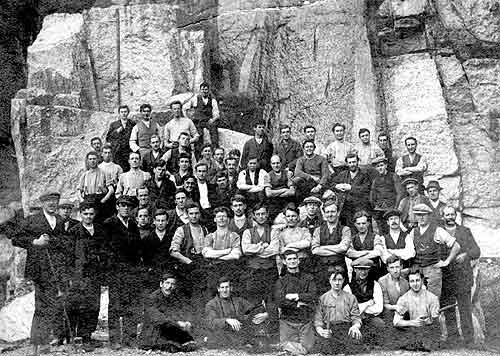
Conscientious objector prisoners at Dartmoor engaged on quarrying work.
On release on 16 March 1917, Demaine was transferred to Arbour Hill Barracks, Dublin, where he again disobeyed, and had a third court-martial there on 23 April 1917. He was sentenced to a further 1 year imprisonment with hard labour, served again in Mountjoy Prison.

‘The Conchie’. Oil Painting by Arthur Gay (1931). Image: copyright: Peace Museum. Depicts a conscientious objector being transported to prison under military escort.
The ‘cat and mouse’ cycle continued with release, then a fourth court-martial at Dublin on 7 March 1918, resulting in 2 years imprisonment with hard labour, served in Walton Prison, Liverpool, and, briefly, at Wakefield Prison in a short-lived and unsuccessful experiment to bring all CO prisoners together.

Wakefield Prison, circa 1909. Image: maggieblanck.com
He was finally released on 16 April 1919 having served in total more than 2 years in prison. However, he and other conscientious objectors, were denied the right to vote until 1926, which for most amounted to ten years after their first convictions in 1916.
On his release he returned to the Royal College of Art and finally completed his studies in 1921. He married Ruth Ethel Bartlett, a photographer, originally from New Zealand, in 1927, and a son was born to them in 1929. The family lived at addresses in South Kensington, London.
By 1931 he was employed by British Dominion Studios as a designer of film sets, creating interiors and studio furnishings. In 1933 he was interviewed by ‘The Daily Mirror’ (12 Dec.) and spoke of the time demands of the work. He said:
Here the art director will say, for instance, ‘the set looks rather bare, can you think of something? It’s got to be ready tomorrow morning’. That allows about half an hour to think of something and less than a day to put that something into a colour scheme with a design which will fit into a setting already in existence.
He also built model dummies for use in the more dramatic film scenes and he told ‘The Daily Mirror‘ that his work for the studios drew on all his art talents: painting, sculpting, modelling, and design. The studios were destroyed by fire in 1936, and George subsequently worked with Ealing Studios and for the Rank Organisation, but continued creating and exhibiting his own artwork.

River Thames. Pool of London.
In 1940 he was employed as a Camouflage Officer at the Civil Defence Camouflage Establishment (CDCE) at Leamington Spa. The main priority of the CDCE in the early stages of the war was to use camouflage to deceive and decoy enemy bombers, by disguising factories, runways, and other strategic targets He was able to use his skills as a set designer for films, architectural sculptor, and model-maker, to build models of likely enemy targets so they could be studied in different lights, e.g. sun and moonlight, to identify the best form of camouflage. Later in the war, the work of the CDCE shifted to the production of dummy tanks, landing craft etc to suggest the invasion of Europe would begin from the Kent coast, rather than from Dorset. Demaine was employed at the CDCE until 1943 and subsequently moved back into film set design for the the Rank Organisation; shown below George Demaine is working on a model for the 1946 film ‘Great Expectations’.

Image courtesy of John Demaine.
He was an Associate Member of the Royal College of Art and exhibited work at shows of the Royal Academy, Royal West of England Academy, Alpine Club Gallery and at Cartwright Hall. Demaine was also a Brother Member of the Art Workers’ Guild from 1950 until 1966.

Watercolour by George Demaine: River Harbour scene (Whitby). Images by courtesy of John Demaine, grandson of the artist
George and Ruth Demaine retired from Hampstead, London, to live at Dover, Kent, where he died in 1966.
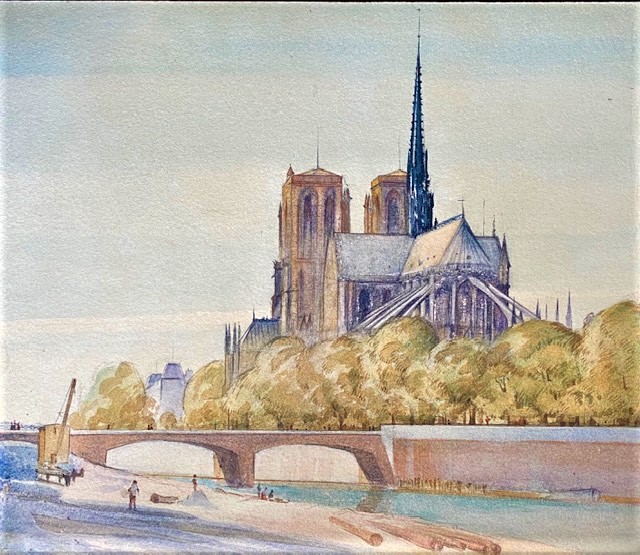
Notre Dame, France.
Reference: Cyril Pearce Records, via Imperial War Museum : www.livesof thefirstworldwar.org
George Demaine is featured in the book, The Highs – The Lows. Past Artists of the Bradford District, for more detail click here