

‘Garden Path’, by Robert Dawson
The Dawson Family:
- Charles Frederick: 1863- 1949
- Robert Arthur: 1874 – 1948
- Mary Elizabeth: 1867 – 1942
Brothers, Robert and Charles Dawson, were both successful landscape, genre and portrait painters. They were also well-regarded teachers and art education administrators. Mary Elizabeth Dawson (nee Bell), married to Charles Frederick Dawson, was also a talented and successful painter, craft worker, and teacher.
The brothers lived in Bingley and their father, also named Charles, was a house painter and decorator by trade, but also a keen amateur artist.
Charles was born in Rillington, Yorkshire, but grew up in Bingley and attended Bingley Grammar School. The 1881 census suggests that at 17 he was employed as a painter and house decorator, but he was also pursuing his interest in art it is believed he studied art at Shipley School of Art and later under Stanhope Forbes at Newlyn.
By 1895 he had became the Head of Bingley School of Art, and was also employed as an art master at Bingley Grammar School. He lived at Main Street, Bingley. In 1892 he married Mary Elizabeth Bell and by 1911 he and Mary had moved to Accrington, where he was the Principal of Accrington School of Art, a post he held until he retired.
His work appeared at the Royal Academy, Walker Art Gallery, Liverpool, Manchester Art Gallery, Cartwright Hall, Bradford and at the International Society of Sculptors, Painters and Gravers. The Haworth Art Gallery has a number of works by both Charles and his wife, Mary Elizabeth. He was a Fellow of the Royal College of Art.

‘Accrington – from my window’, by Charles Dawson. Displayed at Manchester City Galleries.
Mary Elizabeth (nee Bell) was born in Skipton, but by 1881 her family had moved to Trafalgar Street, Bradford; her father, John Bell, was a commercial traveller. Mary was educated at the Girls’ High School, Shipley, and by 1891 the family was living in Saltaire. She married Charles in 1892 and was an art teacher at that time. After her marriage she continued to teach and was the holder of a Masters Diploma in Art.
She also was a successful artist and craft worker, who painted in watercolours and gouache, and also worked in embroidery, as well decoratively with wood. She was a member of the Red Rose Guild of Art Workers, the Attic Club, Manchester, and Bradford Arts Club. Mary exhibited work at the Royal Academy (between 1916 – 1932), Society of Women Artists, the Victoria & Albert Museum, London, as well as exhibitions in Manchester, Liverpool, Leeds, and Bradford. Her work was also exhibited overseas at exhibitions in Stockholm, Holland, New Zealand and Canada. Manchester Art Gallery has one of her paintings: ‘South Street, Port Bredy’ (1925).
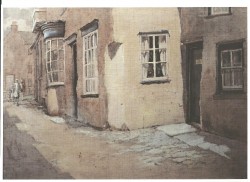
‘Street Scene’, by Mary Dawson.
Robert Dawson was born and lived in Bingley and attended the Bingley Grammar School, where he became a junior teacher, aged 17, as a Junior Form class teacher, teaching art throughout the school.
In 1893 he left teaching to study art full-time at Saltaire Art School, although continued to teach part-time at Saltaire and at Bradford School of Art. In 1895 he began study at the National Art Training School in London (later renamed The Royal College of Art) and became a assistant master at the Royal College of Art (RCA). He became an Associate of the RCA and eventually elected a Fellow (FRCA) in 1936.

Robert Dawson in 1938.
He married Amelia Fox in 1899 and lived in Fulham, London, but by 1901 had been appointed Principal of Belfast School of Art. He stayed at Belfast until 1919, when he was appointed Principal of the prestigious Manchester School of Art, where he stayed until his retirement in 1939.
He was well-regarded by his colleagues and students, and gained a pioneering reputation for linking art with industry, particularly in the field of textile design. In 1931 the Manchester Guardian wrote of him:
He is well known and to know him is to like him. He is tall, active, cheery, moustached and spectacled. Outstanding among his characteristics are his conquering smile and direct, unaffected manner … He is very justifiably proud of his school, and has the satisfaction of knowing that it is (to borrow a phrase from trade) “a going concern.” The school truly thrives.
After retirement, Robert returned to his home town, Bingley, where he could indulge his passion for painting. His grandson, David, said that Robert Dawson: ‘painted almost continually and with a passion akin to an addiction … I suspect some of his best paintings were done during this time’ [post-retirement].
He exhibited work at the Royal Hibernian Academy, the Royal Academy and the Walker Art Gallery, Liverpool, and the New Gallery, Regent Street, London. His grandson, David, also believes Robert had been commissioned to paint wall murals in country mansions. The Queens University, Belfast, holds a painting by Robert of his friend, Professor J.H. Smith (shown below). Robert died at Bingley.
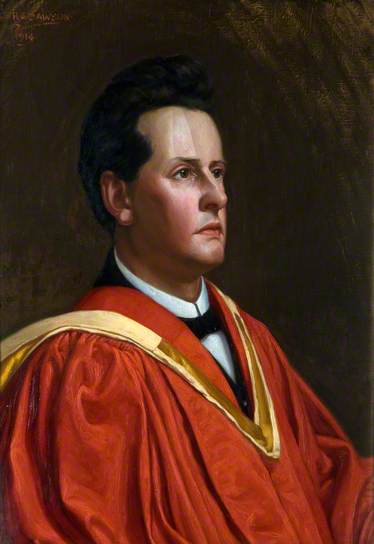
‘Prof. J.H. Smith’. Portrait by Robert Dawson. Image courtesy of BBC ‘Your Portraits’/Queen’s University.
(I am grateful for the valuable help given to me by David Dawson, grandson of Robert, in preparing these profiles, including supplying images, and for the Dawson family for allowing them to be used here).