

The Strid, River Wharfe The artist’s easel and painting bag were found at this spot.
On Friday, September 14th, 1934, the professional watercolour artist, Arthur Reginald Smith, set out early from his home in Grassington, North Yorkshire, to paint the River Wharfe, near Bolton Abbey.
Smith was fascinated by the beauty of the river, and the villages along its upper reaches frequently appeared in his work.
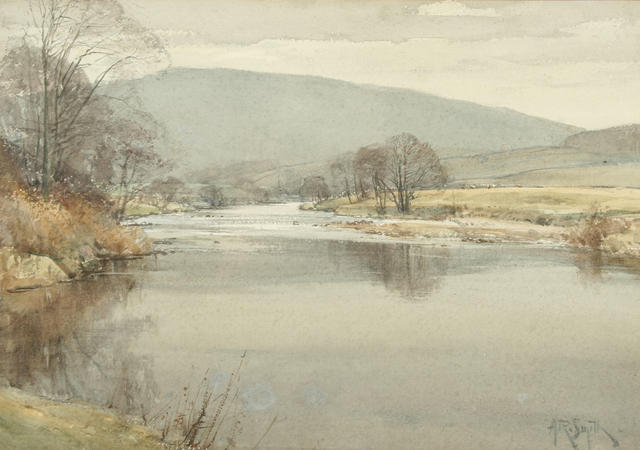
Arthur Reginald Smith: River Wharfe, near Bolton Abbey.
The section he chose to paint that day – The Strid – is a notorious section where the water is forced into a narrow channel about two metres wide (see photograph at top of this page). It was (and still is) a common activity for foolhardy people to jump between the two banks. But the narrowness and depth of the river at this points (over 30 feet deep) makes it particularly dangerous – and those that fall in here rarely survive. The pounding river pulls, whirls and sucks you under into the caves and crevices below.
When the artist failed to return home that evening, the alarm was raised and the police found his easel and painting bag containing sketches of the river on a rock next to The Strid at its narrowest point. The woods were searched, but the artist had disappeared. At first light and over the next week the river was dragged by the police, but no body was found, although his tweed hat was found downstream half a mile from The Strid.
Finally, a water diviner, a Mr R. Brotton, from Richmond in North Yorkshire, was called by police to the search, as he had previously been successful in locating drowned bodies. After standing near the narrowest point at The Strid, holding the artist’s hat, Brotton walked downstream with the two hazel twigs attached with wire. He halted and pointed to a spot in a pool, fifty yards from where the artist’s easel had been found. ” I am sure the body is there”, he told the police.
The river by now was in flood from rain, but once that abated police again dragged the river and on the eleventh day found the submerged body of the artist, wedged against a rock, in the spot indicated by the diviner.
Brotton later told the local newspaper:
When engaged in searching for bodies in water, I believe that if I can get an article of the dead person’s clothing the electricity in my body establishes contact with that of the body. Contact thus made passes through my body to the hazel twig, which drops in my hands to point to the spot where the body lies. (Keighley News 29 September 1934)
It was reported at the time that Smith had been known to to jump the river at this point, so there was a suggestion that he had slipped in the attempt. However, the artist was 63 at the time of his death and it seems extraordinary that a man of his age would do this. The local police had also examined the banks and could offer no explanation why the artist should fall into the river, and the Coroner gave his open verdict: ‘death from drowning’. The artists body was cremated two days later, following a service at the ancient parish church of St Michael, at Linton, close to the artist’s home.
His ashes were scattered from Yockenthwaite Bridge into the river he had loved to paint.

The Wharfe in Flood by Arthur Reginald Smith. Picture in a private collection.