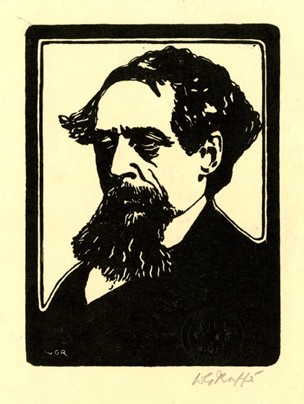
Walter George Raffe. Image: Paul Keen. Ancestry.Com
Walter George Raffe (1888 – 1965), artist, writer and teacher, was born in Wigan, but lived and worked in the Bradford district whilst studying art at Leeds.
Walter’s father was a Drapery Manager, and the family moved around the country – Lancashire, Manchester, Southsea, and London – most likely in pursuance of work by Walter’s father in the drapery trade.
By 1911 Walter was resident as a lodger at 14 Marlborough Road, Shipley, whilst working part-time as an art teacher in a local school and studying art at Leeds College of Art. He gained a scholarship to study at the Royal College of Art and subsequently in 1919 became art director at the Northern Polytechnic (now London Metropolitan University).
He travelled to India in 1921, where he became Principal of Lucknow Government School of Art in India and he also lectured at Calcutta University. He returned to the UK in 1924 and worked for the London County Council as an art lecturer before embarking on a freelance career as a writer and artist.
In the visual arts he worked principally in woodcuts, with work characterised by its pronounced black and white and Arts Nouveau style. He was a prolific writer of both prose and poetry and contributed to a wide range of periodicals dealing with arts, crafts, colour, psychology of art, and occultism.
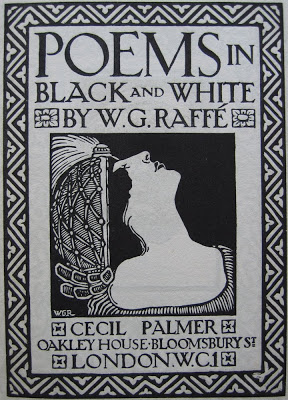
His poems were published in a range of esoteric and art-related journals, including Theosophy, The Linkman, The Ploughshare, and Textilia, and in 1922 a collection of his previously published poetry was published by Cecil Palmer in Poems in Black and White with woodcuts by Raffe (see below). He was also editor at one time for the arts journal, ‘New Publicity’ (later ‘Modern Publicity’) in the late 1920s. Raffe also wrote articles on theatre and ballet design for The Studio and toward the end of his life wrote Dictionary of the Dance (1964).
Earlier he also written and illustrated the books Art and Labour (1927); and Poster Design (1929) and was the illustrator for Children of Aries (1925) by J.C. Campbell. An article by G.E. Fussell on Raffe’s wood engravings is published in Artwork, October 1924.
 In addition to his teaching and writing, his work was exhibited, including at the Walker Art Gallery and the Royal Academy in London. He was elected a Fellow of the Royal Society of Arts in 1919 and was a member of the Arts and Crafts Exhibition Society. Frank Rutter described one of Raffe’s woodcuts in the RA Exhibition of 1920 as “the best thing in the room” and Holbrook Jackson, editor of To-Day, said, “His landscapes are the best I have seen for many a long day.”
He died in 1965 at Enfield, North London.
The Arts Institute, Chicago, has 12 of Raffe’s prints in their collection; and the British Museum has 10 Raffe woodcut prints in theirs (see examples below).
 The Coming Storm. Image: Art Institute, Chicago
 Winter Sleep. Image: Art Institute, Chicago
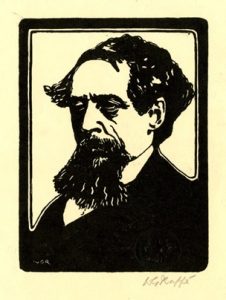 Charles Dickens. Image: British Museum Print Collection.