

The award-winning photographer, John Myers, was born in Bradford in 1944. His work has, over many years, documented the lives of British people, the houses they occupied, and urban spaces around them. His work captures a sense of how ordinary lives were enacted and presented in the recent past.

House and Garden, Chawn Hill, Stourbridge 1979. Image: see artist’s website, below.
John Myer’s work has been widely shown across the UK and overseas and can be found in the permanent collections of the Arts Council and the V&A.
In 2012, Francis Hodgson, Professor in Culture at the University of Brighton, wrote about John Myer’s approach to portraiture:
The scrupulous refusal of the photographer to exploit his sitters is very clear. Nobody’s taken by surprise, nobody satirized by an unfortunate juxtaposition or a chance moment made to seem typical. The sitters are participants in the slow business of the photograph, near-equal partners in an approach to self-portraiture.
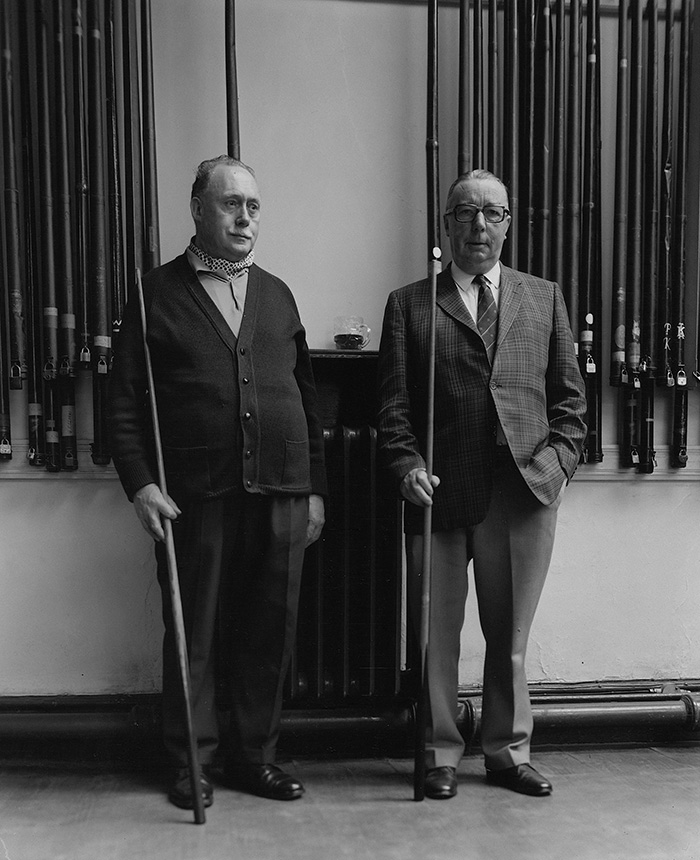
Two snooker players. Image: see artist’s website, below.
John Myers attended Grange Boy’s Grammar School in Bradford and after completing his A levels, studied Fine Art at Durham University’s King’s College in Newcastle upon Tyne, graduating with honours in 1967. He worked as a senior lecturer in fine art at Stourbridge College of Art (1969-89), then as a senior lecturer in painting and Head of the MA Painting Programme at the University of Wolverhampton (1989-2001).
His photography has been shown at solo exhibitions over a 25+ year period, both in the UK and overseas, including at the Allmenningen Galleri, Bergen, Norway, and at Dudley Art Gallery, Rugby Art Gallery and the Gallery of Photography in Dublin. A solo exhibition of his work, The World is Not Beautiful, was presented at The Gateway Gallery, Luton, between February – April, 2017, and scheduled to tour to the Wolverhampton Art Gallery in 2018. His photographs of industrial scenes from the 1980’s were selected for the Foto/Industria Biennale in Bologna, in October/November 2017.
In the USA, John’s work is represented by the Joseph Bellows Gallery, La Jolla, San Diego, California.
John Myer’s work has also been shown, from the early 1970s onwards, in many group exhibitions, including at the Hayward Gallery and Serpentine Gallery in London. Between 2008-10 it was featured in ‘Unpopular Culture, Grayson Perry selects from the Arts Council Collection, and shown at eight UK venues.

TV 1 1973. Image: see artist’s website, below
He was a Welcome Trust Sciart award winner (2000): The Art and Science of Collaboration Team of Adamson-Macedo, Myers, Henley, Walker; awarded a TEMPUS Phare Individual Mobility Grant to visit art academies in Poland (1997); and, early in his career, gained Arts Council funding to publish collections of his work: (1976) Seeing the Unseen: The High Speed Photography of Dr. Harold E. Edgerton; and Middle England (1972).
Other primary sources include: The Dudley Experience, De-Industrialisation, Unemployment and Enterprise in Dudley M.B.C. 1979-1983, published in 1990; and John Myers Middle England (2011), published by the Ikon Gallery, Birmingham, with introduction by Jonathan Watkins and Pete James, and essays by Ian Jeffrey, Paul Lewis, and Eugenie Shinkle.
John Myer’s work has also been the subject of articles and essays in a wide range of journals, blogs, and national newspapers, including Camera, Creative Camera, The London Magazine, and The Guardian. It has also featured in books, including Unpopular Culture (2008) by Grayson Perry, published by Hayward Publishing.
The University of Birmingham Library holds The John Myers Photographic Archive of his work between 1972-1981, containing nearly 300 photographs, including portraits and images from the familiar domestic and suburban environment. The Library also holds a small archive of photographs by Dr. Harold Edgerton, inventor of single and multi-flash stroboscopic photography, and which formed an exhibition organised in 1976 by John Myers.
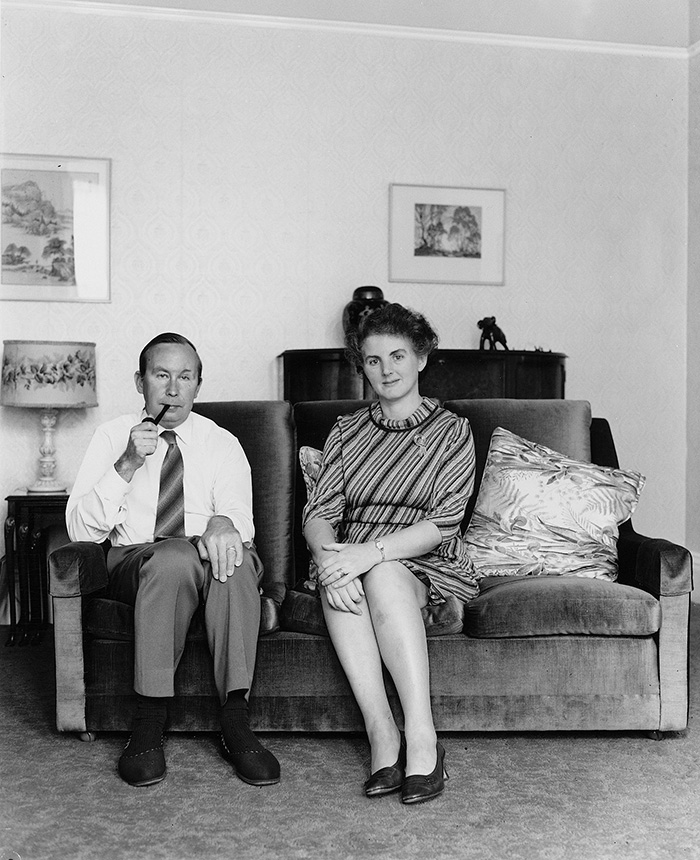
Mr & Mrs Seabourne, 1973. Image: see artist’s website, below.
Artists Website: http://www.johnmyersphotographs.com