
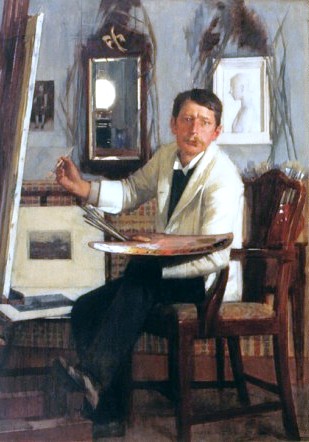
Self-portrait. Image: Dunedin Art Gallery, New Zealand.
Although Henry La Thangue (1859 – 1929) was born in Croydon and never lived in Bradford, he had Yorkshire ancestry and spent a considerable amount of time in the city painting portraits at the start of his artistic career – an important source of income for the young artist. He was also closely involved in the development of an artistic community in the city, and in particular the formation of the Arcadian Art Club in 1886 at the Swan Arcade in Bradford. La Thangue was made President of the Art Club and his idea of ‘plein air’ painting – working in natural light out of doors – was influential in shaping the direction of landscape painting in the district. His influence on colour can clearly be seen in in the work of later local landscape painters, such as Walter Foster and Herbert Royle.
He attended school at Dulwich College in South London, where two of his school friends, Stanhope Forbes and Frederick Goodall, were also aspiring artists. Little is known of his early life until he began studying art in London, initially at the Lambeth School of Art, then later at The Royal Academy (1874-9), where he was awarded a gold medal, enabling him to study at the Ecole des Beaux-Arts in Paris for three years.
His period in France had a significant influence on the way he painted, and particularly the development of his ‘plein air’ and realistic style of working, influenced by the French Impressionist painters. Whilst in France, La Thangue spent his vacation time on the Brittany coast with other like-minded artists, including Stanhope Forbes and Bastien Lepage.

‘The Young Farmhand’. Image: Wikiart.
On his return to England in 1884, he travelled frequently to Bradford, where he was on friendly terms with John Maddocks, a local merchant, manufacturer, and amateur artist, who introduced La Thangue to prominent members of the Bradford business community and led to portrait commissions for him.
One portrait was of Abraham Mitchell, a wealthy local art collector (shown below). ‘The Connoisseur’, painted in 1887 depicts Mitchell and his family in their own home, with Mitchell giving serious attention to a recently acquired painting. Although obviously not an example of open air painting, it does still present the sitter in a more natural way than was normally the case with portraits at this time.

‘The Connoisseur’. Image: Wikiart/Bradford Museums & Galleries
It was said that La Thangue’s influence was to have a big impact on Mitchell’s collection, as the artist’s views on colour, open air painting, and more natural style of work became more popular with and adopted by local artists.
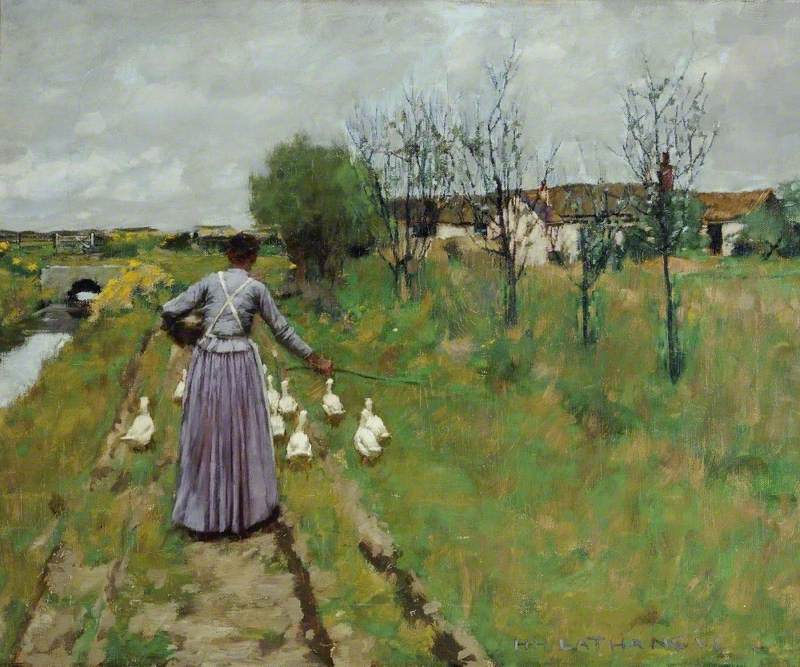
‘Landscape Study’. Image: Art UK/ Rotherham Heritage Services
In 1885 La Thangue married the actress Kate Rietiker (stage name, Leeson) and they lived for a time in Norfolk, where La Thangue painted rural scenes characterized by their social realism. He later moved to Sussex and became an early member of the New English Art Club (NEAC) in London. All the founding members of the NEAC had studied art in Paris and were influenced by the more natural style of French painting. This contrasted with the prevailing situation at the Royal Academy – characterized by the conservatism of the work exhibited and the way it was judged. Although La Thangue was critical of the Royal Academy style of teaching at this time – describing it as ‘the diseased root from which other evils grow’ – he was later reconciled with them and was elected an Associate Member in 1912.
His work is widely exhibited in public galleries across Britain, including at the Tate Gallery in London. In the North of England it can be found at Cartwright Hall, Bradford (another example below), and at public galleries in Oldham, Rochdale, Rotherham, Hull, Liverpool, Manchester, Salford, Newcastle, and Blackburn. It is also found in public art galleries in Australia and New Zealand.

‘In the Orchard’. Painting submitted by the artist to the Bradford Art Museum Spring Exhibition, 1894, and now in the permanent collection at Cartwright Hall, Bradford.
Bibliography
The Mental Outlook in Painting. Lectures to the students of the Royal Academy of Arts, January, 1915. Published by Winsor & Newton, London & New York, 1915.
Painters and Peasants : Henry Herbert La Thangue and British rural naturalism, 1880-1905. An exhibition catalogue published by Bolton Museum and Art Gallery, Bolton, 2000.