
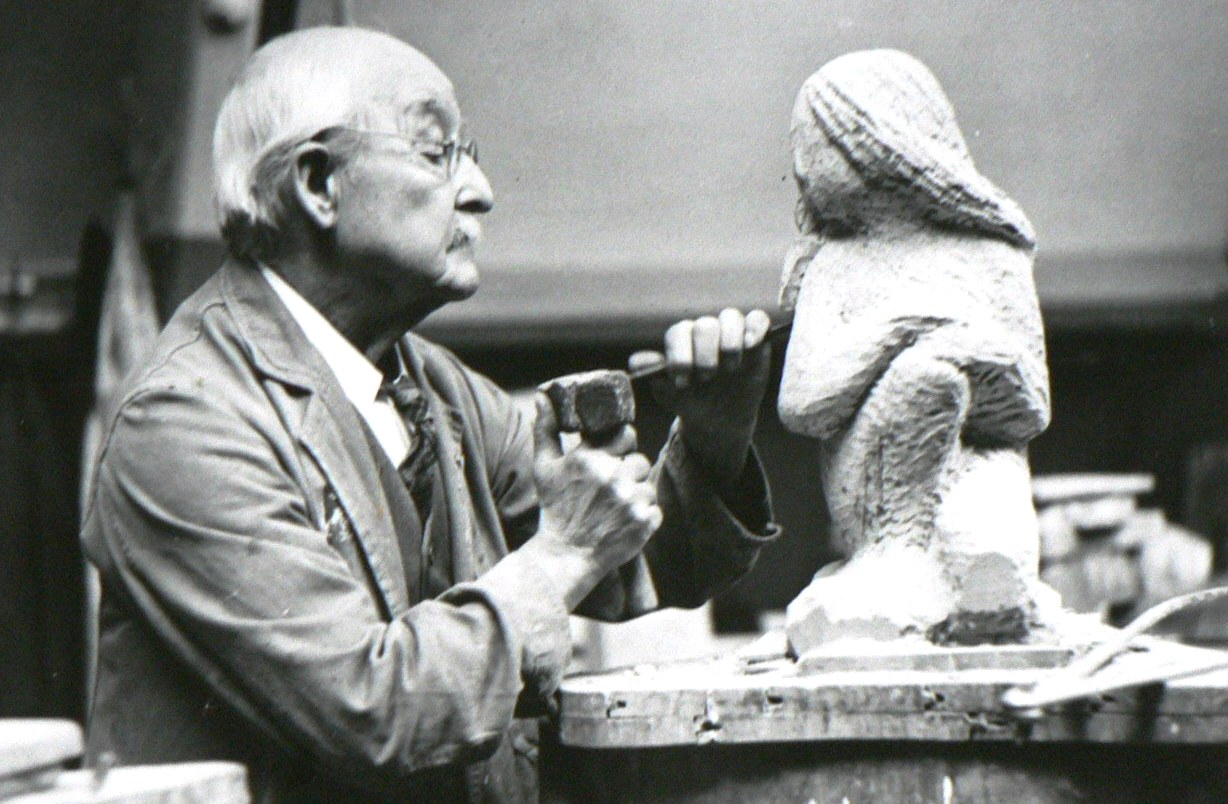
Alex Smith in his workshop, Keighley, 1951
Sculptor and painter, Alex Smith (1863-1953) was born in Nottingham, the son of a stone carver, and moved to Keighley in 1889 to work as a tutor of sculpture and carving at Keighley School of Art.
He joined forces with a local craftsman, Antony Boothman, to establish Mssrs Smith and Boothman, architectural sculptures, and worked on war memorials, cinemas, pubs, churches and other buildings throughout the district, including above the Keighley Library entrance, the Arcade on North Street, and at Cartwright Hall, Bradford. He had a workshop on Dalston Lane and worked in stone, marble, alabaster, cement and wood.
He carved ‘Refugees’ in wood to commemorate the arrival in Keighley of Belgium people displaced by the First World War; this stands now on a plinth in the entrance to Cartwright Hall (see ‘The Sculptor and the Refugees’ at Refugees.)

‘Refugees’, in the entrance to Cliffe Castle, Keighley
In 1929 and 1948 he painted murals on canvas in Keighley Library. These were on display until the early 1970s, when during ‘modernisation’ of the building they became hidden behind a false ceiling. In 2006 they were rediscovered in a poor condition but sympathetically restored. Scenes respectively from Westward Ho! and Robinson Crusoe, originally painted in 1929 to celebrate the opening of a children’s library, are now on display in the ground floor lending library, whilst scenes from The Rubaiyat of Omar Khayyam (see below) are to be found at both ends of the first floor Local History Study centre.

Murals painted by Alex Smith in the Local History Studies Section, Keighley Library

Smith was a member of Keighley Arts Club and painted portraits of musicians in the Keighley Musical Union and Orchestra; his paintings were regularly exhibited at the Spring Exhibition, Cartwright Hall. Cliffe Castle has on display a fine piece of stone carving by Alex Smith of musical instruments rescued from The Queen’s Theatre (later The Hippodrome) when it was demolished in 1961 (see image below).
He also made the crozier and cross for the Bishop of Bradford, and there are some fine examples of his wood carving at the Christ Church, Oakworth.

At the age of 84 he returned to Keighley Art School – as a pupil – to develop his talents, studying life painting, carving and modelling for 20 hours each week.