
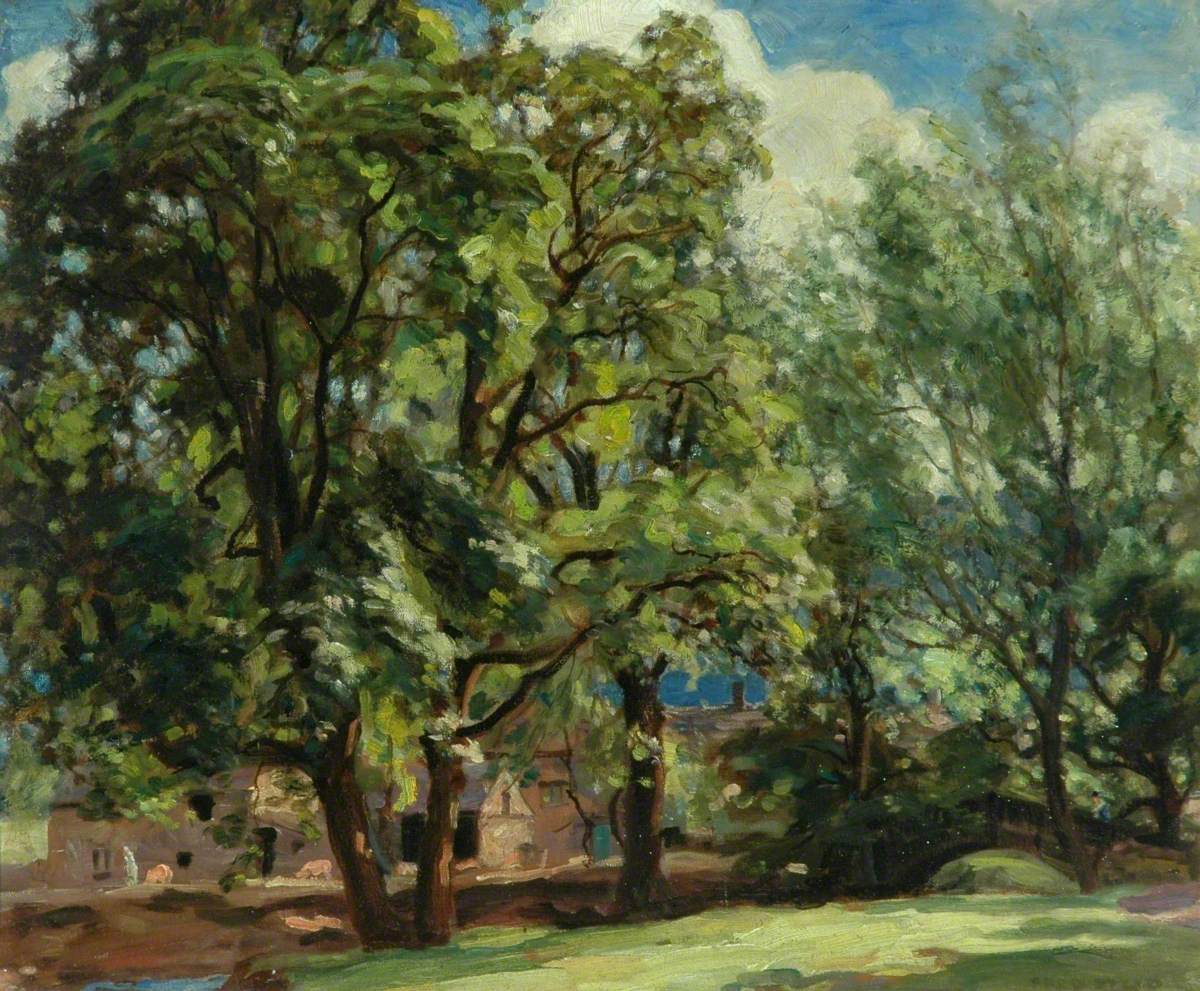
‘Beckfoot’. Image: Bradford Museums and Galleries;
‘Beckfoot’, painted around 1890, by local artist, Fred Stead, is in the permanent collection of Bradford Museums and Galleries Service and was displayed at Cliffe Castle in 2025.
It is an oil on canvas painting measuring 49 x 59.5 cm. The artist has chosen to use oils for this painting, which adds layer and texture to the tree trunks and emphasises their strength and maturity.
The painting was gifted by May Stead wife of the artist to Bradford Museums in 1940 shortly after Fred’s death. It depicts a glade of trees in full summer at a well-known local beauty spot on Harden Beck close to is confluence with the River Aire. The old packhorse bridge and weir is seen to the right of the painting.
At first glance the casual onlooker might dismiss the painting as a pleasant enough scene; a group of trees, but nothing special. But the closer and longer you look the more you can see.
Firstly, it is a study of the shapes of the trees. In the left foreground the split trunk of the tree dominates the scene, with its tangle of sturdy branches. The eye leads away from this, right, to the more delicate trunks of the tree nearest the bridge. The source of the light is from the south-west, that is from the top right of the painting. This creates layers of shade and light and serves to highlight the forms of the trees. The sunlight also emphasises the pastel colour of a farmyard in the background and serves as a lighter relief to the darker colours of the trees.
Above all though, the scene presents the colour green in all its many hues, including the green of the leaves and grass of the foreground. The variety of green is matched with an almost equal variety of brown: from the sun-soaked tan of the farm buildings, to the darker shades of the trunks, branches, bridge, farmhouse wall, and shadows. The scene is framed by the white and blue of the sky; the white is echoed by the light falling on the branches on the main tree, left. The white of the sky, seen through the branches, gives perspective and induces an almost three-dimensional effect.
The viewpoint of the artist appears to be around 50 yards away, slightly uphill from the glade, as he chooses to present a full, rather than partial, picture of the trees. A figure is seen leaning on the bridge; another is glimpsed in the farmyard in the background, along with grazing or recumbent animals.
It is a scene that reminds the viewer of the full pleasing power of nature, particularly the strength and longevity of trees, at the height of summer.
The Artist

Frederick (Fred) Stead (1863-1940) was born in Saltaire into a large and poor working class family. Yet despite this he became one of Bradford’s most talented and successful artists. After leaving school he worked at the local Salts Mill as a millhand, but attended evening art classes at the nearby Saltaire Art School.
His talent for art was recognised and he was awarded a scholarship to study full-time at the National Art Training School in London. There he gained Gold and Silver medals for his work and a Travelling Scholarship that took him to Europe to study art.
On his return to Britain he taught art in Bradford and Saltaire and became a School Inspector for art for the West Riding County Council. In 1896 he was appointed Head of the Saltaire Art School and in the same year married a local teacher and fellow artist, May Greening, the daughter of a local printer. They had two children and lived at Ghyllwood Drive, Bingley, within walking distance of the scene depicted here.
His own work was widely exhibited, including on over 30 occasions at Royal Academy Shows. He used oil and watercolours to paint a range of figurative genre scenes, along with commissioned portraits, and landscapes, particularly of the Yorkshire region. His paintings can be found in public galleries in Bradford, Calderdale, Preston, and Salford, as well as in private collections across Britain and overseas.