

Self-portrait of Fred Stead (by courtesy of the Long family)
Frederick (Fred) Stead (1863 – 1940) was born in Saltaire on the 3rd August 1863 and lived for the latter part of his life at Ghyllwood Drive, Bingley. He was a talented and well-regarded artist who painted a wide range of subjects, including portraits, landscapes, urban, still life and genre scenes.
Fred was the last of 10 children born to his parents, Samuel and Sarah. The Stead family shared a house with another family in Caroline Street, Saltaire, close to Salts Mill, where all the members of the household, who were able to, worked. Fred’s mother, Sarah, died, aged 46, less than 6 months after his birth, worn out by her life.
He would have been raised after his mother’s death by his siblings, and after leaving school it appears he worked initially, most likely, at Salts Mill. However, in his own time he attended evening classes at the nearby Saltaire Art School, where his talent for art was recognised and encouraged.
He was granted a scholarship to study at the National Art Training School in London (later renamed The Royal College of Art). At the National School he gained Gold and Silver medals for his artwork and was awarded a Travelling Scholarship that took him to Italy, Switzerland, Germany and France to study.

Canal near Bingley. Image: Calderdale Museums & Galleries
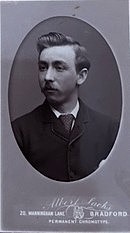
Fred Stead. C.1890
On his return to Britain, he taught at both Saltaire and Bradford Schools of Art, where he was a Life Art Master, and was also an occasional Inspector in Art for the West Riding County Council. In 1896 he was appointed Head of the Saltaire Art School, but gave this up to work full time as a portrait and landscape painter when he found that increasing demand for commissioned work made it difficult for him to both teach and paint.
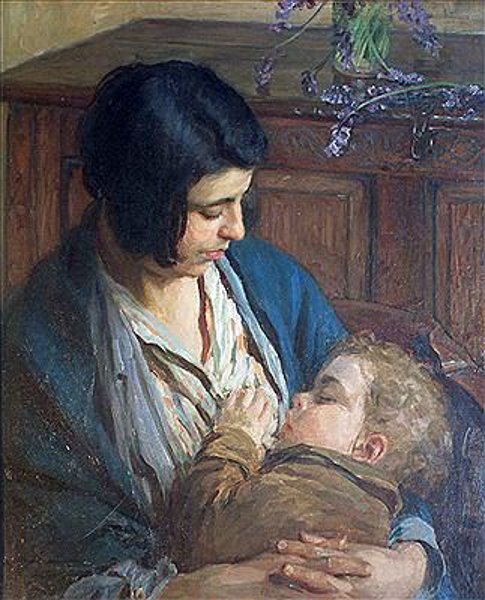
Mother and Child. Image: I am a child website.
He subsequently became a successful and leading portrait painter in oils of the more affluent or influential members of Bradford society, which supported his wider range of art subject interests, including Yorkshire urban and landscape scenes, still life, and other genre portrait work (see ‘Mother and Child’ example above).
In 1896 he also married May Stead, another well-regarded local artist, particularly of miniature portraits. Fred had met May whilst she was a student at the Saltaire School of Art and they had become engaged when she moved to the National Art T raining School to study. May Stead is depicted in Fred Stead’s painting below: ‘Mother and Two Children with a Picnic’.

Fred Stead, C.1900
In 1923 a selection of Fred’s artwork was exhibited at the opening of the annual Saltaire Conversazioni at the Victoria Hall in the village. The artwork included a commissioned portrait of local soldier, Second-Lieut. Edgar Marsden Kermode, D.S.O., M.C. and Bar, D.C.M. who had been killed in action on the Western Front during WW1. This must have been a particularly poignant commission for the artist, as Fred and May’s first son, Samuel, had been killed during the Somme Offensive in 1916, aged 18, and had no known grave.

Shipley Market, Evening. Image: in a private collection.
Fred Stead’s work was well-regarded nationally and internationally; his paintings were bought by collectors in America, Canada and Australia, as well as in Britain. He was a Chairman of the Society of Yorkshire Artists and a lifetime member of the Bradford Art Club,
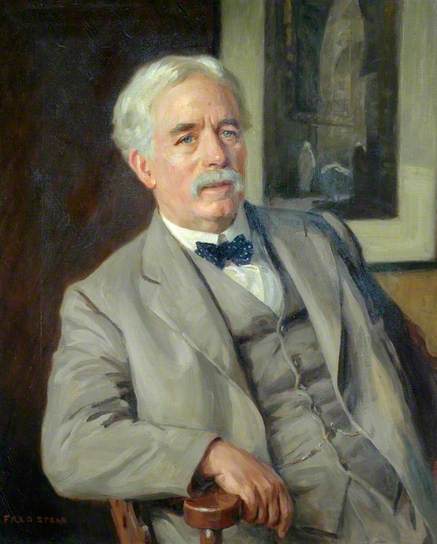
Fred Stead’s portrait of the local pioneering photographer, Alex Keighley. Image: Bradford Museums & Galleries
From 1888 onward he exhibited regularly with the Yorkshire Union of Artists, as well as at exhibitions in Birmingham, Liverpool, Manchester, and on over 30 occasions with the Royal Academy. After his death in 194o, his widow, May, helped to organise a memorial exhibition of his work at Cartwright Hall, Bradford; many of his paintings were sold to private collectors at this exhibition.

‘Mother and Two Children with a Picnic’. Circa 1923. In a private collection.
His paintings can be found today in many private collections and in the public collections at Bradford, Calderdale, Salford and Preston.

Still life. Flowers in a Vase. Image: in a private collection.
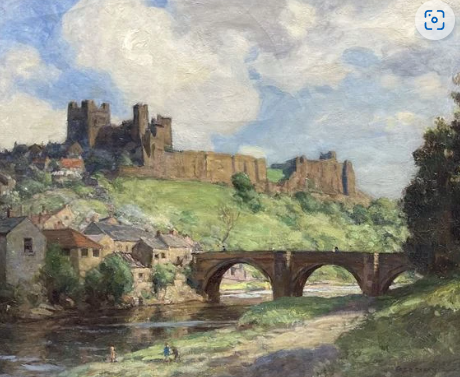
Green Bridge and Richmond Castle. Image; in a private collection.
(With grateful thanks to the direct descendants of the artist: Stephen Long and his family, for photographs and other images of Fred and May Stead. Thanks too, for additional biographical information from Saltaire local history researchers: Colin Coates, in particular, as well as Tish Lawson, Ian Watson and Maggie Smith, for their help in helping me compile this profile of Fred Stead).