
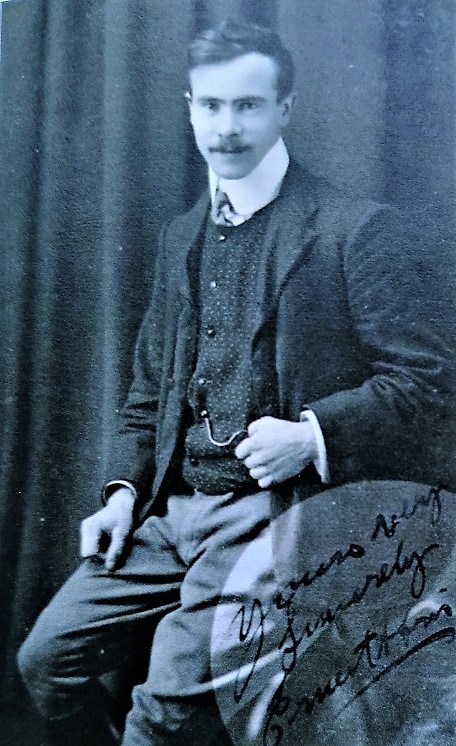
Ernest Aris. Photo: Chignall
The talented illustrator and author, Ernest Aris (1882 -1963) spent his formative years in Bradford, including his art training at Bradford School of Art.
During his working life he is estimated to have written and illustrated over 170 children’s and natural history books, as well as illustrating over 250 mainly children’s or natural history books for other authors (Chignall, 2021). However, today his work is often surprisingly overlooked, and his name omitted in the past from directories of children’s book illustrators. However, recent biographies of Aris (see sources below) are helping to positively revise the legacy of his work, particularly his book illustrations.
He was born 22nd April 1882 in Islington, North London, to parents, father, Alfred, a lithographic artist, and mother, Emily. His birth name was recorded as Alfred Ernest Walter George Ellis, but he shortened this for use in his professional life. Another son in the family, Albert, was born in 1883.
Around the mid 1890s the family had moved to Bradford, living at addresses in Springcliffe, then Southfield Square, and by 1901 they were resident at 34, Whetley Hill, Bradford. Alfred senior had found work with a local printing company and by 1899 Ernest was an art student at Bradford School of Art under the tutorship of Charles Stephenson, and where he had won a prize in a National Art Competition.
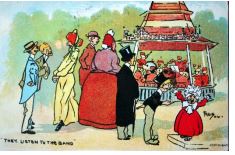
After receiving his art diploma, Ernest is known to have worked in, or for, the art department of the nearby printing company of Percy Lund Humphries (PLH), where he designed souvenir postcards for the Pictorial Postcard Co. to commemorate the Bradford Exhibition of 1904; example below ‘They Listen to the Band’, signed by Aris, dated 1904, and printed by PLH. He also acted as a reporter and illustrator for The Jackdaw, a magazine printed by P L Humphries between 1904-05 to emphasise celebrations of the 1904 Exhibition.
PLH was by this time at the forefront of printing technology and in 1904 had installed one of the first monotype machines in Britain and had become early specialists in the use of half-tone printing. Working for the company would have given Ernest a good working knowledge of printing techniques, as well as developing his business acumen. His time there would have also provided him with a portfolio of work to show other printing and publishing companies.
As with many other young and ambitious graphic designer from the provinces, by 1908/9 Ernest had moved to London and had found work taught art, 1909-12 for the International Correspondence School. During his early years in London, he also attended the Royal College of Art, most likely studying art part-time, whilst pursuing a freelance career as a portrait painter.
He is known to have exhibited at the Royal Academy, the Royal Institute of Painters in Watercolour, the Royal Watercolour Society, and the Royal Society of British Artists. But the irregular nature of a career as a fine artist led him to seek more regular work in commercial art and book illustration.
He was particularly interested in natural history, so sought and found work in this area of illustration. London United Tramways, for example, commissioned a series of posters from him each illustrating a London destination where wildlife could be seen, for example ‘The Kingfisher at Home’ see below.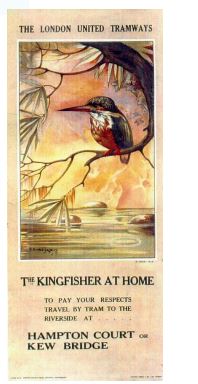
From 1907 onward, he concentrated on book illustration, with a particular emphasis on catching the attention of the reader with attractive cover designs. In 1909 he published his first book: My Very First Book of Animals, published by Hodder & Stoughton, a non-fiction book aimed at children.
Around 1907 onward he had begun to be commissioned to illustrate (and probably write) fictional children’s books and in 1912 he illustrated Dilly Duckling for the prolific children’s author, Mabel Mackintosh.
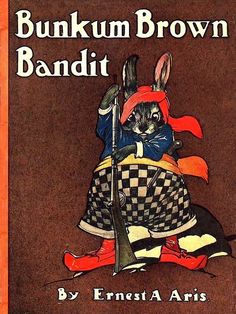
This is regarded as a turning point for Aris (Dawson, 2011), who decided to pursue his own career direction in the field of children’s fiction and illustration, using his own name as author and/or illustrator. Between 1912 and 1925 Ernest concentrated on creating his own books with anthropomorphic animal figures as the central characters (typically see ‘Bunkum Brown Bandit’, 1915, below).
In addition to children’s fiction and illustration, which became the main form of his income, he was also commissioned by a wide range of organisations, including London Transport, to design a wide range of items, including natural history themed posters, cigarette cards, calendars, jig-saw puzzles, board games, as well as illustrated books on the countryside, flora and fauna, and angling, which he enjoyed as a leisure pastime.
This motivation to succeed as both an author and an illustrator was perhaps advanced by his marriage in 1913 to Winifred Archer Ould and the purchase of their home at Oak Avenue, Hornsey, North London, where he lived until his death. Their son, Kenneth, was born in 1917.
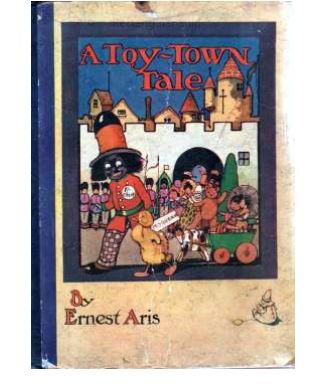
During World War One, Ernest was reluctantly conscripted in 1916 to the Royal Army Medical Corps, serving at the Bacteriological Hospital, Colchester, as a laboratory technician. However, his army service did not prevent him from writing and illustration. For example, he wrote and illustrated A Toy Town Tale, 1917, (below) which reflected wartime themes.
In 1916 he was asked by Beatrix Potter to produce a set of six coloured drawings from sketches she had given him to use in a proposed book, ‘The Oakman’.
Beatrix Potter had always illustrated her own stories, but by this time she had married William Heelis and was combining agricultural work on her smallholding with the demands of her publisher, Frederick Warne & Co., for even more stories. In addition, she was complaining of failing eyesight and stiffening fingers, which led her to seek external help for some of her stories. Warne & Co. had spotted Ernest’s work and sent her examples of it.
Potter was sufficiently impressed enough to write to Ernest, using her married name of Mrs Heelis and sent him pencil sketches of her designs, complete with annotated instructions, including suggested colour choices. However, there was no guidance as to the storyline, so Ernest just had the pencil sketches to work on.
Aris submitted his illustrations for the book, but made suggestions for change to the compositions and commented that Potter’s proposed colour scheme for the characters was, ‘a little on the sombre side’ and that ‘clean, bright colours are ‘essential for children’. This criticism initially did not seem to have bothered Beatrix Potter, but the relationship between the two author/illustrators worsened when Frederick Warne accused Aris of plagiarism – as his latest book, The Treasure Seekers (1916), featured a rabbit called Peter.
Aris claimed in his defence that he had never heard of Potter’s The Tale of Peter Rabbit (1902) and that the name, Peter, he had chosen for his own character was a coincidence. Given Beatrix Potter’s status in the world of children’s fiction by that time, his denial seems rather disingenuous, and she later wrote to him that she considered that his ‘work ‘…has considerable technical facility [but] no originality.’ (Dawson, 2011). To add fuel to the dispute, an American publisher used Ernest’s pictures to illustrate their plagiarised version of Potter’s The Story of a Fierce Bad Rabbit.
The plagiarism allegations would undoubtedly have spread around the confines of the literary world, and it is likely that Aris subsequently damaged his own professional reputation in the short term among his peers. Soon afterwards he is known to have changed publishers and adopted pseudonyms for his own books, including ‘Robin A Hood’ and ‘Dan Crow’ (see below); the ‘Robin Hood’ reference may have had ironic connotations for Aris in relation to the plagiarism accusations!
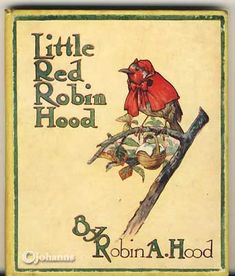
In 1919, after his discharge from army service, Ernest continued his freelance and commissioned illustrations, including work for the children’s author Herman Ould, a cousin of his wife.
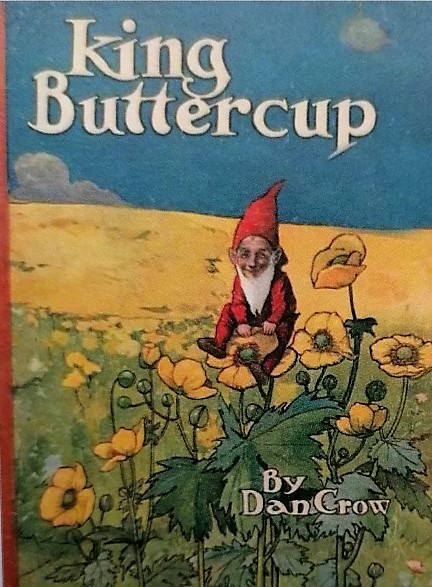
Around 1912 Ernest had created a rabbit character called ‘Tasseltip’ who had appeared in his book, ‘Billie Rabbit‘. ‘Tasseltip’ proved to be a favourite character with children and was to appear in other stories and also featured in a series of 32 hollowcast lead figure made by Britains, the toy company, and known collectively as the ‘Cococubs’ . These were given away by Cadburys of Bournville as a promotion between 1934-39 – over 300,000 children collected the ‘Cococub’ figures during this period.
Cadburys also launched board games, annuals, and other toys with Ernest Aris designs.
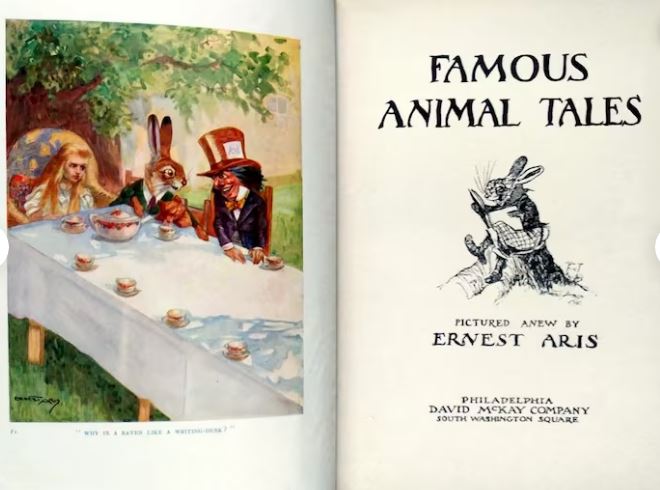
In 1935 he illustrated ‘Famous Animal Tales’, which was a compendium of his own and other authors’ children’s stories, and this is often regarded by bibliophiles as his finest collection of book illustrations.
From around 1926 onward Ernest had been commissioned by Enid Blyton and her publisher, George Newnes, to produce book illustrations, and he also illustrated Blyton’s ‘Sunny Stories Calendar’, in 1946 and again in 1950.
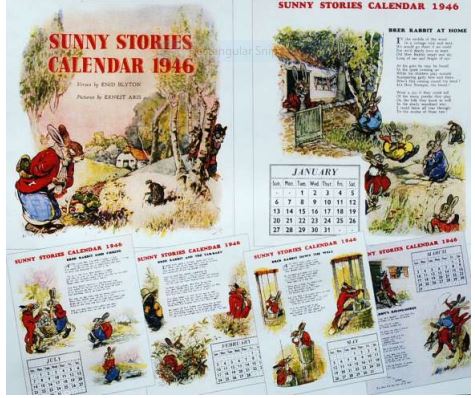
By 1946, Ernest had become profoundly deaf. Becoming rather isolated with his disability, there was a surge of activity from him as he produced more children’s fictional books, along with a range of educational books in his ‘Nature Series’.
In 1953 he suffered a stroke that left him badly disabled and he died aged 80 at his Hornsey home on the 14 April 1963.
Sources
Chignall, D. (Revised version 2021) Ernest Aris: The Man Who Drew for Beatrix Potter. Lulu Publishing.
(With thanks also to Dudley Chignall for additional help re. sources concerning Aris’s time as an art student at Bradford)
Dawson, S. (2011) Ernest Aris. A Lost Legacy … PhD Thesis, Cardiff University. Online at https://orca.cardiff.ac.uk/id/eprint/19515 Accessed 1 Nov 2022.
V&A (2015). Collections: Illustrations to The Oakman’ Available online at https://collections.vam.ac.uk/item/O1315682/illustration-to-the-oakmen-drawing-ernest-aris/ Accessed 2022.
Images: see the Dawson source, above.