

The poster designer, Eric Lombers (1914 – 1978) B.E.M., was born in Lancashire but lived in Bradford from 1946, where he taught lettering and graphic design at Bradford School of Art until his death.
He was born in Worsley, near Salford, to parents, George Lombers, a Chartered Accounts Clerk, and his mother, Mary. His birth name was registered as George Eric Lombers, but later preferred to use his middle name or initial to sign his artwork. Eric studied commercial art at Salford School of Art, where he met fellow student, Tom Eckersley, and with whom he formed a long-term creative friendship and design partnership.
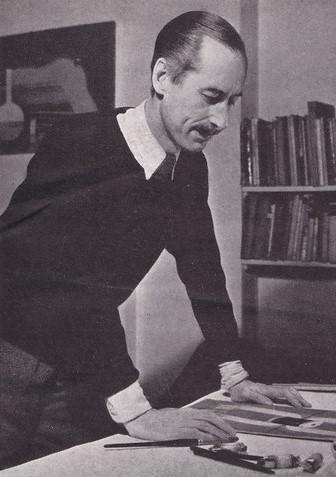 Eckersley, (pictured right) in later years, recalled how the two of them would push their tables together at the art school to work on joint poster projects inspired by the latest designs from Edward McKnight Kauffer and A.M. Cassandre (Bowness, 2020).
Both men displayed exceptional talent from the start, with Eric Lombers winning the School’s Heywood Medal in 1932-33, and with Tom Eckersley winning it the following year.
Eric also won £21 prize money for his 1933 entry in the Royal Society of Arts competition for Industrial Design, judged by Tom Purvis – one of the country’s leading poster artists.
In 1934, encouraged by the Principal of Salford School of Art, Harold Rhodes, an active member of the Design in Industries Association, the two artists moved to London to seek freelance work.
The pair rented a studio in Ebury Street in the West End, but struggled at first to find poster design commissions, with agencies rejecting ‘their type of work’ (Bowness, 2020). They eventually settled for newspaper illustration commissions, including for the News Chronicle, Daily Mirror, Draper’s Record, and Man and His Clothes (magazine). They also created advertising for the Nickeloid Electrotype Company.
However, in 1935, determined to find poster design commissions, they wrote to Frank Pick, by this time the Managing Director of London Transport, requesting a meeting; Pick and his colleagues had by this time carved a reputation for engaging talented young artists to create eye-catching travel poster designs.
Eric and Tom were subsequently invited to submit samples of their work for consideration. Their work was seen and favoured by Pick’s Head of Publicity, Christian Barman, who commissioned them to produce a poster promoting London Zoo, which was accepted and published (see below).
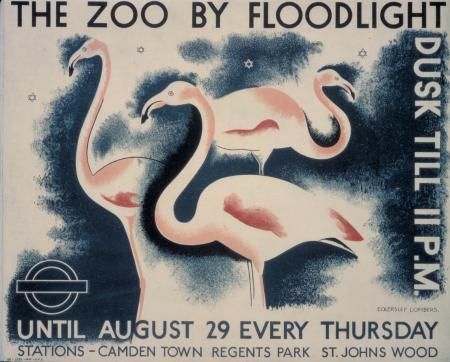
Image: London Transport Museum
Barman was a creative force at London Transport and recognised the talent of the two young northern artists. This led to a succession of commissions for London Transport, including leaflets, press advertising – and posters, many of which drew praise from the public and both the general and specialist art press. For example, their bus travel poster, By Bus to the Pictures To-night (1935), shown below, gained particular praise for its technical innovation and contemporary approach to the subject matter.

Image: London Transport Museum
Their success with London Transport led to other commissions, notably from Shell-Mex, BP, the GPO, and the BBC. The clothing retailer, Austin Reed, also commissioned them to produce posters for display on London Transport underground stations and elsewhere.
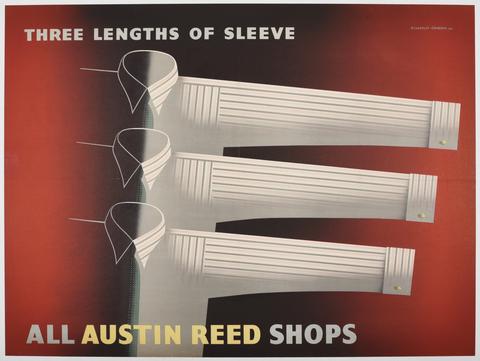
Three Lengths of Sleeve, Austin Reed, 1940
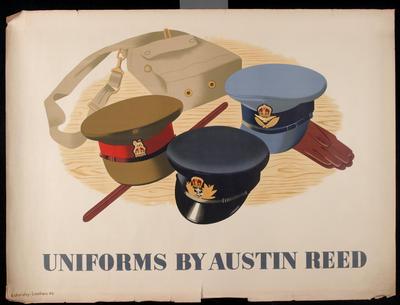
Uniforms by Austin Reed, 1940
The Lombers and Eckersley ‘brand’ became a distinctive and recognisable style in the British commercial art world of the 1930s. In addition to posters, they were also commissioned for a range of other forms of commercial advertising, including brochure and magazine illustration, and, occasionally, window displays. Between 1935 and 1941, examples of their work also appeared in Commercial Art and Modern Publicity, as well as the German design magazines Graphis and Gebrauchsgraphik. They were, as Commercial Art had noted in 1935, “young designers full of promise.” (Bowness, 2020). From 1937, both artists also taught poster design part-time at the Westminster School of Art.
By the late 1930s, their reputation had advanced to the point where the artwork of both were featured in Tom Purvis’ Poster Progress (1937), and Austin Cooper’s Making a Poster (1938), both books published by The Studio Ltd.
In 1939, and with the start of the Second World War, the two artists went in different military directions. Tom Eckersley originally joined the Royal Air Force as a cartographer, before being transferred to the Publicity Section of the Air Ministry. Eric Lombers enlisted as a Sapper in the Royal Engineers as a military cartographer. In 1940, whilst in service, he married Marjorie Bower, a teacher, at Clayton Parish Church, in Marjorie’s home city, Bradford.
He served as a cartographer in North Africa, Malta, and Italy. He was awarded the British Empire Medal in 1945 for meritorious service while employed as a draughtsman in General Staff, Operations HQ in Italy during 1944 and 1945. His devotion to duty in maintaining and improving the many sets of maps required by the Command was an important contribution to the success of the campaign. The citation for the award noted that ‘…his foresight, resourcefulness, industry, reliability, and unfailing cheerfulness under heavy strain were invariably an important contribution to the efficiency of the headquarters’.
After the war ended, the two artists came back together for a while to work on posters for RoSPA, GPO, and Ministry of Food (see example below). Tom Eckersley had also married by this time and he and his wife, Daisy, shared a house briefly in Wandsworth, London, with Eric and Marjorie before both couples went their own ways.

Image: Science Museum
Reference
Bownes, D. (2020) Eckersley – Lombers Poster Partnership 1934-1946. Available online at https://posterhouse.org/blog/eckersley-lombers-poster-partnership-1934-1946/ Accessed 2 October 2022.
(For a more detailed description of the Eckersley – Lombers working relations, see above source)