
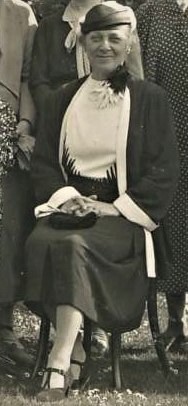
Image: by courtesy of Jennifer Weatherhead
The artist, Ethel May Mallinson (1878 – 1970) lived for over 50 years in Ilkley. Her watercolours were characterised by their fluidity, impressionist style and subtle colouring.
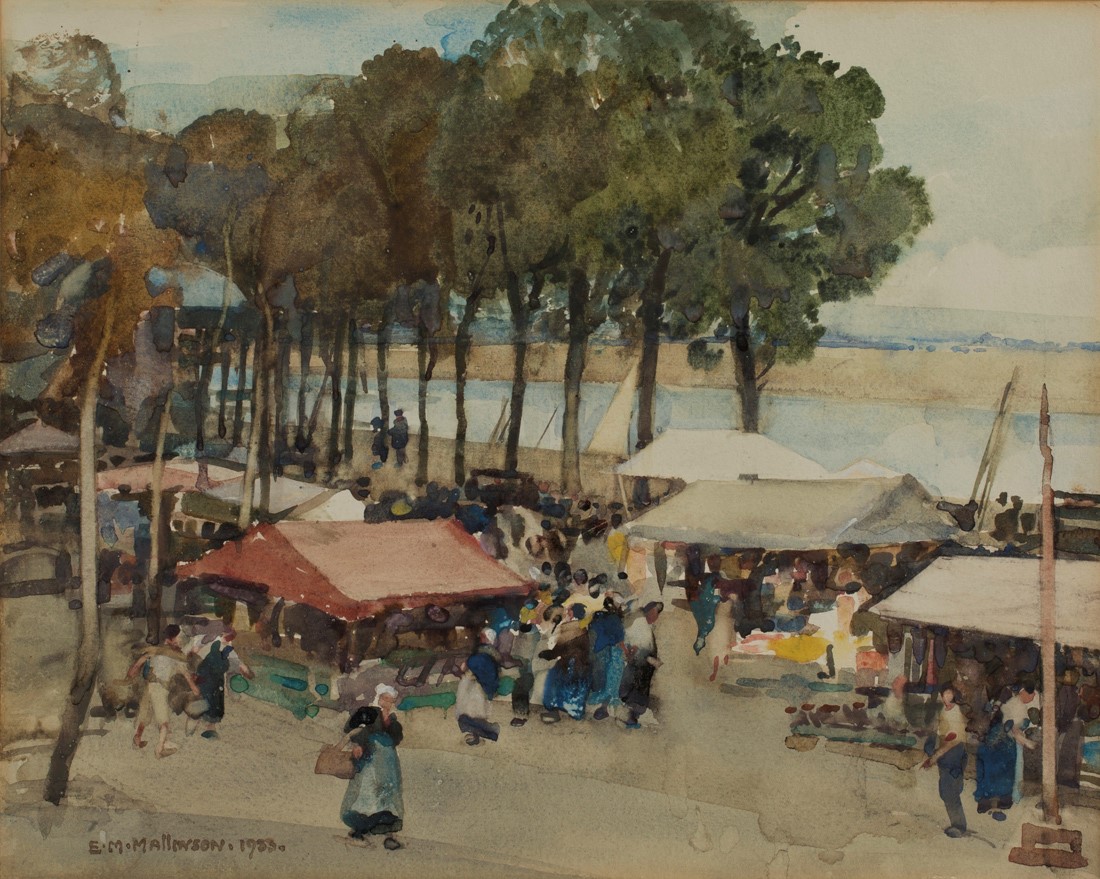
Dutch Market Scene (1933). Image: in a private collection.
Ethel was born in Potternewton, Leeds, the second of four children to parents, William and Jessie. William Arthur Mallinson was a partner in the woollen cloth manufacturers, Thomas Pratt & Sons, of Yeadon, and Scottish-born Jessie Nicoll (nee Smith), was originally from Dundee. The family moved to Ilkley around 1892.
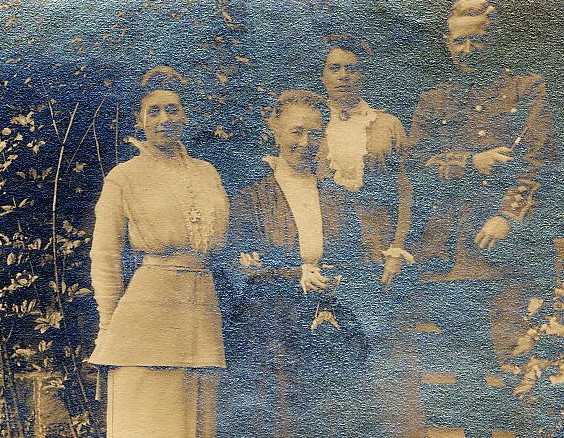
Ethel Mallinson, left, and other family members. Photograph by courtesy of Anthea Boylston.
The family were struck by double tragedy, first when William Mallinson in 1893 was found dead, aged 44, in the London Midland Railway Hotel, London; the London Coroner recorded a verdict of suicide, ‘whilst of unsound mind’. Then, in 1916, Ethel’s younger brother Eric, a Lieutenant in the Duke of Wellingtons Regiment, was killed on the Somme during WW1.
After William’s death, Jessie, and the children moved home to take up residence at Middleton Villas, Ilkley, where Jessie lived until her 100th year. Ethel studied at the Leeds School of Art, and her obituary in 1970 noted that she had also spent a period of time in Paris studying art.
Ethel became good friends to (Jessie) Beatrice Kitson, who was active in local public service. Beatrice Kitson was a member of the prominent Kitson family in Leeds, with a long history of engineering and manufacturing in the city, and Ethel was a frequent visitor to Elmet Hall, Roundhay, the Kitson family home. In mid-life, Beatrice Kitson became a Leeds Magistrate, a Poor Law Guardian, and during WW2 was elected Lord Mayor of Leeds, the first woman to be appointed to this post.
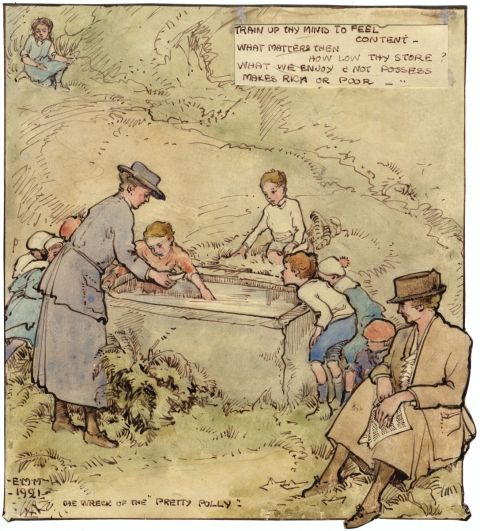
‘Children in Yorkshire Countryside’, 1921. Image: in a private collection.
Ethel and Beatrice both shared humanitarian interests and would accompanied Leeds city children out on trips to Bolton Abbey or Ilkley, where Ethel would also sketch the children at play.
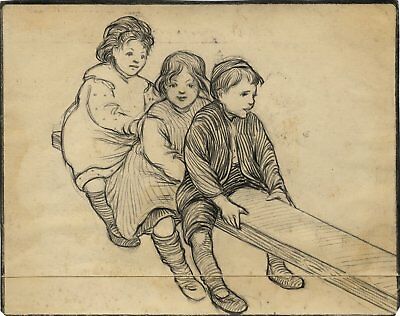
Children on a seesaw by Ethel Mallinson. Image: in a private collection.
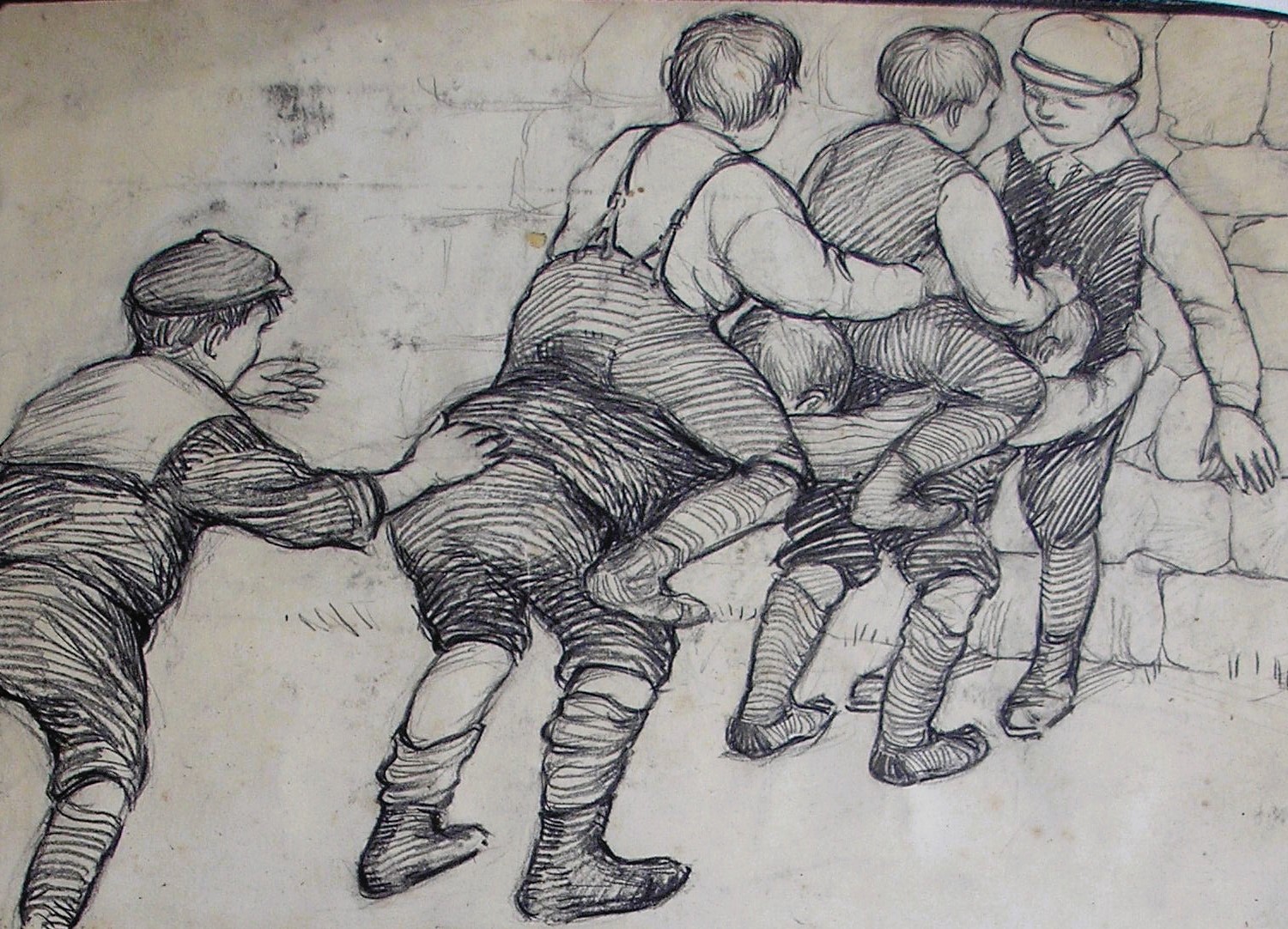
Ethel Mallinson sketch by courtesy of Anthea Boylston.
In the first decades of the 20th century, the two friends also travelled widely, often by bicycle, touring England and Scotland, as well as journeying abroad across Belgium, Italy and North Africa. Ethel recorded their travels in her sketchbooks (see example below), and Beatrice later observed (see sources below ) that Ethel’s companionship:
…Taught me to see things to which I had hitherto been blind: the wonderful gradations of shade and colour, mass and outline. I believe that those who are not artists need to be taught to see just as much as being taught to sing.
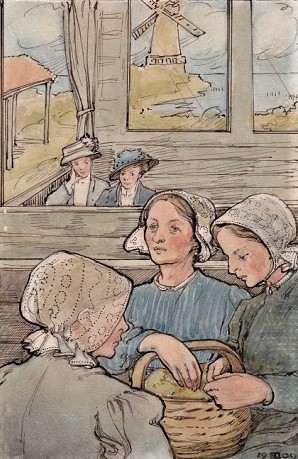
Ethel & Beatrice on train in Flanders. Image: in a private collection.
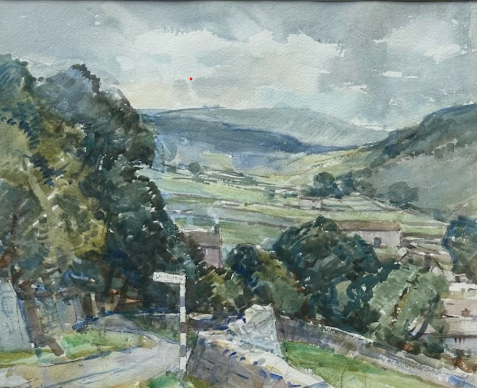
Yorkshire Dales. Road to Leyburn. Image: in a private collection
In addition to land and townscape scenes, Ethel’s work, in the early 20th century, also reflected the turbulent political and social upheavals of the period. These included her watercolour of a wise owl (in a woman’s bonnet) reading the 1909 Beveridge report on unemployment, and a collage featuring civilian protest and military images (see below).
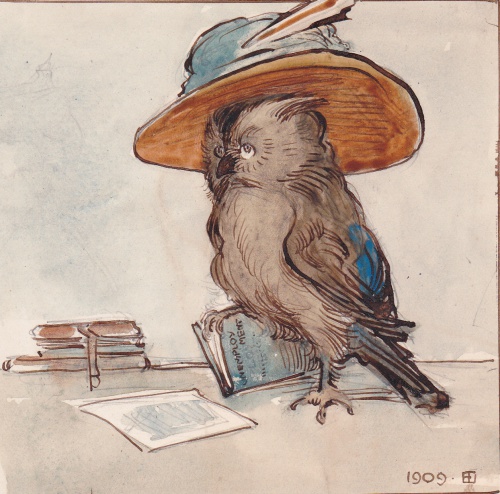
Images: in private collections

From around 1898 onward, Ethel exhibited her artwork both regionally and nationally. She was a member of the Leeds Fine Art Society, and was its Secretary for 40 years, from 1908 to 1948. Her watercolours were also exhibited widely, particularly at Scottish shows of the Royal Glasgow Institute of Fine Art, Royal Scottish Academy, and Royal Scottish Academy of Painters in Watercolour.
She was also a member of the Yorkshire Union of Artists, and of the Ilkley Art Club, exhibiting watercolours at their regional shows. Her work was also featured at the Yorkshire Artists Exhibition, 1951, at the Heal’s Gallery, London.
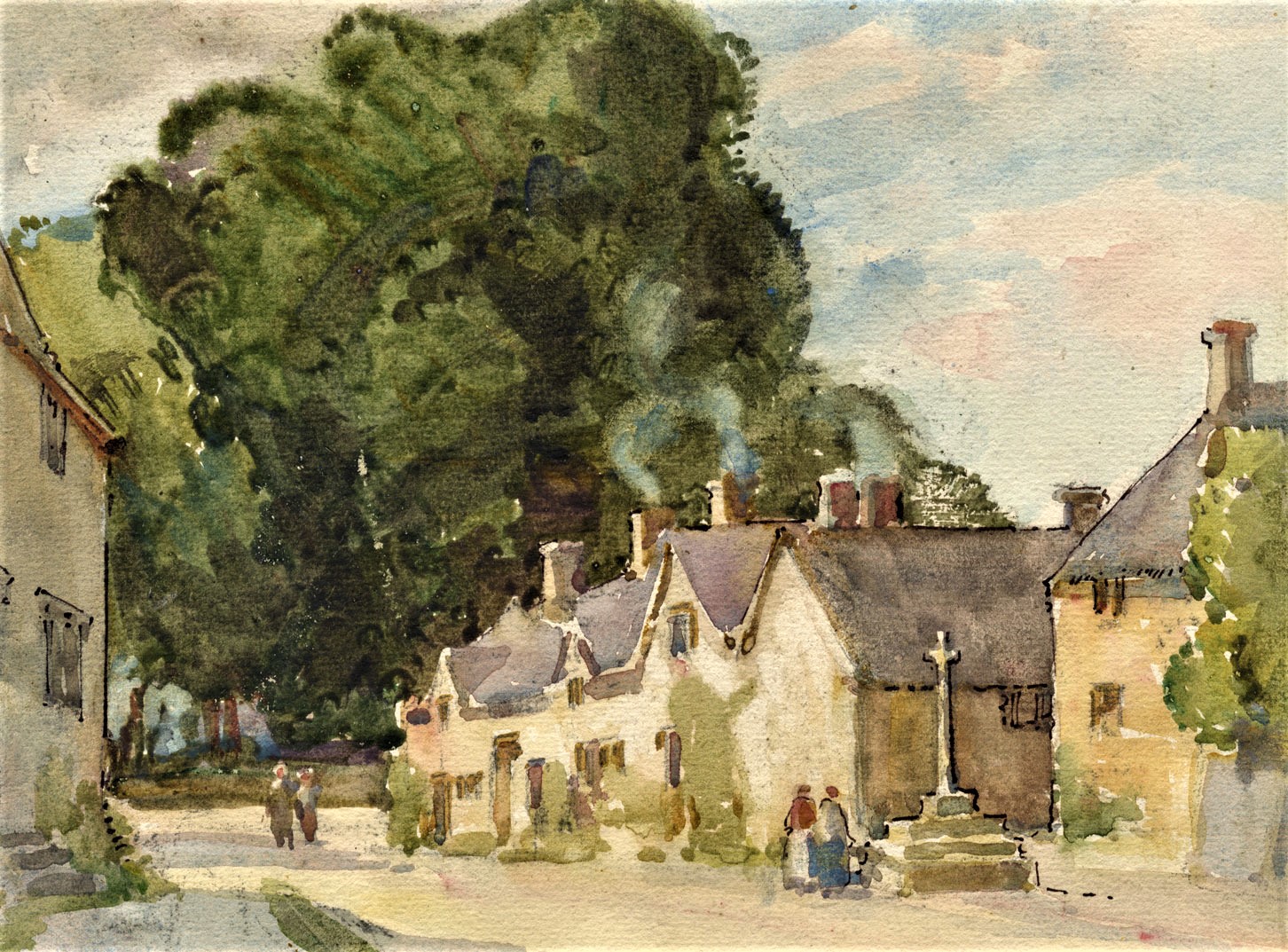
Village, with Stone Cross, circa 1920. Image: in a private collection.
Herbert Thompson, the music and art critic of the Yorkshire Post (1856-1945), wrote in 1927 that Ethel:
…Unites the freedom of a sketch with the carefully planned design of a considered composition; everything in it is absolutely right, yet it has the sense of spontaneity that is one of the greatest charms in watercolour … [Her] brilliantly clever drawings’ show an inborn sense of form which makes her hastiest draughtsmanship expressive.
Ethel’s friendship with Beatrice Kitson, and her links with the Ilkley Art Club and Leeds Fine Art Society, brought her into contact with many Bradford district artists, including Frank Suddards, and Gertrude Priestman, as well as other regional artists, such as Jacob Kramer and Ina Kitson Clark. At Leeds Fine Arts Society she also exhibited alongside Robert Hawthorn Kitson (1873-1947), the brother of Beatrice and himself a watercolour artist, and an old friend and patron of the artist, Frank Brangwyn.
Ethel lived at the family home in Ilkley until her mother, Jessie, died in 1948. By this time her sister Hilda had married and moved south to Tunbridge Wells. Ethel joined her sister in Kent, moving to live in Tonbridge. In Tonbridge, she continued to paint, and after her death in 1970 a leader writer in the Kent and Sussex Courier arts critic, ‘M.S.’ noted that Ethel was ‘gay and spirited in outlook, and these qualities are shown in her work’ and that she:
… Was familiar with her upright, Victorian and immaculate figure, painting in the streets with complete concentration and making watercolours of a disappearing Tonbridge, which will remain valuable records, as well as paintings of distinction … Her delight in painting and complete indifference to criticism sometimes led people to underestimate her considerable talent.
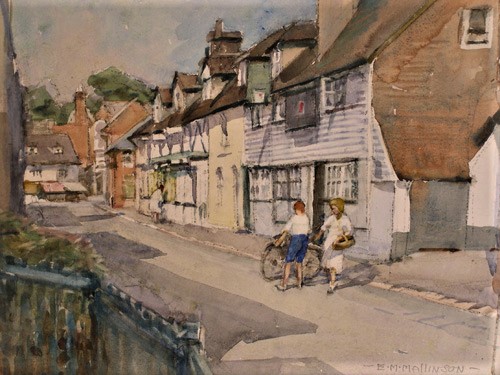
Street Scene, Kent. Image: In a private collection.
In July 1970, a few months after Ethel’s death, there was a display of her artwork by the Tonbridge Theatre and Arts Club at the Old Library, Tonbridge School . It covered the 20 years of Ethel’s paintings whilst resident in the town and included scenes of old Tonbridge, flower paintings, as well as landscapes of Italy, Kent, Sussex – and Yorkshire.
*
Sources:
Anthea Boylston (2018) Auntie B’s War. The Life of Leeds’ First Female Mayor. ISBN- 13: 978-1727081107
and/or: Phelps Ancestry at phelps-ancestry.co.uk