

Alexander Keighley. Photo: British Library
Alex Keighley (1861 – 1947) the son of Joseph Keighley, a wealthy worsted manufacturer, was a pioneer in the pictorial movement in photography. He was born at Flosh House, Spring Gardens Lane in the town that carried his name, and the family later moved to Steeton High Hall, near Keighley in 1897.
Alex initially attended a local Dame School, but at 13 continued his studies at the Keighley Trade and Grammar School, later to be known as the Mechanics Institute. There was a emphasis on science and practical skills at the school, and Alex, who showed a particular interest in biology, was offered a scholarship to continue his science studies at the School of Mines (later the Royal College of Science) in London.
He had originally aspired to study medicine, but his father recalled him from his studies in London to work in the family firm at Coney Lane, Keighley. He started on the shop floor and worked his way around the different sections of the factory; he stayed with the family firm for 46 years until 1923, when, aged 62, he could devote all his retirement energies to photography.
His involvement with photography developed parallel to his work with the family firm and arose from his interest in nature. He became a member of the Yorkshire Naturalists’ Union, where he was introduced to photography as a way of recording landscape and the environment. He bought himself a complete photography outfit and installed a darkroom in his home.
From an early age he had sketched and painted landscape, so photography linked well with his inclinations toward nature and art. On trade trips to the Bradford Wool Exchange, Alex would often visit the city art gallery and he became a member of the Bradford Photographic Society.
As a young amateur photographer, Keighley was significantly influenced by the work and writings of Henry Peach Robinson, who often combined up to nine negatives in one print to produce the right effect. The overall aim of ‘Pictorial’ photographers, as they were called, at this time was to lift photography from the realms of the technical into the artistic to make it an art form to rival painting. Keighley often enlarged his negatives, working on the detail at each stage, such as softening natural lighting, and using pastel, chalk or pencil on the negatives to produce the desired effect. He would often build a print from multiple negatives, combining these to produce a pleasing artistic impression.
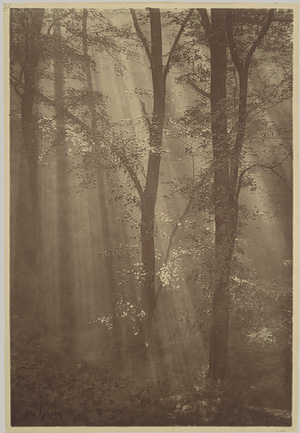
‘The Dayspring from On High’ (1917). Image: Heibrunn Timeline of Art History. Depicts Clough Wood on the slopes above the Steeton home of the artist.
In 1887 Alex submitted a set of 12 prints to a competition organised by the journal, ‘The Amateur Photographer’ – and won. This stimulated his interest and in 1889 he formed the Keighley and District Photographic Association with the aim of extolling nature in an impressionistic way.

‘Fantasy’ (1913). Image: Ray Vintner; see source below
Keighley travelled around the district on photographic excursions to beauty spots with fellow members of the Association preparing a body of prints for exhibitions and in 1889 he submitted four prints, which were accepted for display by The Photographic Society. This led him to become invited to join the ‘Linked Ring’, a group of Pictorialist photographers who adhered to atmospheric artistic arrangements and asymmetrical compositions. He also travelled further afield and it is said that on a trip to Marrakech he disguised his camera as a brown parcel so he could photograph local people unobtrusively.
The years 1900 to 1910 were particularly significant for him in terms of recognition.

‘The Melon Stall’ (1907). Image: Ray Vintner; see source below.
He exhibited his work widely in Britain and in salons across Europe and America and was an important figure behind the formation of the Yorkshire Photographic Union, the first federation of regional societies in England. In 1911 he became a Fellow of the Royal Photographic Society and later, in 1924, was awarded Honorary RPS Fellowship. He was also twice awarded the Prix d’Honneur of the International Salon of Photographers and in his lifetime was elected by American photographers as ‘World Pictorial Photographer No. 1’.
In 1943, at the Diamond Jubilee Exhibition organised by the Yorkshire Photographic Union, around 150 of his photographs were displayed, including many scenes close to his Steeton home. In addition to photography, Alex Keighley was also a proficient pastel painter and exhibited landscape scenes, particularly of the Yorkshire Dales, with the Bradford Art Club
Examples of his photographs are exhibited at Cliffe Castle, Keighley and examples can easily be found online or in the books featured below.
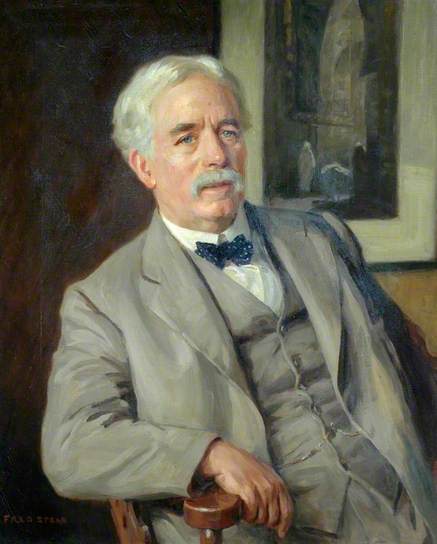
Portrait of Alex Keighley by Frederick Stead. Image: Bradford Museums & Galleries
Alex Keighley died in 1947, aged 86, and is buried in Steeton Cemetery, next to the wall of his home at High Hall. He is buried alongside his wife, Lily, who died in 1924, aged 46.

Biographies
A biography of his life, with examples of his work, was published in 1947 by the RPS Historical Group: ‘Alex Keighley, artist and photographer: 1883-1947’, by J.L. Hankey and J. Dudley Johnston.
In 2013 a more extensive biography by the artist, Ray Vintner, was published: ‘Alex Keighley. A Pioneer of the Pictorial Movement in Photography’, published by Linkhall Productions, 2013. ISBN 9780992740207