

G.E. Brumfitt, 1944/45. Picture source: Brumfitt family tree, Geni Heritage Site.
Artist, teacher and musician, George Edward Brumfitt (1917-1993) was born in Bradford, the son of Fred and Pauline (nee Aspinall). The family later moved to Windhill, near Shipley, and George showed an early talent for both visual art and music. He attended the Salts School and was a member of the Bradford Cathedral choir and played the cello to a high standard in a local orchestra.
He initially studied art at the Shipley School of Art, gaining 1st class passes with distinction in drawing. From Shipley he was then admitted to study at an advanced level at the Royal College of Art in London. It was reported that his ‘modernistic’ paintings were used to decorate the walls of a dance at Shipley Technical School in 1935 (Shipley Times 9 March 1935) and later two of his paintings from this period were exhibited respectively at the Spring Art Exhibitions, 1938 and 1939, at the Cartwright Hall, Bradford.
In London, in addition to his art studies, he joined the London Junior Orchestra as a cellist. The London Junior Orchestra brought together amateur young musicians who had played in school and other local orchestras and whose professions or studies had drawn them to London. It gave the amateur musicians an opportunity to develop their collective and individual talents in the capital. After WW2 he played with the George Melachrino String Orchestra, who regularly broadcast on the BBC.
In 1939 at the start of World War Two, George left the Royal College and joined the Ministry of Home Security’s Camouflage Directorate to become a camouflage artist, and was registered in the the 1939 census as boarding in a house in Stamford, Lincolnshire, most likely working on camouflage for Army and RAF bases in the area. From 1940 he served in the army, at first in in the ranks, but in 1944 was commissioned as a Second Lieutenant in the East Yorkshire Regiment (Duke oy York’s Own).
After his army discharge in 1946, George developed his own art career, both in teaching and with his own painting. In 1946 he was appointed as head of painting at the Blackpool School of Art and in 1947 he married Margaret Taylor, from Barnsley, and they had three sons, and a daughter.
A former art student, David Midgley, of Blackpool, remembers George Brumfitt as being a committed and talented teacher. He writes:
‘Mr Brumfitt taught me a lot about observation. I have still kept a small sketch of the back of a leg and Mr Brumfitt’s explanations about figure drawing helped me greatly in my understanding of depicting the body.’ (History of Blackpool Facebook Group 1/5/22).
Another art student at that time was Harry Colledge, who was also taught by George (Ted) Brumfitt:
Ted was a brilliant teacher, typically northern, forthright , full of a dry humour and an understanding of all his students that was remarkable. He had no enemies and was respected by all as someone who knew what he was talking about, somebody who was a consummate professional.
Ted was a well informed man, intellectual, his knowledge of art history and painting techniques was quite prodigious, he taught us to grind our own oil paints from basic colours as well as the more normal canvas and other supports preparation … He was an avid reader introducing us teenagers to Lewis Mumford amongst other writers we would probably never hear of.
I could go on for ever about him, he had a profound influence for good on my life, a truly remarkable man. (Harry Colledge, via History of Blackpool Facebook Group.)
George Brumfitt was also one of nine artists who had their work featured at Batley Art Gallery in a ‘Northern Group of Painters’ exhibition in 1951.
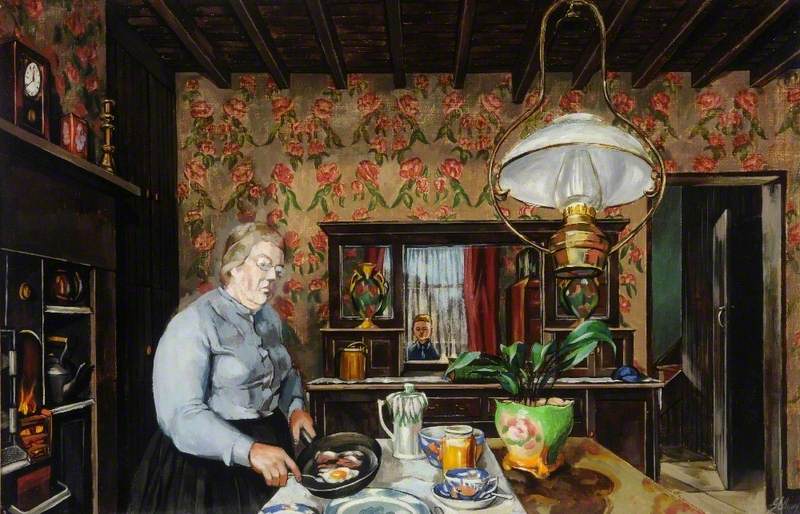
‘Things Past’. Image: Heritage Doncaster

Aunty Hilda Washing. Image: Heritage Doncaster
George worked at Blackpool until 1964, when he was appointed as Principal of the Doncaster School of Art (later the Doncaster College of Art). He stayed in this post until his retirement in 1976.
In the early 1970s George painted a series of ‘Things Past’ interior domestic scenes, each recalling a local childhood memory. One of these was later featured in a Royal Academy Summer Exhibition in 1981, and a collection of the ‘Things Past’ series was later donated by him in 1984 to the Doncaster Art Gallery, where a number were exhibited during September and October, 1986. Three examples of the ‘Things Past’ series are shown above and below, but others in the series can be viewed at the Art UK website: Art UK
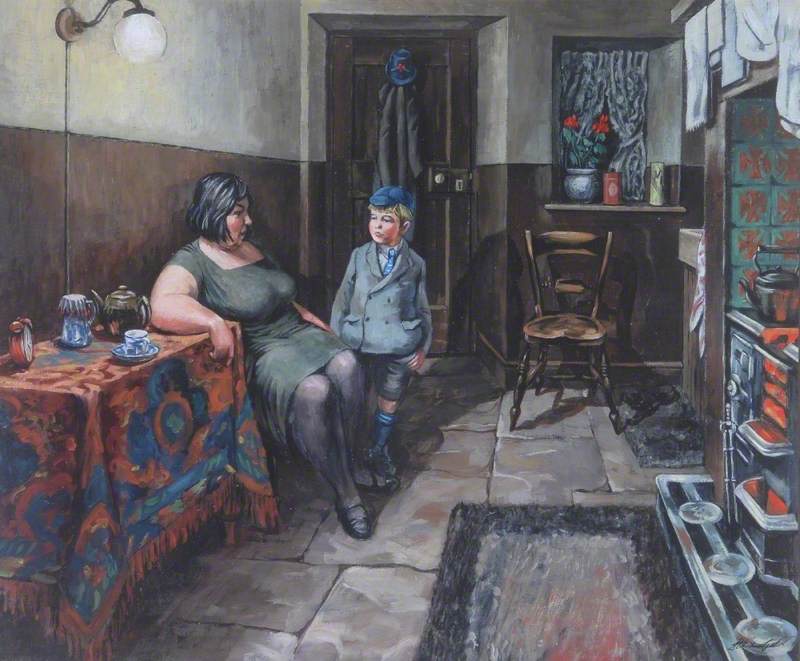
‘Hilda’s Warning: ‘Mind you’re in by half-past seven, it’s bath night’. Image: Heritage Doncaster
When he was first appointed at Doncaster, the School was confined to small premises in Dockin Hill Road, Doncaster, with only 400 students. However, under his guidance and management the range of courses developed and the student numbers increased over time to 1,800. The School also expanded physically, gradually taking over the former technical college in St George Gate until the School of Art occupied both buildings. At his retirement, George drew praise from senior colleagues for his ‘outstanding’ contribution to art education both locally and regionally in the town during his tenure at the college.
Just prior to his retirement, George and a colleague, Eric Platt, staged a joint exhibition at the College of their artwork, titled ‘People, Things and Places’. This was partly to showcase their own respective artwork talents, as well as to highlight the differences in art training and education between the 1930s and the 1970s – and particularly the emphasis given to life drawing in pre-WW2 art education.
After his retirement in 1976, George moved to live at Thornton-le-Dale in North Yorkshire, where he continued to paint, particularly Dales landscape scenes. He died in Sheffield in 1993.
*
(With thanks to researcher, Colin Coates, Saltaire Village Website, and Neil McGregor, Assistant Manager, Heritage Doncaster for their generous help in compiling this profile of the artist, along with contributors from the History of Blackpool Facebook Group, particularly Harry Colledge and David Midgley)