

Richard Franz Bayer (1901-1990) was a painter, illustrator, and teacher at Bradford Grammar School.
Richard was born in Vienna. His father, Richard Wagner, died before he was born, and before he married, so he was given his mother’s name, Bayer. His mother died when he was a child of three, so he was sent to live with a grandfather. After his grandfather died, Richard, aged 15, then lived with an uncle and his family.
After his school education, he studied art, advanced teaching methods and psychology in Austria. He subsequently taught in classes experimenting with art in primary education and worked with Professor F.Cizek, a pioneer in art education, and contributed articles to the International Journal of Psychology.
In the years leading to the start of WW2, he became politically active in Austria. Richard’s political newspaper cartoons led him into conflict with the right-wing government. He addressed secret anti-Nazi meetings, joined protest marches, and took charge of 4,000 young people, members of the Social Democratic youth movement.
When Hitler annexed Austria, Richard lost his teaching job and faced arrest and imprisonment. His wife, Frances, and their daughter, Lise Lotte, had earlier fled to England and, with the help of the Quaker Movement, Richard escaped the country in 1939 only a month before war was declared with Britain. He later said that he was carrying a pistol in case of interception, the first 5 bullets were intended for the Nazis, the last one for himself.
He was reunited with his wife and daughter in the UK, with the intention of sailing to the USA. But by that time, the last passenger ship to the USA had sailed, so they stayed in the UK.
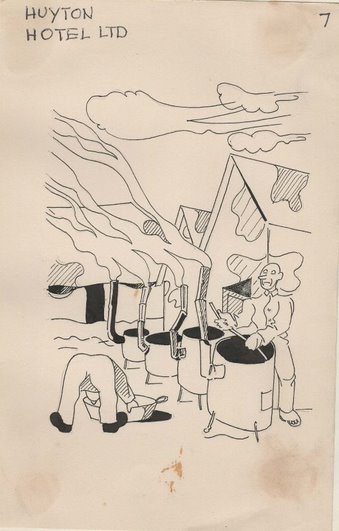
Richard initially found work teaching at a school in Hertfordshire, but as this was in a Protected Area (security sensitive) he was detained and interned at Huyton Camp, near Liverpool as a possible ‘dangerous alien’. Here, Richard turned his artistic skills to good use, designing satirical postcards about camp life, as well as political comment about the war (see examples below, by courtesy of the Bayer family). He produced over 70 cartoons, which were copied and resulted in over 5,000 postcards, used by the detainees for communication or as a record of their confinement. Richard’s son, Paul, said of his father’s cartoons:
The cartoons were mostly black and white and formed a catalogue from which other detainees could choose. My father would then take orders, produce the pen outline and then other inmates would colour them. A bit of a cottage industry in unusual surroundings.


After a few months, his loyalty to Britain established, Richard left Liverpool and made for London, where he worked as a sign-writer, including painting huge posters for the cinema industry. However, he applied for teaching work and in 1941 took up a teaching post at Bradford Grammar School, as art master, where he stayed until 1966.
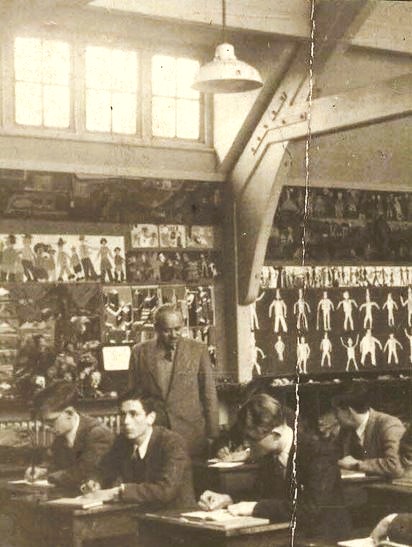
Richard Bayer in the art room at Bradford Grammar School. Image by courtesy of the Bayer family.
During this period David Hockney was a pupil and Richard became Hockney’s tutor, mentor and lifelong friend. In latter life, Richard recalled he was able to write ‘Very Good’ on Hockney’s pre-GCE art report! He said of Hockney’s time at the school (Bradford ‘Telegraph & Argus’, 21/01/1981):
He was an excellent cartoonist, but he didn’t bother about other subjects. All he wanted to do was to study in the art group. But for his GCE examinations he buckled down and did quite well.
Richard and his family lived at 21 Fairway, Shipley, and in 1943 he became secretary of the International Centre in Bradford, a social club to help refugees assimilate into Yorkshire life. His daughter, Lise, also became an artist and teacher.
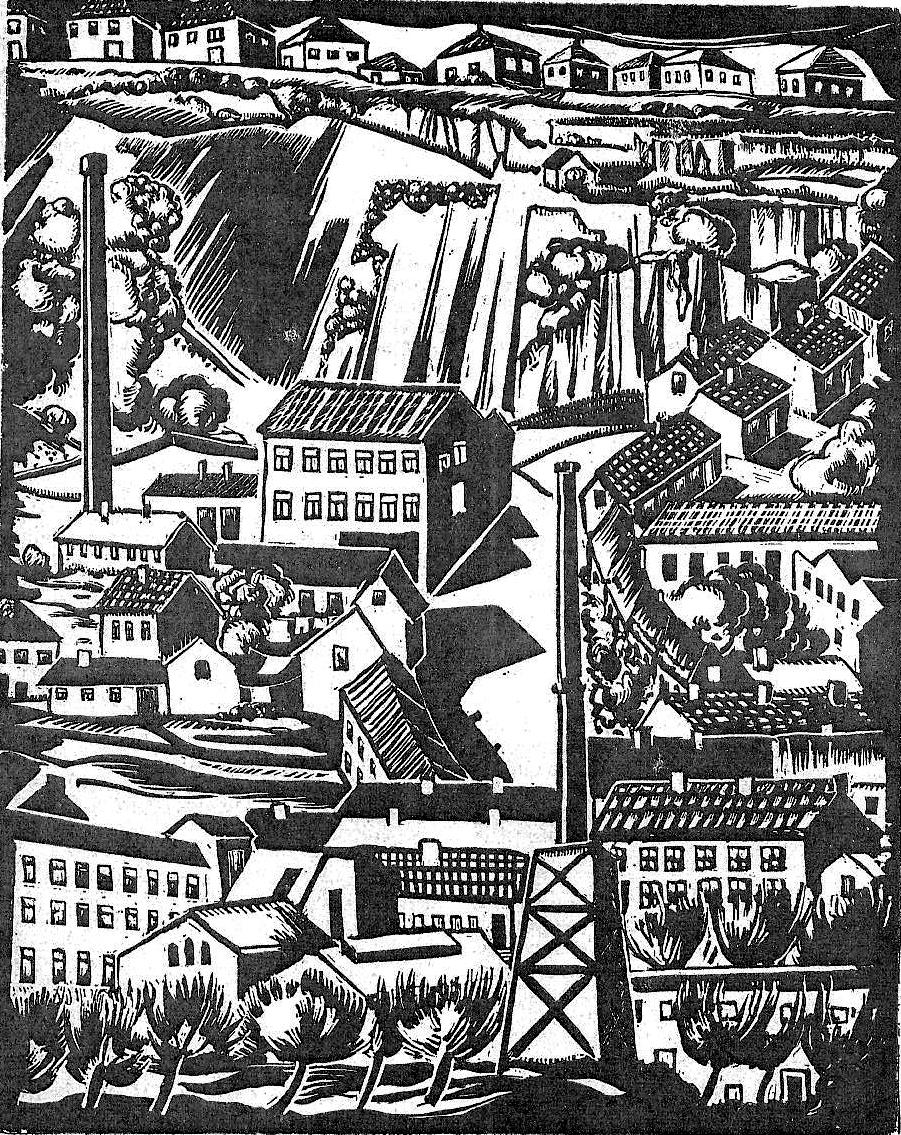
Wrose Hill, from Bradford Road, Frizinghall. Image: The Dalesman.
He was a member of the Bradford Arts Club from 1943 to 1962 and was the founder member of the Shipley Arts Club.
Richard’s first wife wife, Frances, died in the 1950s and Richard later remarried, and his wife, Barbara (née Constantine) raised two sons, Paul and Peter. The family moved to Menston, where Richard became a founder member of the Menston Arts Club, its first President, and later its Vice-Chairman and an Honorary Member.

‘Whitby’. Image: The Dalesman.

‘Knaresborough’. Image: by courtesy of the Bayer family
He painted in oils, gauche, watercolours and acrylics and also worked in ceramics, scraperboard, lino-cutting and silhouette-cutting. He had been inspired to take up this latter skill after a meeting Lottie Reineiger, a creator of animated silhouette films. He said:
I took it up commercially at art shows … and it has proved very popular. They don’t take long – about two minutes. On one occasion I did silhouettes on the stage of the Bingley Playhouse.


(Examples above of Richard Bayer’s silhouette cutting, by courtesy of the Bayer family.)
Richard’s paintings were exhibited locally, including a solo show at Bradford Central Library, 1972. His scraperboard illustrations also featured in the Dalesman magazine.
An exhibition of the full range of his artwork, including postcards he had made during his period of detention, was held at Kirklands in Menston, 1981, to mark his 80th birthday and Richard’s long association with the Menston Arts Club.

View of Bradford. Image: The Dalesman.
The following image, by courtesy of the Bayer family, shows an artwork collage by Richard illustrating features of his life, including images of Bradford City Hall, Bradford Grammar School, and a silhouette of himself alongside an archetypal Yorkshire flat-capper! Also shown are the Cow and Calf Rocks on Ilkley Moor – one of his favourite subjects – and close to where his ashes, and those of his second wife, Barbara, were scattered.

(With thanks to Richard’s son, Paul Bayer and family, for their help with the biographical detail and provision of images for this profile.)