

Foxhounds by Wright Barker. In a private collection.
(Wright Barker’s headstone at Harrogate Cemetery gives Wright Barker’s birth year as 1865, but historian, Dr. Paul Jennings, who has researched the Barker family, has established that the birth year was 1863).
Wright Barker (1863 – 1941) started his early working life as a weft worker in a local worsted textile mill, but by 1891 had established himself as an artist successful enough to exhibit a painting at a Royal Academy show. His animal studies paintings are still popular today.
He was born at Great Horton, Bradford, and lived with his family, initially at Bartle Square, then at nearby Falcon Street. His parents, father, Benjamin, and mother, Lydia, both worked in the local textile industry; Benjamin had a supervisory position as an overlooker. The 1881 census records Wright as himself working in the weft room of a worsted mill, but in 1885 Wright left Bradford, and the 1891 census records him as living in lodgings at Edwinstowe, Nottinghamshire, and his profession is recorded as ‘artist’.
It is unclear where, or how, he learned to paint professionally, and to such a high standard. However, his Bradford home was in walking distance of the Bradford Art School, so it is possible he initially attended classes there.
A newspaper obituary following the artist’s death in 1941 reported that Wright had started painting whilst in Bradford and had became an early member of the Bradford Art Guild, and exhibited three artworks at the Guild’s first show in Bradford in 1884. It also reported that Barker had studied art at some point in his career at the Académie Julian in Paris, and that he had exhibited work at the Paris Salon on several occasions. The same obituary also noted that Wright in his heyday had painted animal portraits for the Duke and Duchess of Portland, Lord Barnby of Blyth, Nottinghamshire, and also for the Duke of Peñaranda, of Spain (Yorkshire Post & Leeds Intelligence, 11/03/1941).
(Any additional information as to why Wright Barker left the Bradford area to live in the East Midlands would be welcomed)
In 1891 he first exhibited work, ‘In Forest’s Depths Unseen‘, with the Royal Academy and continued to exhibit work at Royal Academy shows until the mid 1930s.
In 1892 he married Ellen Mary (nee Alcock), farmer’s daughter from Tuxford, in Nottingham. Ellen’s father, William Alcock, owned the 475 acre Priors Park Farm at Tuxford, and employed 9 agricultural workers, so it is likely that Wright would have gained opportunities to study the working animals on his father-in-law’s property, and gain introductions to other prominent families in the area.

‘Clearing the Land’. Painting in a private collection.

Four Horses. Painting in a private collection
Such was his success as a painter, that by 1901 the couple were living at Ollerton, Nottinghamshire, with an income sufficient to employ two domestic servants. They raised a family of four children, three daughters and a son, although their first child, Gladys, died in 1901, aged six. Their third daughter, Kathleen (1901-1969,) followed in her father’s footsteps by becoming a successful artist, illustrator and writer of books about animals.
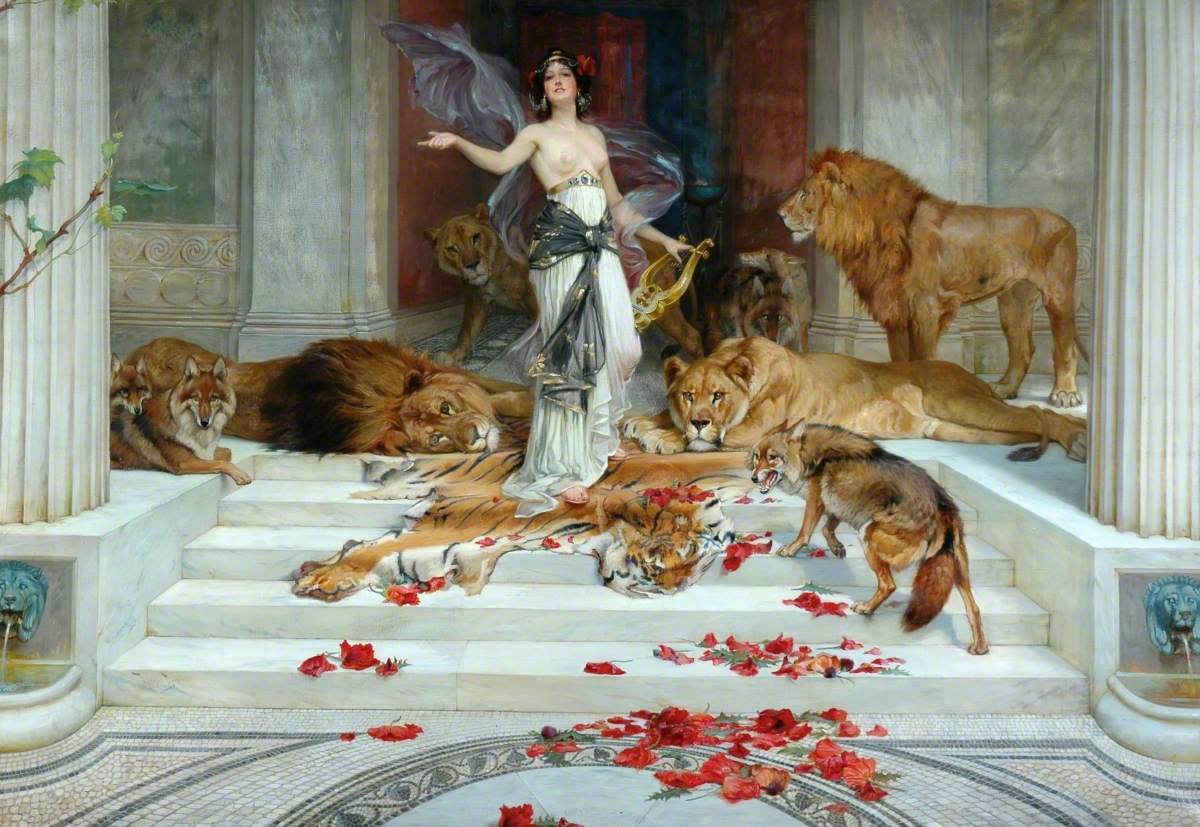
‘Circe’. Image: Bradford Museums and Galleries
Wright’s own prolific output included portraits, landscape, and rural genre scenes, and in 1902 he gifted his painting – a pre-Raphaelite-styled portrait, ‘Circe’ – to Cartwright Hall, Bradford (see above).
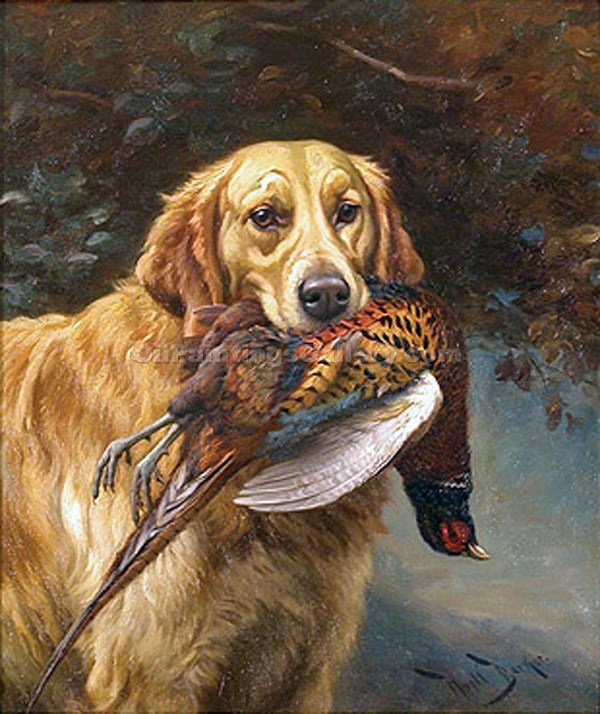
Golden Retriever with a Pheasant. Painting in a private collection.
But it was his animal paintings that became popular with the public, with his often commissioned horse and dog studies gaining particular attention and favour. During King Edward VII’s stay at Rufford Abbey in 1905, for example, Barker was commissioned to paint a life-sized artwork of the Monarch’s favourite dog, ‘Ceaser’, a wire fox terrier, who was inseparable from the King and followed behind the King’s coffin at his funeral.
He is also known to have cast in bronze a statue of the champion race-horse, ‘St. Simon’, that died in 1908.
By 1911, Wright’s income from his paintings was sufficient to employ a governess for the children, as well as two live-in domestic servants.
Around 1914/15 the family moved to Harrogate, where in 1939 they were living at 16 Duchy Road, and toward the end of his life he also became a picture dealer. He died in Harrogate and is buried in the town.
In addition to his association with the Royal Academy, Wright Barker was a member of the Royal Society of British Artists in 1896, exhibiting regularly at their shows. He also exhibited at shows of the Royal Society of Artists and the Royal Scottish Academy. He also exhibited work at Yorkshire Union of Artists shows.
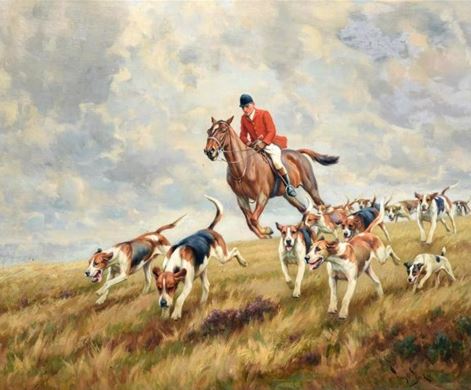
‘On the Scent’ In a private collection.
His work is still popular today and can be found in public collections, including Bradford Museums and Galleries; the Mercer Art Gallery, Harrogate; Ferens Art Gallery, Hull; Kirklees Museums and Galleries. It is also in the collections of Middlesborough Town Hall, Mansfield District Council, the Central Manchester University Hospitals Group, and Manchester Royal Infirmary.
See also the Harrogate Civic Society website: The Barkers
(With thanks to the Edwinstowe Historical Society, and to Dr. Paul Jennings of Harrogate, for their previous research into the artist’s life and work.)