

James Arundel (1875 – 1960) was born in Bradford. In a long and adventurous life he was a builder, poet, broadcaster – and professional artist. In his teens, he and a friend ran away from their homes to America, both working their passages on cargo boats. They got as far as Philadelphia where they did odd jobs, but James came back to Britain when his father sent him money for his return journey.
Back home, he worked for his father in the building industry and in 1907 was part of a team that built the first unattended lighthouse in the world at Platte Fougere, near Guernsey. He became eventually the head of the firm of Arundel Contractors, with building maintenance contracts for the UK government that included lighthouse, railway and building repairs. He became interested in art, but did not take up painting professionally until he was in his fifties and by the end of his life had painted over 1000 works.
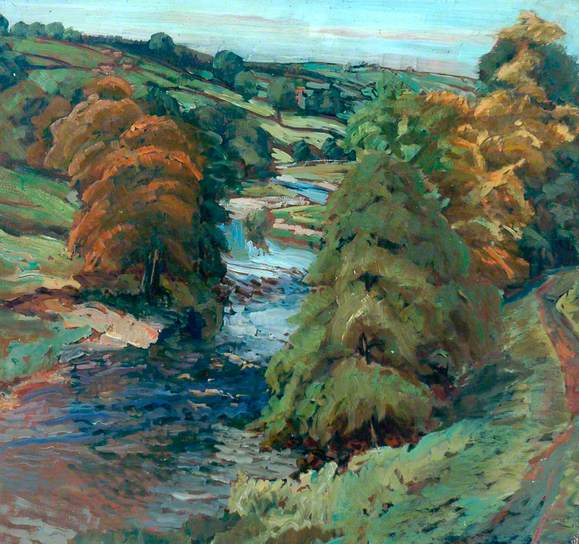
‘Near Barden Bridge’. BBC ‘Your Paintings’/Bradford Museums & Galleries
He painted landscapes in the Yorkshire Dales, and also abroad in Europe, British Columbia, and the West Indies. He was particularly fond of France, and visited often to paint there – so often he was made an Honorary Mayor of a town in the Dordogne Region!
In later life he began to wrote poetry based on his travels overseas. He also took part in the North Countryman radio programme in the 1940s, where he spoke fluently about his life and work.
His paintings were exhibited in many Yorkshire galleries, then increasingly further afield, including at Royal Academy shows, the Paris Salon, and the Wertheim Gallery in London.
His friend, fellow artist, Percy Monkman, said of Arundel:
He was a lively, volatile character, red of face, small in stature, but as tough as they make ’em. He always spoke with a broad Yorkshire accent, whether he was in distinguished company or at his local pub. … He painted in a vibrant, colourful, expressionistic style, with strong reds and hot tones. In winter he concerned himself with ‘still life’ pictures of exotic birds and flowers, often painting well into the night … I remember him once exhorting me to “drink a bottle of Burgundy and let thisself go, lad.”
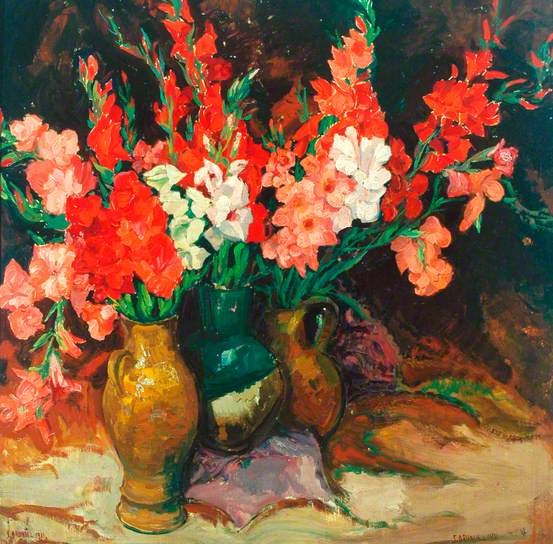
‘Gladioli’. Image: BBC ‘Your Paintings’/Hepworth Wakefield
Despite his blunt style, James Arundel was an avid reader and was knowledgeable about French Impressionism, particularly the work of Gauguin.
Arundel contributed artwork to the Dalesman magazine and signed his work in red with just his surname. His paintings can be found in the collections of Bradford Museums and Galleries, Calderdale Council, Ferens Art Gallery, Harrogate, the Hepworth Wakefield, Kirklees Museums & Galleries, Manchester City Art Gallery and Salford Art Gallery. Cartwright Hall displayed 70 of his paintings in 1958 in a retrospective exhibition.
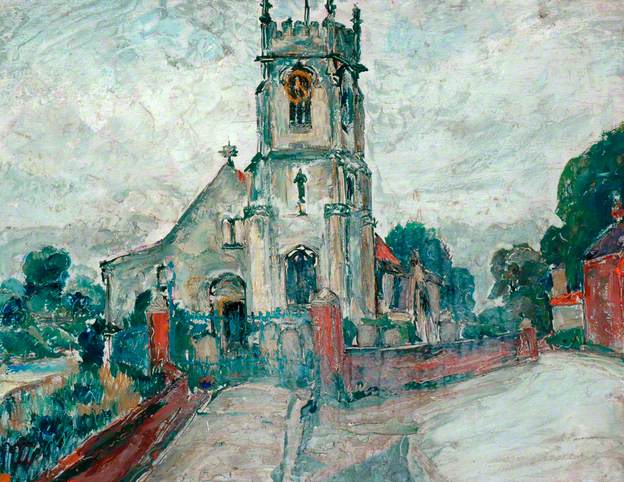
‘Cawood Church’. Image: BBC ‘Your Paintings’/Kirklees Museums & Galleries
In 1921 James bought Locksley Hall in North Somercotes, Lincolnshire and this became a second family home until 1945. During this time he retained a Bradford home and studio at Blenheim Road, and lived there during the week, returning to Locksley Hall at the weekends.