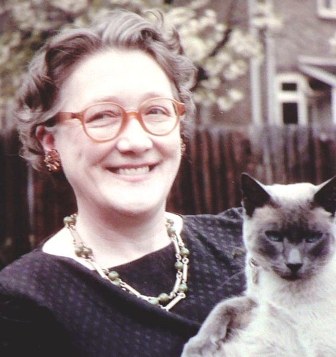
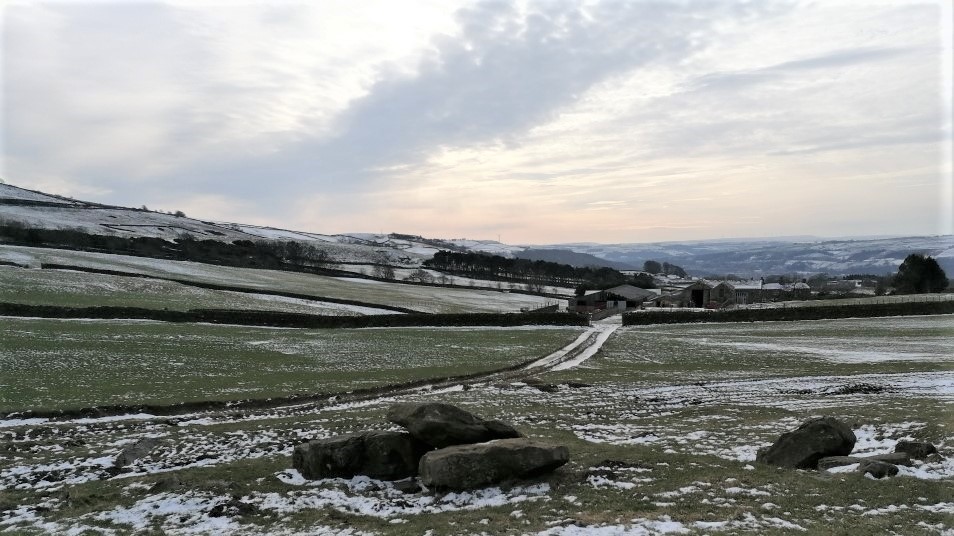
Designer, painter, and teacher, Dorothy Wade, (1913 -2009) grew up in Silsden at Cragg House and farm. The farm is on the edge of Ilkley Moor, overlooking the Aire Valley (see below) and Dorothy was the daughter of a poultry farmer, Thomas E. Wade, and mother, Annie.
Dorothy also had a sister, Hilda, who went on to study at Homerton College, Cambridge.

Dorothy Wade, in her late teens, outside Cragg House, Silsden.
Dorothy studied initially at Keighley School of Art, gaining in 1934 first class passes for drawing and dress design courses. She continued her studies to an advanced level at both the Leeds and Bradford Art Colleges. She later taught art students Bradford College, including David Hockney, before moving to London, where she taught at the London College of Fashion.
In later life she told her friend, Vijay Sawmynaden, that, at first, she was heckled and mocked by her London students for her Yorkshire accent. However, Dorothy rose to become head of the art section at the college; a prestigious post she held until her retirement in the early 1970s.
The College occupied an important position in preparing designers during her time there, particularly during the fashion conscious and heady late 1950s and 1960s. Dorothy met many influential designers of that period and was a friend with John Cavanagh, the successful Irish couturier. Cavanagh was renowned for his elegant ‘Paris Chic’ style tailoring, which included designing the wedding dresses for the Duchess of Kent in 1961 and Princess Alexandra in 1963. Dorothy was given a bespoke outfit by Cavanagh in exchange for one of her own paintings.

Dorothy Wade, in her capacity of Head of Art at the London College of Fashion, greets the Queen Mother
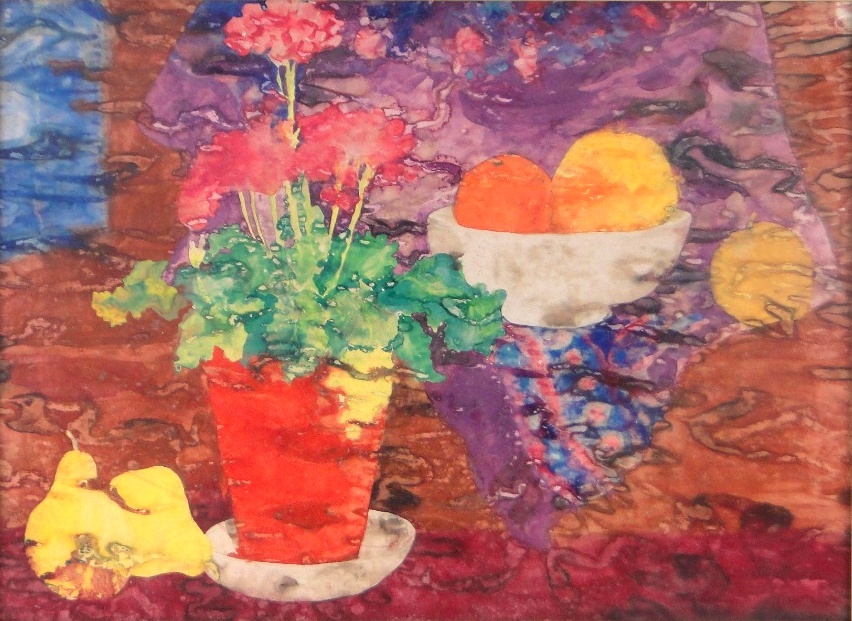
Still Life in Impressionist Style. Image: in a private collection.
In her own time, Dorothy painted in a semi-abstract style and her work was influenced by the British colourist, Matthew Smith and her own watercolours were characterised by the strong use of colour (see examples here). Shortly after her retirement she said of this:
I’d lived so long in the greyness of the North, but I always wanted to live in a colourful background. The first time I ever travelled abroad, I went on a train to Venice. The impact was tremendous: I don’t think I’ve ever got over the brightness and the light. I couldn’t go back to the North now; the greyness is over everything; I see everything in colour (source: Bradford ‘Telegraph & Argus’, 23/04/1980).
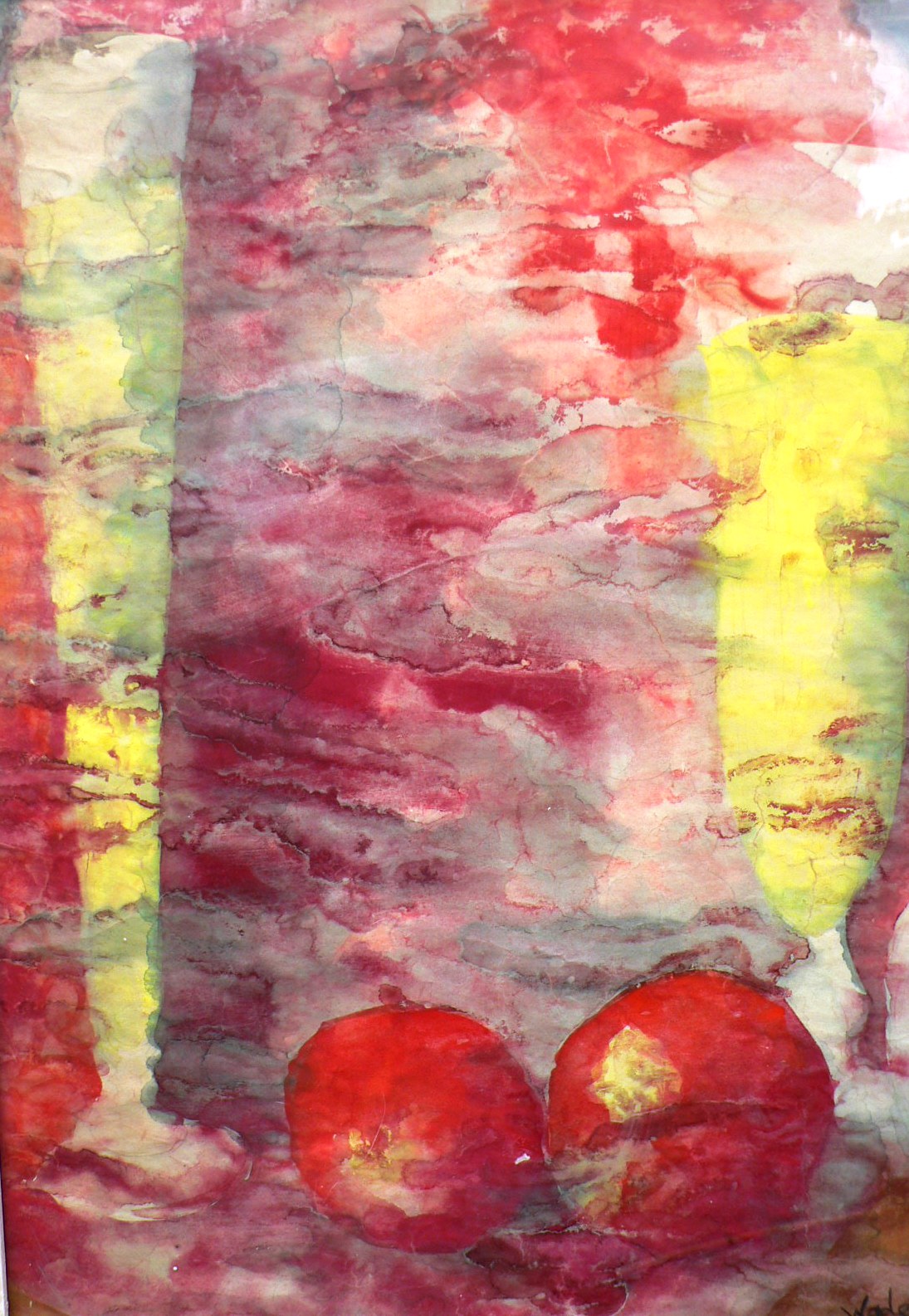
Still life. Image by courtesy of Vijay Sawmynaden
She was a close friend to the painter and engraver, Robert Charles Peter (1888-1980), and the two artists shared a house in Kew until his death from cancer.

Dorothy Wade with her partner, the artist/engraver, R.C.Peter.
They travelled extensively across Europe, USA, and after retirement Dorothy travelled to India, to paint. The patterns and colours of India were a recurring feature of her subsequent work.
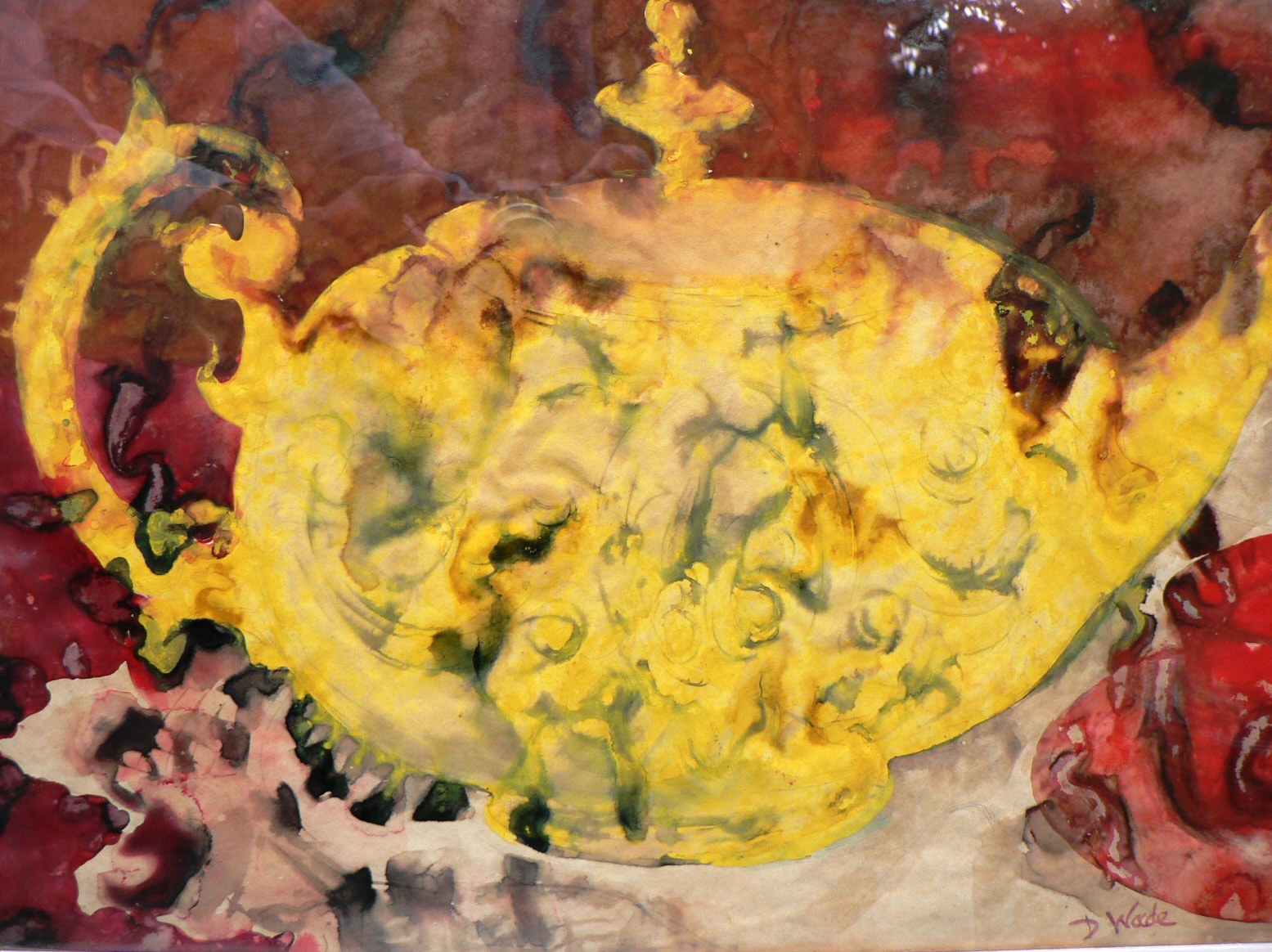
Teapot. Image by courtesy of Vijay Sawmynaden
Her paintings were exhibited with the Royal Society of British Artists, Women’s International Art Club, Leicester Galleries, Beaux Art Gallery and at the Woodstock Gallery, London. Many are also now in private collections.
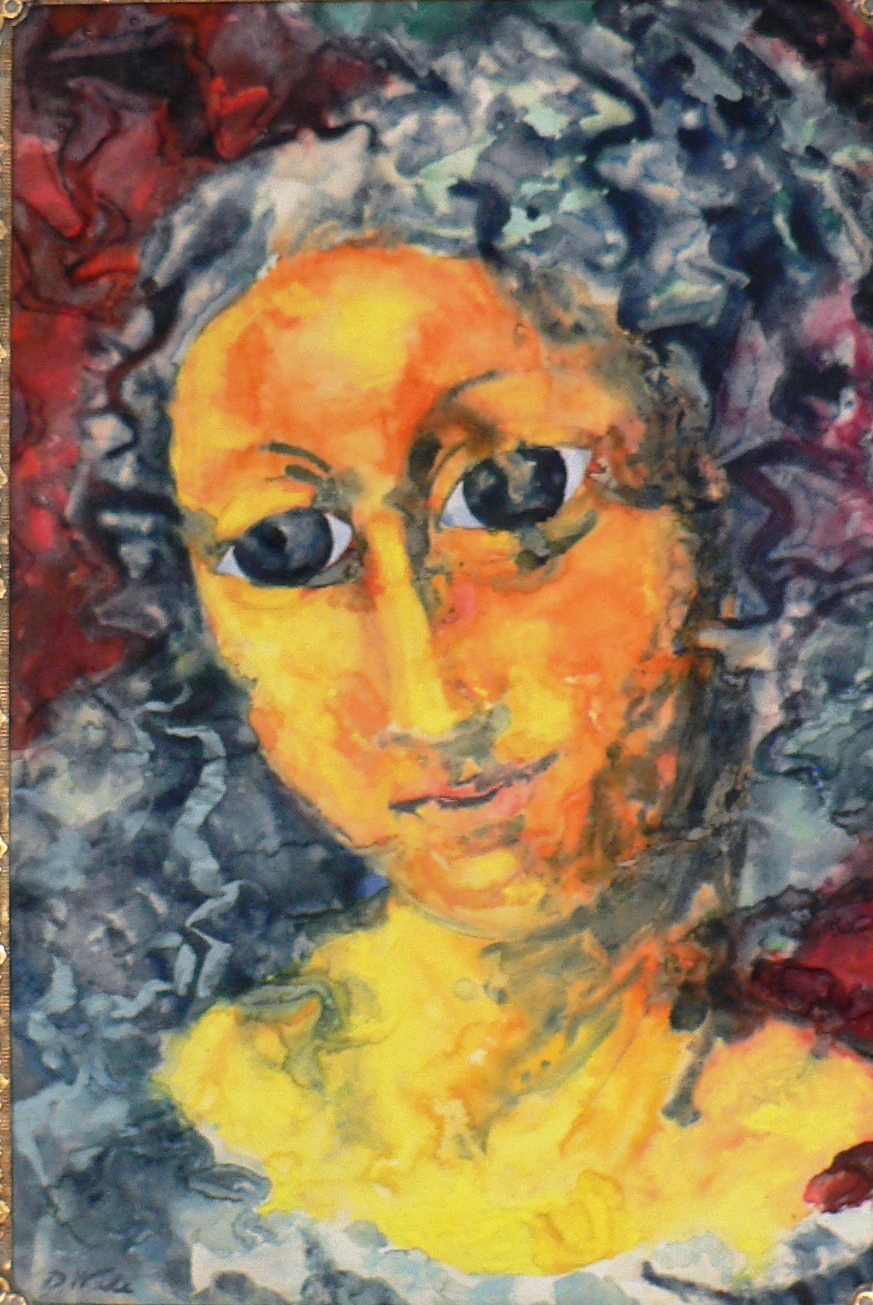
Portrait of an unknown woman. Image by courtesy of Vijay Sawmynaden
In 1970 Dorothy was elected an Associate of the Society of Industrial Artists and Designers and in the final stage of her life Dorothy lived at New Malden, Surrey, where, until well into old age, she was an art tutor with the University of the Third Age.
*
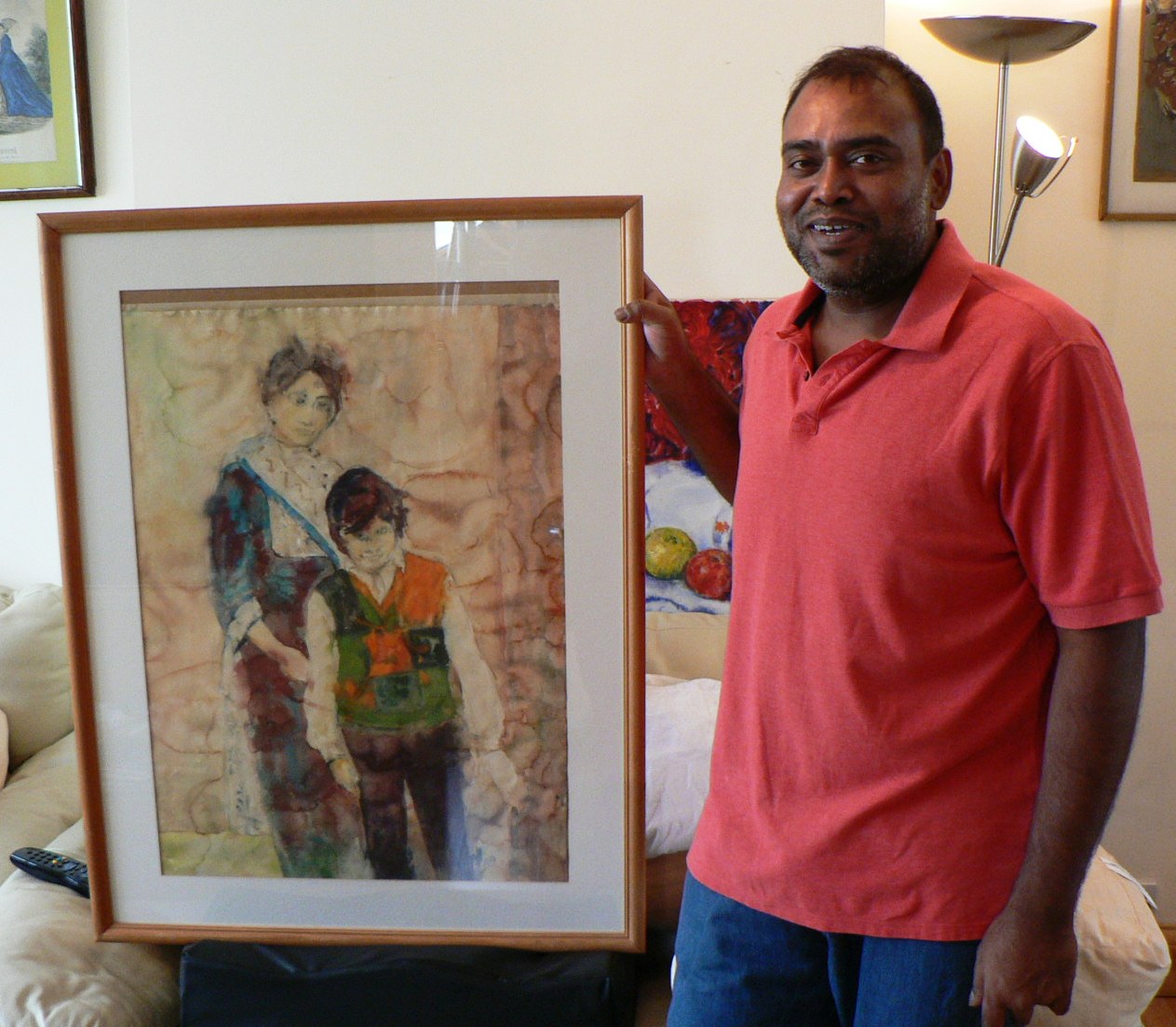
(With thanks to Vijay Sawmynaden of New Malden, lifelong friend of Dorothy Wade, for his help in compiling this profile – see photograph below of Vijay with a portrait of him and his mother painted by Dorothy Wade.)