
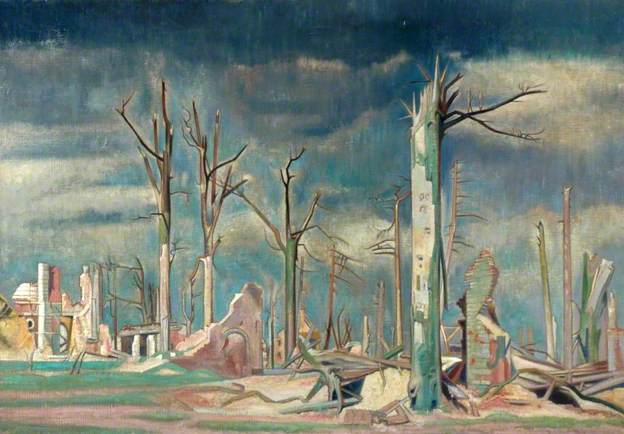
‘Avenue at Vourlon’, Sir William Rothenstein. Image: Art UK/Bradford Museums & Galleries
Artists from Bradford have been Official War Artists, whilst others have responded to their own war experiences through art – or have used art as a personal protest against all forms of armed conflict.
Official (and unofficial) War Artists
The outbreak of war in 1914 led to an immediate collapse of the art market in Britain. Many of the younger artists, to survive economically, and from a sense of patriotism, enlisted in various branches of the services. The Ilkley artist, Norman Tennant, for example, as a member of the local Territorial Army, immediately enlisted in the Royal Artillery.
However, artists now in the services began to sketch and record their experiences, and pictures illustrating the war began to appear in London exhibitions. These proved a success and led to demands for more by people with an insatiable appetite for visual images of the conflict.
This led to Official War Artists being appointed by the British War Office, ostensibly to serve the needs of propaganda, and presenting, in the early years, only images approved by government censors. For example, depictions of dead British soldiers were unacceptable, but images of devastated landscape and buildings went unchallenged – surprising, given that the blasted scenes would undoubtedly have presented a suggestion of the human carnage that followed in its wake.
Sir William Rothenstein
A local artist, Sir William Rothenstein, was active in persuading the War Office to appoint war artists, and in 1917 Rothenstein, although by now in his mid-forties, was given a three month artist commission by The Ministry of Information to record battlefield scenes in France.
In December 1917 he went to the Somme and Ypres Salient, where he painted the scenes of battle devastation around him, and also spent some time painting portraits of Indian troops. In 1918 he was still in France when the Germans launched a counter-offensive and Rothenstein acted as an unofficial hospital orderly helping the wounded.
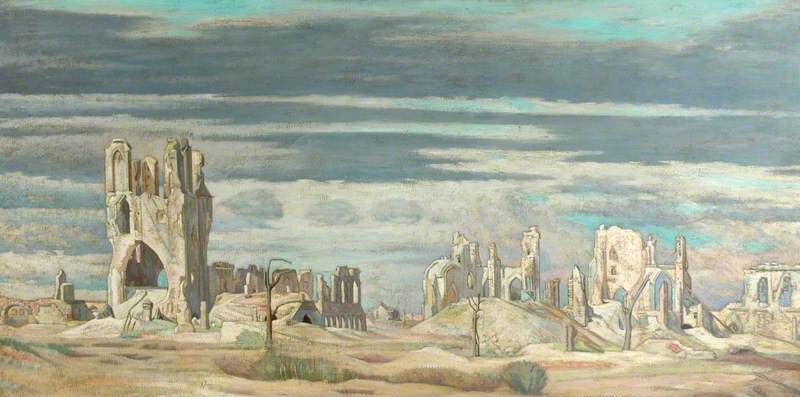
‘The Cloth Hall, Ypres’. Image: Art UK/ Bradford Museums and Galleries
Rothenstein’s war paintings focused on the impact that war had on the architecture and nature in the battlefields. At the end of March 1918 he returned to Britain and exhibited his work in London. In his catalogue to the exhibition, he wrote:
Over a battlefield, where the hopes and fears and passions of thousands of men were concentrated, a strange atmosphere of awe seems to hang. Throughout the desolation of war there is a pattern of austere beauty, and the human drama associated with war gives to this beauty a religious character … I felt as a pilgrim visiting sacred sites.

‘Blasted Trees’. Image: Art UK/ Bradford Museums and Galleries
In 1919, commissioned by the Canadian War Records, Rothenstein visited Germany to paint scenes of the aftermath of the war, including ‘The Watch on the Rhine’, shown below, exhibited in Canada in 1920 and now in the UK Imperial War Museum art collection.

‘The Watch on the Rhine’ Image: Art UK /Imperial War Museums
During the Second World War, Rothenstein, by now in his sixties, volunteered to visit RAF aerodromes to paint portraits of Royal Air Force personnel. He produced nearly 150 portraits of officers and aircraftmen and a selection of his work was published in 1942 in the book, Men of the R.A.F. : 40 Portraits (Oxford University Press). Two of his paintings depicting groups of pilots: Aircrew Group at RAF Tangmere (1941) – shown below – and Bomber Crew (1940), are now in the collection of the Royal Air Force Museum.
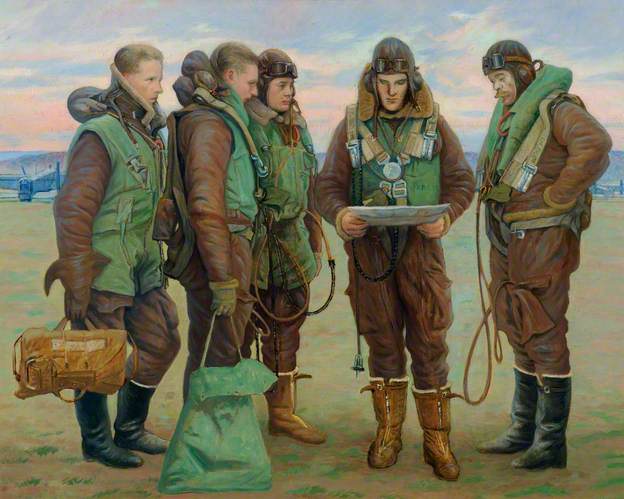
‘Aircrew Group at RAF Tangmere’. Image: Art UK/Royal Air Force Museum
Norman Tennant
In 1913, the Ilkley, illustrator and etcher, Norman Tennant, joined the Territorial Army (without parental consent) and so was transferred into the regular army at the start of the 1914-18 war.
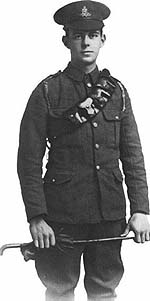
He saw action as a signaller on the Western Front in the 11th Howitzer Battery of the 49th West Riding Territorial Division and was awarded the DCM in 1915 for wounds received whilst repairing telephone wires under heavy shell fire. He was again wounded in the face in May 1918, removing him from active duty for the remainder of the war.
He became an ‘unofficial war artist’. Norman kept diaries and sketchbooks during his war service and later wrote and illustrated the book, A Saturday Night Soldier’s War (1983). Given his injuries and length of time he served on the Western Front, his sketches throughout the war are remarkably humorous in tone and capture the off-duty moments of the troops. The one below is typical of most in his book.

His dustjacket illustration for his book does, however, captures the exhaustion and terror of the horses under shell-fire.
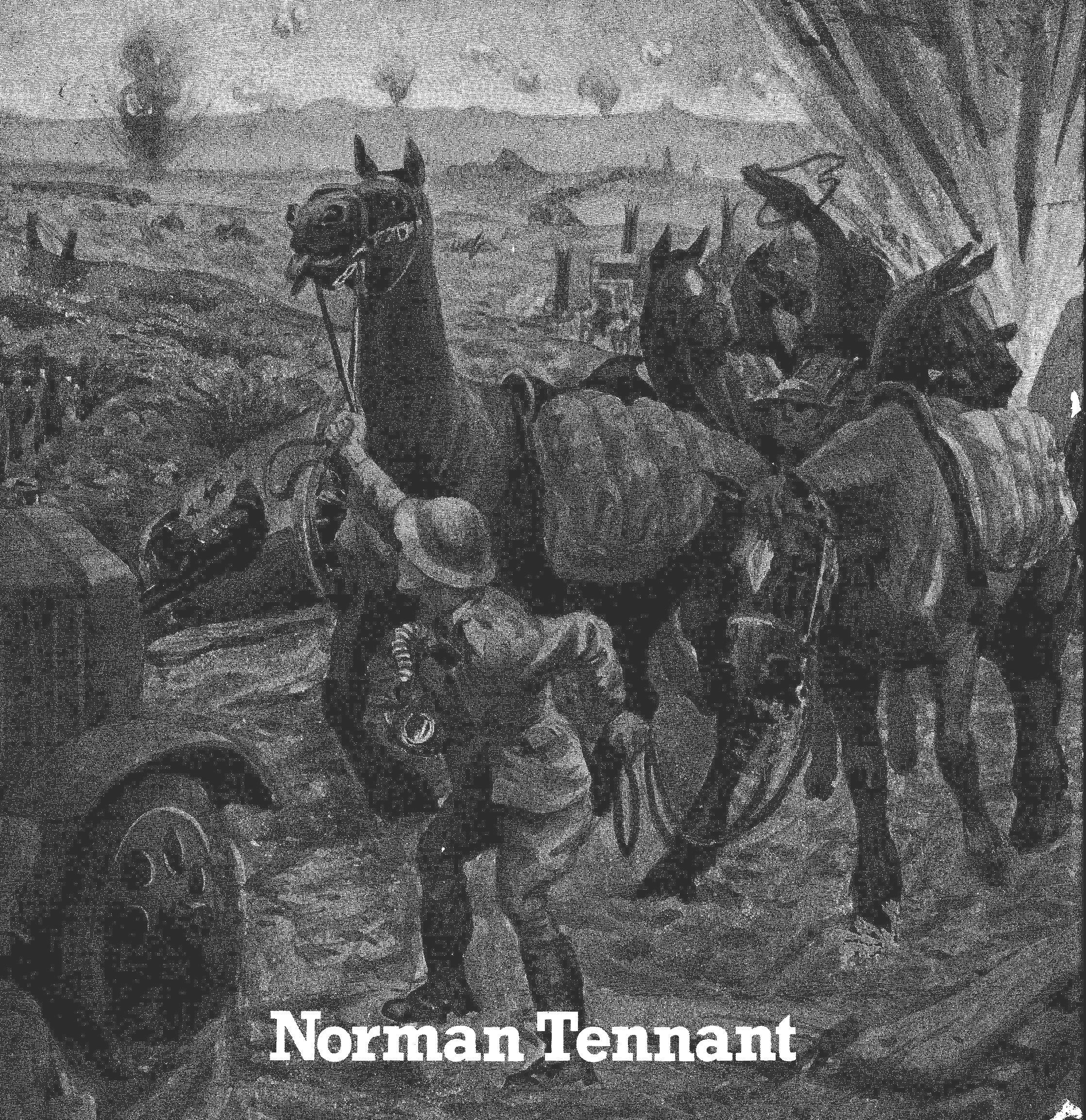
His diary entries often contain references to the plight of the horses obliged to pull the heavy guns.
Still raining hard as we struck camp and hauled the vehicles out of the deep mud onto the road; two wagons got bogged down but we managed to drag them out in time for the Battery to move off at 8am. The outriders’ horses were needed for the teams … several more horses died of exhaustion on the way and now the drivers too had to dismount and lead their teams.
After the war, Norman studied art at Bradford, then at the Royal College of Art in London. After graduation, he taught at a number of art colleges before becoming Head of the Arts & Crafts Department at East Ham Technical College in East London.
Reginald Hanson Fawcett
Another ‘unofficial war artist’ was Reginald Hanson Fawcett. Born 1892, at Wilsden, near Bradford, Reginald was a gifted amateur artist and at the start of WW1 he volunteered for Army service. He served in the Royal Engineers as a signalman, operating close to the front line in France & Belgium. He had taken a sketch pad and watercolour paints with him to France and whenever he could painted scenes around the Somme battlefield.
Miraculously he emerged physical unscathed from the war and by 1918 had produced an impressive portfolio of battlefield sketches, now in the possession of family members; two examples are shown here. After his discharge in 1919 he returned to Wilsden, where he became village postmaster, as well as a distinguished local historian and landscape artist of scenes around the village and surrounding district.

Contalmaison Churh. The Somme 13 Oct 1916.

Baizieu, Somme 5 Aug 1916. Image: Tim Brown
Richard Eurich
The Bradford-born artist, Richard Eurich, was already a successful artist at the start of the Second World War. Aged 36, he was too old to be called up into the services, so instead volunteered to work as a part-time ambulance driver, Air Raid Protection warden, and farm-worker. However, as the war progressed, Eurich saw an opportunity to become an Official War Artist with the Royal Navy, as he had always been fascinated by the sea. He was commissioned to paint two naval scenes initially, but the War Artists Advisory Committee, impressed with his war, soon gave him additional work.
He subsequently painted a series of work on the evacuation of Dunkirk and the series, The Withdrawal from Dunkirk, now in the National Maritime Museum, were shown at the National Gallery in August 1941. They immediately resonated with the public, as they captured the scale, ferocity of fighting, and desperate situation on the beaches of Dunkirk. One of the series is shown below.
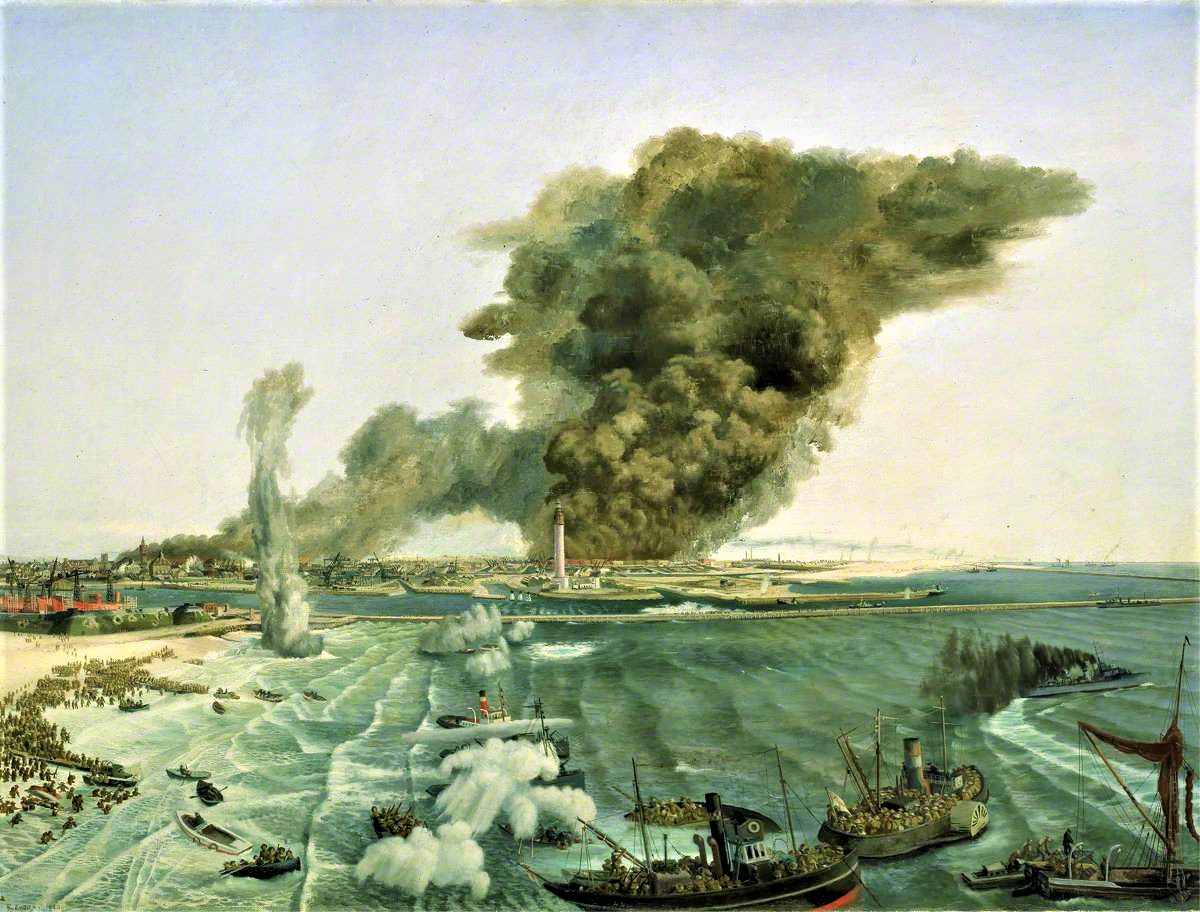
Richard Eurich. ‘Withdrawal from Dunkirk, June 1940’ Image: National Maritime Museum
Eurich also painted many other dramas at sea. His painting, ‘Survivors from a Torpedoed Ship’, based on an actual incident, shows three sailors clinging, half frozen, to the upturned lifeboat after their ship was torpedoed. Although the three men were eventually picked up, the seaman in the middle of the group did not survive the ordeal. A seagull has landed on the prow, indifferent to the plight of the men.
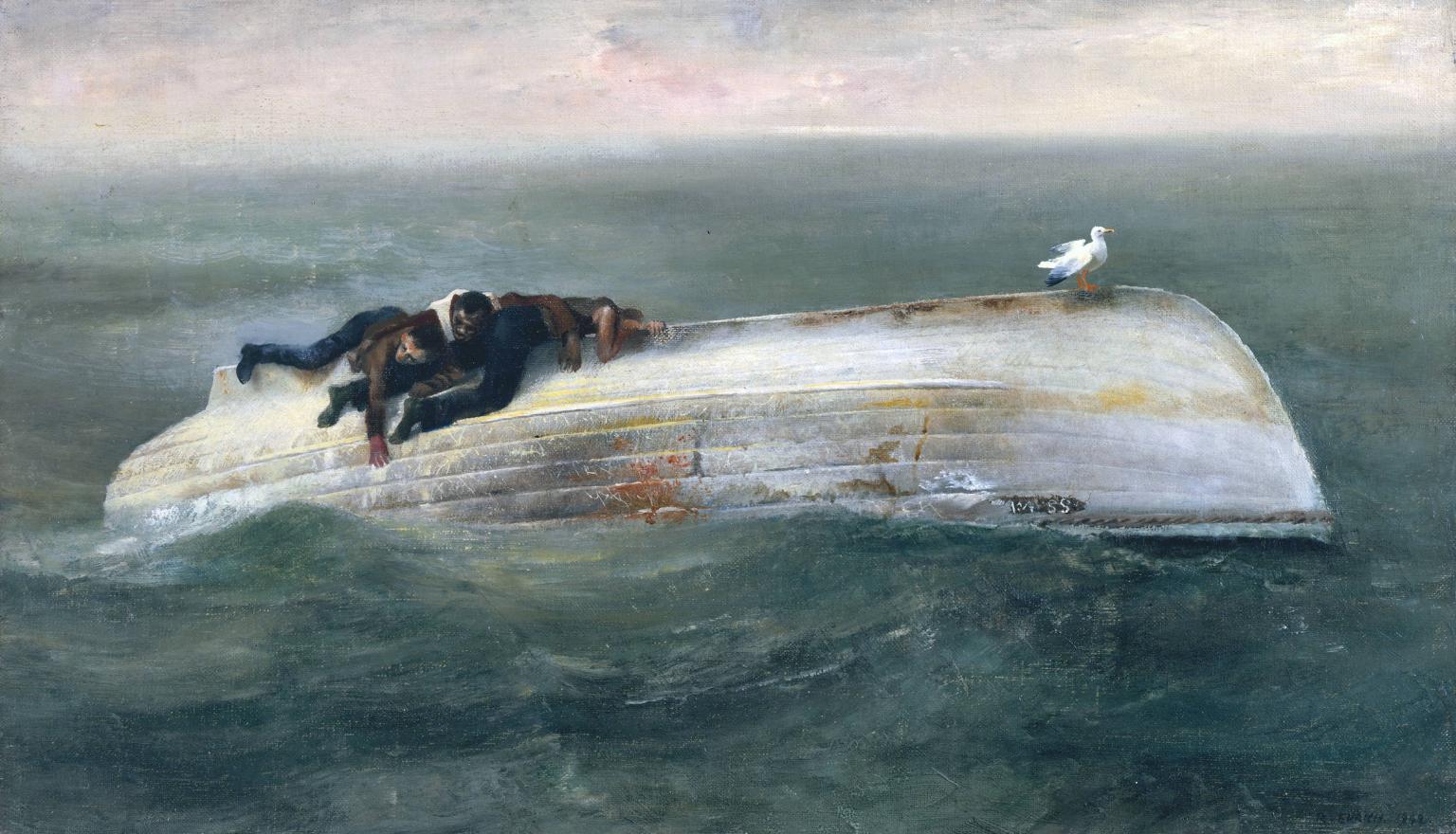
‘Survivors from a Torpedoed Ship’. Image: Art UK/Tate Collection
Robert Lee
The sculptor and painter, Robert Lee, served in the Royal Artillery Signals during World War Two and was captured in the Western Desert and sent to Germany. There he witnessed the bombing of Dresden and was later forced to bury the dead of Freital, a suburb of the city. Two hundred German civilians were killed in Freital, mostly women and children. This had a profound influence on his life. In 2003 he told a local journalist:
This was the most terrible event of my life engraved forever in my memory among a mass of horrific experiences.
After the war, he built a successful art career but never forgot his wartime experiences, and images from his experiences recurred in his later work; see ‘The Deposition’, below.

‘The Deposition’. Image: see artist memorial website.
In 1991 Robert and two friends returned to the Freital graveyard, now overgrown with trees and flowers, where he was inspired to paint ‘The Resurrection’, showing the spirits of people living among the trees. During 1996-7 he also worked on the sculpture ‘An Angel for Dresden’, carved in lime wood, which he donated to the Frauenkirche in Dresden. The sculpture shows an angel wide-eyed and starting to cover its face in shock at the death and destruction around it. In 2007 the people of Dresden awarded Robert a medal and certificate in thanks and honour for his work on the ‘Angel’.

‘The Angel of Dresden’, by Robert Lee.
There is a memorial website to the artist at http://www.roberthlee.co.uk/index.html
Donald Rooum
The political cartoonist, Donald Rooum, was born in Bradford. Donald had shown a keen interest in politics from his early teens, following the lead from his father, who was active in the Labour Party. He had been conscripted into the military service toward the end of World War Two, but appealed against this on the grounds of Conscientious Objection. He was subsequently given a political rating as a ‘subversive’, spared from service overseas, and spent most of his military life working in the kitchen of an Army camp. After the war, Donald trained in commercial art at Bradford College, ironically, part-funded by the Army.
From 1949 onward, Donald began to become more publicly prominent in the anarchist movement, participating in summer schools and speaking in public in Bradford and at Speaker’s Corner, London. He was a founding member of the Malatesta anarchist social club in London and began what was to be a long association with Freedom Press Publications, becoming a writer, and later editor, for Freedom, the anarchist newspaper.
From the early 1950s onward draw a regular cartoon strip for The Syndicalist, an anarchist magazine. The cartoons proved popular and from the late 1950s Donald’s work began to appear in a wide range of other left of centre publications, including The Daily Mirror, Private Eye, and The Spectator. He also had a long association, from 1962 onward, as a cartoonist for Peace News, and was the originator of the ‘Sprite’ cartoon strip for The Skeptic magazine.
Donald was also an active campaigner for peace and against injustice, often active and to the forefront of public demonstrations in London and elsewhere. He became particularly noted for his ‘Wildcat’ protest cartoons.

*
See also: Bradford Paintings – ‘The Conchie’.
Pingback:Pause: An Artist’s View of War | The Great War and Chalford