

Memorial to James Adam, Emmanuel College, Cambridge. Image copy right & courtesy of www.victorianweb.org
1874 – 1951
Ernest George Gillick, sculptor and medallist, was born in Bradford, the son of a local tailor. His family, however, enjoyed travelling and, aged 11, he left the city and went to Nottingham, where he was apprenticed to a lace designer. His talent for drawing was recognised and he attended Nottingham School of Art, where he studied under the sculptor, Oliver Shepphard. At Nottingham he won a scholarship that enabled him to study in London at the Royal College of Art, where he was tutored by the French sculptor, Edouard Lanteri, who helped Ernest obtain a travelling scholarship in 1902 to Italy and Paris.
On his return to England, Ernest took a studio in Cheyne Row, then later a house in King’s Road, Chelsea, where many of his finest works were designed. After the First World War, the public drive to erect war memorials led to many commissions for sculptors and Ernest’s work in the 1930s included sculptures on the memorial to The Missing, at the Vis-en-Artois war cemetery, France.

Sculture by Ernest Gillick at the Vis-en-Artois war memorial. Image: copyright www.greatwar.co.uk
In 1935 he was awarded the Royal Society of British Sculptors’ medal for the best work of the year, the statue, ‘Ex Tenebris Lux’, of a women contemplating the Book of Wisdom, now on display at the Christchurch Art Gallery, New Zealand (see image below).

Image: Christchurch Art Gallery, New Zealand.
Other public and commercial commissions include:
A statue of Henry V11 in Cardiff City Hall; allegorical group statue for National westminster Bank, London (see image below); memorials at Emanuel and Trinity Colleges, Cambridge; memorial statue at Winchester College; war memorial at Glasgow in George Square; figures of J.W.M. Turner and Richard Cosway on the Victoria & Albert Museum in London; the Sir George Frampton memorial in St. Paul’s Cathedral crypt; and memorial fountain to the novelist Ouida (Marie Louise de la Ramée) at Bury St. Edmunds. However, Ernest, speaking to a journalist from the Yorkshire Observer in 1935, considered that one his best works was the bronze statue, now owned by Cartwright Hall, of Sir Francis Sharp Powell, MP, who lived in Bradford.
He also designed commemorative medals for the Royal Mint, Royal Academy, Inner Temple, Red Cross, LMS Railways, and Lord Mayor of London.
Ernest’s work was exhibited at the Royal Academy (RA) and he was elected an Associate Member of the RA in 1935. In the same year he was elected Master of the Art Workers’ Guild, and in 1938 elected a Fellow of the Royal British Society of Sculptors. He was also a member of the Dover Street Arts Club. For full list of exhibitions and awards visit sculpture.gla.ac.uk
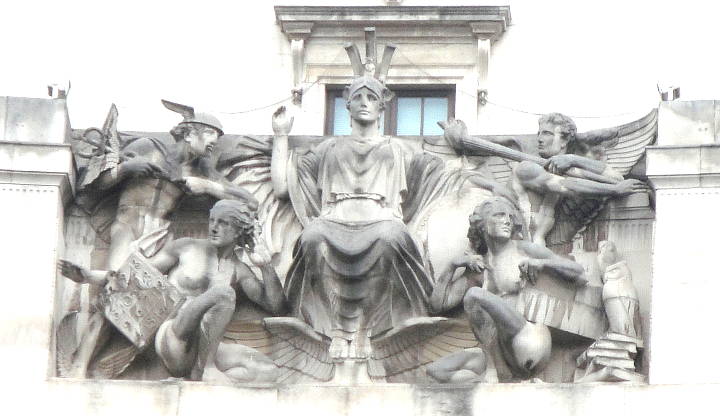
Allegorical Group, National Westminster Bank, London. Image copyright & courtesy of www.victorianweb.org
He was married to the sculptor, medallist and painter Mary Tutin, and although never resided again in Bradford, he often visited the city. He told the Yorkshire Observer in 1935:
I have returned there many times since and always go back for holidays, and think there’s no place like it in the world.
His work in bronze, ‘The Olive Branch’, was shown at Cartwright Hall, Bradford, in 1951 at the Festival Of Britain Exhibition, shortly before the sculptor’s death in London.